Webinar syndication means distributing a webinar offer or related content through a third party to reach an audience beyond your own channels. Before buying it, define the action you will pay for. A delivered contact, a webinar registration and a person who watched are different results, each needing its own evidence.
Two proposals can both quote a cost per lead while selling different things. One might deliver people who requested a related guide. Another might deliver registrations for your live session. Neither description, by itself, establishes attendance.
This guide gives you a buying specification, an event-evidence table and a fictional cost example to use when reviewing a proposal.
What webinar syndication can mean
Webinar content syndication covers several arrangements. For an upcoming live session, a provider might promote the event and deliver registrations. For an on-demand campaign, the offer might be access to a recording. A related-asset campaign might distribute a guide first, with a later invitation to your webinar.
Ask which arrangement the proposal describes and what the person actually sees. Someone requesting a guide has not necessarily requested your webinar, even if the topics match.
Paid syndication is one part of a wider webinar promotion plan. Owned promotion reaches people through channels you control. Partner co-marketing uses a shared campaign and agreed responsibilities. Multistreaming sends the broadcast to multiple destinations. It does not itself procure accepted contact records.
Consider a paid pilot when you can name the audience, explain why the webinar is useful to them, inspect delivery evidence and handle follow-up. If those answers are still vague, an owned-channel or partner test may help you settle them before committing to volume. Work on webinar lead quality starts with audience and topic fit, even when a provider can satisfy every field in a purchase order.
Name the event the provider will deliver
Reach Marketing's webinar syndication page describes leads in terms of downloads or registrations and separately describes billing around a digital-asset download. That is a reason to clarify the precise billable event in your proposal. It is not evidence of what any individual prospect watched, or a recommendation of the provider.
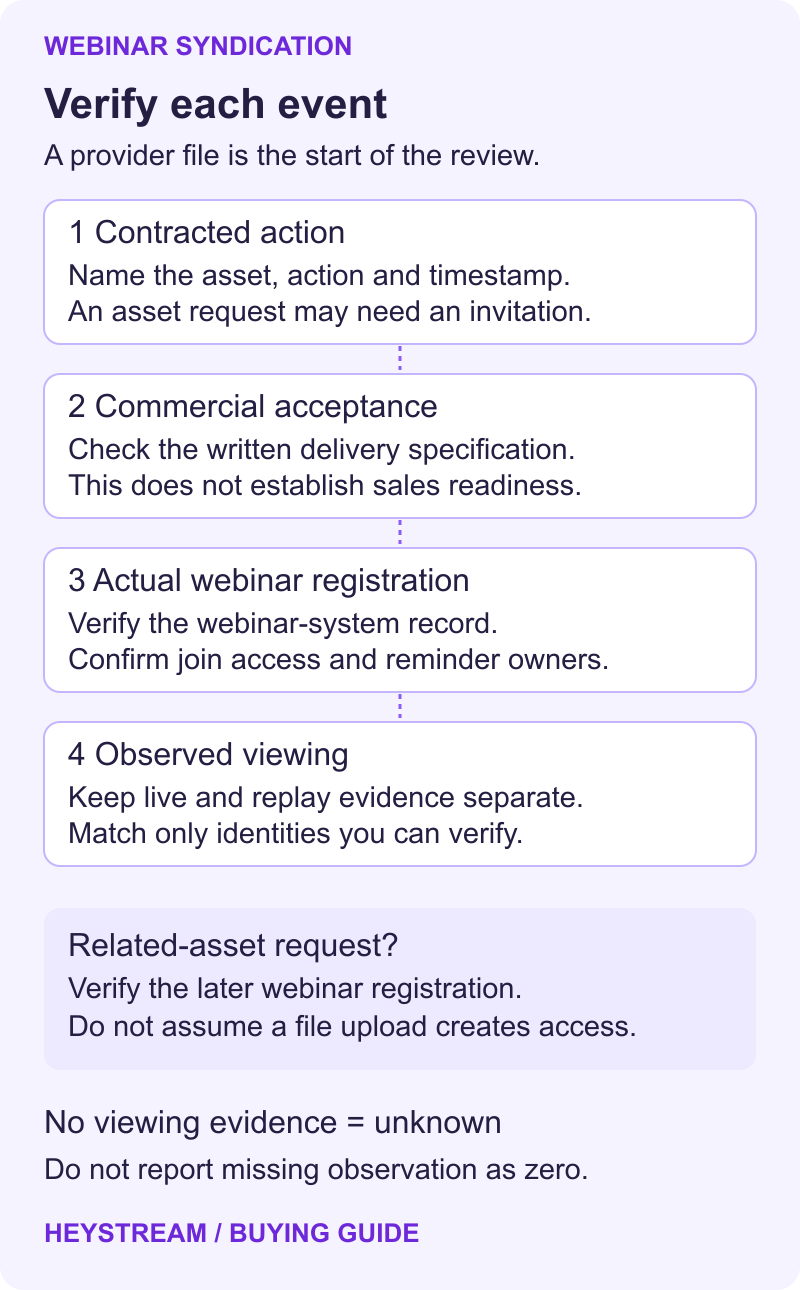
Use a separate name for each state you can substantiate.
| State | Minimum evidence | What you can count | What it does not establish |
|---|---|---|---|
| Delivered record | Provider, campaign, source record ID, original action and timestamp | Records received | Acceptance, registration or viewing |
| Commercially accepted contact | Review outcome against written criteria and duplicate rules | Unique contacts conforming to the specification | Sales acceptance or buying intent |
| Webinar registration | Registration-system record for the actual webinar | Verified registrations | Attendance or replay viewing |
| Live attendance | Matched live-viewing record for the session | Observed live attendees | Replay use or sales readiness |
| Replay engagement | Matched replay-viewing record within a stated window | Observed replay viewers | Live attendance or permission for every follow-up use |
| Verified next step | Evidence of the specific action, such as a completed meeting booking | That action | An opportunity, sale or causal revenue attribution |
Here, commercially accepted means the contact conforms to your delivery specification. Your sales team needs its own evidence and definition before calling the person sales-accepted or qualified.
NetLine's 2026 research summary separates content registration from later consumption in its vendor-network research across content formats. Preserve that distinction in your webinar reporting. The research is not a webinar-syndication attendance benchmark or a prescribed follow-up delay.
If you cannot observe viewing, report it as unknown. Do not turn an unavailable observation into zero attendance or count the contact as a failed conversion.
Write the buying specification around the webinar journey
Copy the specification below into your proposal review. Replace each prompt with an agreed answer and a named owner before signing. Ask for the delivery schema and a sample using fictional data so you can check what the fields actually prove.
| Decision | Agreed answer to record | Evidence owner |
|---|---|---|
| Audience | Companies, roles, geography and explicit exclusions | Buyer and provider |
| Existing contacts | Treatment of customers, open opportunities and permitted suppression lists | Buyer operations |
| Promoted offer | Exact asset, message, landing page and original action | Campaign owner |
| Billable event | Action that earns payment and proof required for it | Buyer and provider |
| Form and join access | Form host, actual registration step and join-link issuer | Webinar operations |
| Live or replay | Event date, replay-access terms and observation window | Webinar operations |
| Duplicate rule | Identity key, cross-provider rule and review period | Buyer operations |
| Delivery fields | Required IDs, timestamps, action and evidence references | Provider |
| Provenance | Collection property, disclosure version and applicable permission or lawful-basis context | Responsible privacy owner |
| Delivery timing | Batch cadence, expected lag and secure transfer method | Provider and operations |
| Rejections | Review deadline, reasons, dispute route and replacement terms | Buyer and provider |
| Follow-up | Owner, allowed next action and suppression handling | Marketing or sales operations |
The join-access row deserves an explicit answer. If the provider hosts a form, who creates the registration in your webinar system? Who issues valid access, sends reminders and provides replay access? How will you test the failure path? A contact-file upload should never be assumed to perform those jobs.
For provenance, ask where and when the original action occurred, which asset it concerned, what disclosure the person saw and how the relevant evidence can be reviewed. Agree how objections and suppression updates move between the parties. A generic permission label leaves too much unexplained.
The ICO's business-to-business marketing guidance explains that UK rules vary by recipient type and contact method, while personal-data obligations can still apply. The guidance is currently under review following legislative changes. Have your responsible owner determine the rules for your campaign and recipients rather than treating a provider label as universal permission to contact people.
Compare proposals using the same denominator
The following is one fictional campaign, created only to explain the arithmetic. It is not a quote, benchmark, customer result or forecast.
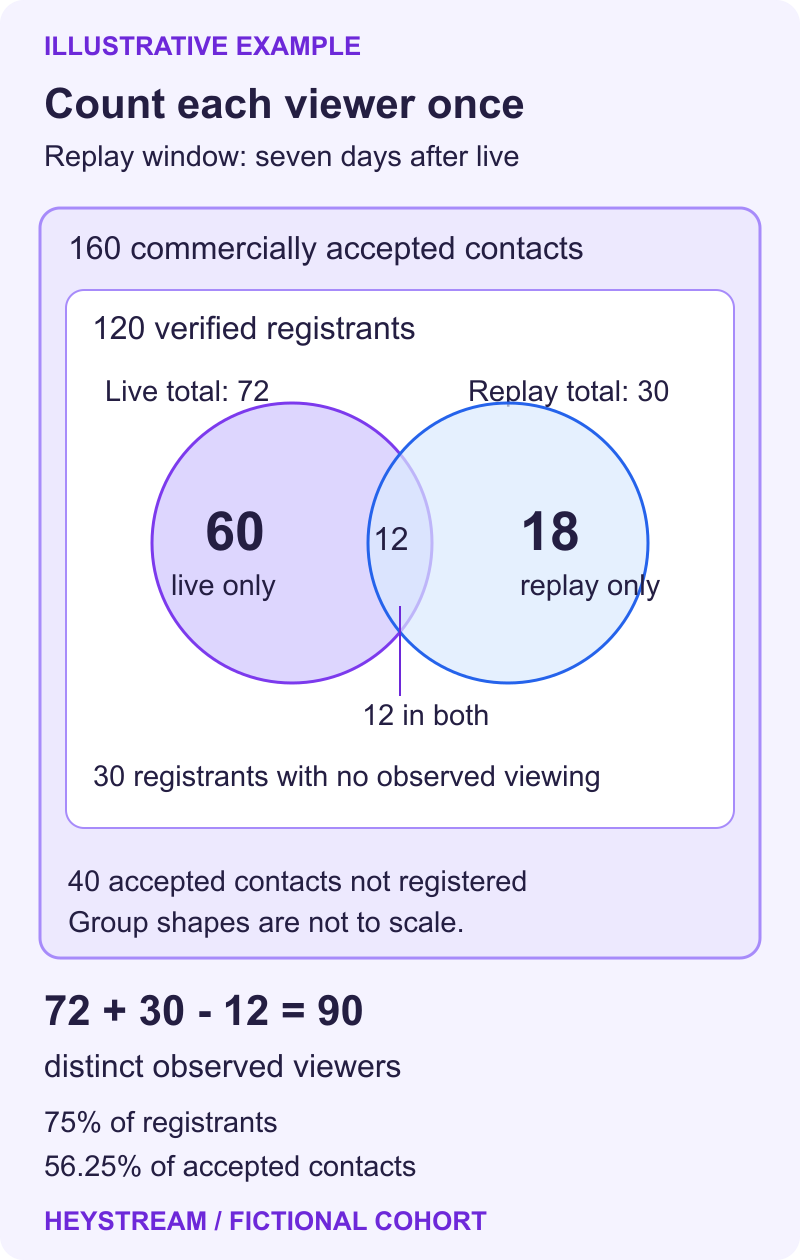
Assume a USD 4,000 campaign fee and 200 delivered records. After applying the agreed criteria and duplicate rule, you accept 160 unique contacts. Within that accepted cohort, you verify 120 webinar registrations. All viewing observations below belong to those 120 registrants.
You observe 72 live attendees and 30 replay viewers during the seven days after the live session. Twelve replay viewers also attended live.
| Measure | Calculation | Result |
|---|---|---|
| Acceptance of delivered records | 160 / 200 | 80% |
| Registration among accepted contacts | 120 / 160 | 75% |
| Live attendance among registrants | 72 / 120 | 60% |
| Distinct observed live-or-replay viewers | 72 + 30 - 12 | 90 people |
| Observed live-or-replay viewers among registrants | 90 / 120 | 75% |
| Observed live-or-replay viewers among accepted contacts | 90 / 160 | 56.25% |
| Fee per delivered record | USD 4,000 / 200 | USD 20 |
| Fee per accepted contact | USD 4,000 / 160 | USD 25 |
| Fee per verified registration | USD 4,000 / 120 | About USD 33.33 |
| Fee per distinct observed viewer | USD 4,000 / 90 | About USD 44.44 |
Both 75% viewing among registrants and 56.25% viewing among accepted contacts describe this same fictional cohort. The denominator changes the question. Neither is a universal attendance rate.
Adding 72 and 30 without removing the 12 overlapping viewers would double-count people. Keep the seven-day replay window visible, too. Comparing it with another provider's live-only count would mix different observations.
The cost rows divide the same campaign fee only. They exclude internal operating costs and do not calculate customer acquisition cost, profit or ROI. If the identity match is incomplete, stop at the last verified event. A cheaper delivered-record price is not enough to establish a cheaper registration or viewer.
Test the handoff before committing to volume
Run a bounded pilot with a first-batch review owner, a delivery window and a review date. Agree what would make you continue, correct the process or stop. Set those criteria around your actual campaign goal and operating capacity; there is no universal pilot size or pass mark in this guide.
Walk a fictional record through the proposed process before using real campaign data:
- Locate the original action, asset, source ID and timestamp.
- Apply the targeting, duplicate and provenance checks. Record the acceptance decision and reason.
- Verify whether the person completed the actual webinar registration. If they only requested another asset, identify the remaining invitation and registration steps.
- Confirm who provides join access, reminders and replay access, including who handles a failed handoff.
- Check how live and replay observations attach to that registration. Preserve unknowns where observation is unavailable.
- Assign the permitted follow-up action and its owner.
Use webinar source tracking for acquisition context and registration-path checks. UTMs do not prove third-party permission or resolve a missing identity match. The guide to webinar CRM integration covers data mapping and destination responsibilities; the supported events and actions depend on the integration involved.
During first-batch review, assign one primary rejection reason per rejected contact for the main totals. Keep secondary reasons available for diagnosis without counting the same contact repeatedly. Apply the agreed duplicate rule across providers and against your permitted suppression set.
Hold records with missing provenance or conflicting identity for review through the agreed secure process. Use fictional examples in documentation, and keep real contact files and credentials out of informal email exchanges.
If the provider cannot substantiate the contracted action, require correction before expansion. If delivery conforms but audience response is weak, inspect the audience, webinar promise and follow-up. Relabelling accepted contacts as buying intent will not answer that problem. Compare complete, comparable cohorts; claims about lift or attribution need a separately designed evaluation.
Keep the provider record separate from the audience record
Preserve how the contact was acquired even as your team learns more about their behavior. A later replay visit can change the next action without overwriting the original asset request or the commercial acceptance decision.
At minimum, retain these linked groups of fields:
- Provider, campaign and source record IDs, plus the original asset, action and time.
- Commercial acceptance status, review reason and reviewer.
- Permitted registration identity, webinar ID and verified registration time.
- Separate live and replay observations, their windows and any missing evidence.
- Review owner and next action, with applicable follow-up restrictions.
Keep source evidence distinct from later CRM interpretation. An MQL label is a business classification. It cannot substitute for the missing registration or viewing record beneath it. Likewise, an anonymous view cannot automatically be matched to a delivered contact.
For broadcasts hosted in HeyStream, audience intelligence brings registration details, attendance, replay activity and follow-up context into audience records. That helps your team inspect first-party broadcast behavior. The external provider-to-registration handoff still needs its own verification. This capability does not establish a syndication audience network, native purchased-lead ingestion, third-party identity reconciliation or automatic revenue attribution.
Review the pilot against the event you bought
Keep delivery acceptance and the downstream campaign goal in the same review, with separate conclusions.
| What the evidence shows | Next decision |
|---|---|
| Conforming delivery and usable downstream evidence | Compare the observed result with the goal and operating capacity before expanding |
| Conforming delivery but weak audience response | Review audience fit, the webinar promise and follow-up before buying more |
| Missing or contradictory delivery evidence | Resolve the contract-evidence gap or stop expansion |
| Downstream behavior is not observable | Report the last verified event and fix observation before claiming a viewing outcome |
A webinar performance report can carry the agreed cohort, evidence limits and next decision into the stakeholder review. Keep commercial acceptance, webinar response and any later sales outcome separate in that report.
Before you sign, confirm that you can check off each item:
- The proposal names one billable action and the evidence needed to verify it.
- Targeting, exclusions, duplicate rules and rejection terms are written down.
- A fictional delivery sample shows what the record proves and what it leaves unknown.
- Registration, join access, reminders and replay each have an owner.
- Provenance, follow-up responsibilities and suppression handling have been reviewed.
- The pilot has a review date, comparable denominators and agreed decisions for continuing or stopping.
If the proposal cannot tell you whether you are buying an asset request, a registration or observed viewing, settle that question before comparing its cost per lead.