If your webinar reports still stop at registrations and attendance, you’re missing the signals that actually point to revenue. B2B teams need metrics that show who engaged, who raised their hand, and which sessions influenced pipeline.
This guide breaks down the seven webinar metrics that matter most in 2026 and how to use them to spot sales-ready prospects faster.
Why Most B2B Teams Track the Wrong Webinar Metrics
Your last webinar had 347 registrants. You felt good about that number until you looked at conversions three weeks later. Zero new opportunities. Zero pipeline.
Most B2B marketing teams track vanity metrics that make them feel productive but don't predict revenue. They obsess over registration numbers and total attendees while ignoring the behavioral signals that actually identify sales-ready prospects.
The problem isn't your content or your audience. The problem is you're measuring the wrong things.
In 2026, successful B2B teams track metrics that connect webinar engagement directly to pipeline. They know which attendees clicked CTAs, who stayed for the full session, and who's ready for a sales conversation. They stop guessing about interest and start acting on engagement data.
Here are the seven webinar metrics that actually predict pipeline growth, plus the three most teams ignore completely.
The 7 Webinar Metrics That Actually Predict Pipeline
1. Registration-to-Attendance Rate
Your registration-to-attendance rate shows how well you're attracting genuinely interested prospects versus tire-kickers.
What to track: Percentage of registrants who actually attend your live session.
Why it matters: A 40-60% attendance rate indicates strong topic-audience fit. Below 30% suggests your registration process attracts unqualified leads. Above 70% means you're reaching highly engaged prospects who convert better.
How to improve it: Send reminder sequences that reinforce value, not just logistics. Instead of "Don't forget about tomorrow's webinar," try "Tomorrow: See the exact framework [Company X] used to increase conversions by 40%."
Benchmark: Aim for 45-55% attendance rate for cold audiences, 60-70% for existing customers or warm leads.
2. Average Watch Time Per Attendee
Watch time reveals true engagement better than any other single metric. Prospects who stay engaged for 30+ minutes are exponentially more likely to convert than those who drop off after five minutes.
What to track: How long each attendee stays on your webinar, broken down by individual and segment.
Why it matters: Attendees who watch 75% or more of your session show serious buying intent. They're investing significant time in your solution, which correlates directly with sales readiness.
Actionable insight: Create different follow-up sequences based on watch time. Someone who watched 10 minutes gets educational content. Someone who watched 45 minutes gets a direct sales outreach.
Benchmark: Target 25+ minutes average watch time for a 45-minute webinar. Anything above 35 minutes indicates exceptional engagement.
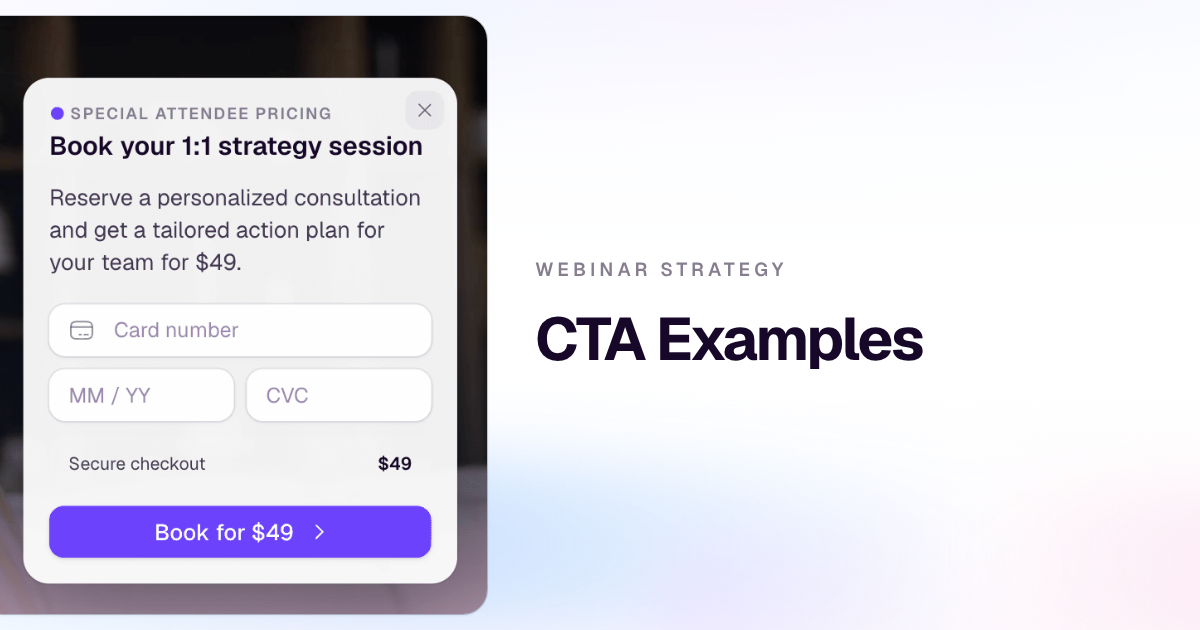
3. CTA Click Rate During Live Session
Your CTA click rate during the live session identifies prospects taking action at peak engagement moments.
What to track: Percentage of attendees who click your calls-to-action during the webinar (not just at the end).
Why it matters: Prospects who click CTAs during your presentation are showing active buying interest. They're not just passively consuming content; they're ready to take next steps.
Best practice: Present multiple CTAs throughout your session, not just at the end. Track clicks on demo requests, resource downloads, and calendar bookings separately.
Benchmark: Expect 8-15% of live attendees to click at least one CTA during the session. Anything above 20% indicates exceptional content-audience alignment.
4. Replay View Rate
Replay views often generate more conversions than live attendance because prospects can consume content when they're ready to focus.
What to track: How many people watch your webinar replay and for how long.
Why it matters: Prospects who seek out your replay are self-qualifying. They're making an intentional decision to invest time in your content, often when they're actively evaluating solutions.
Hidden opportunity: Many teams ignore replay viewers in their follow-up sequences. These prospects often convert at higher rates than live attendees because they're watching with purchase intent.
Benchmark: Expect replay views to equal 60-80% of your live attendance within 30 days.
5. Follow-Up Reply Rate
Your follow-up reply rate measures how well your webinar content primes prospects for sales conversations.
What to track: Percentage of attendees who respond to your post-webinar outreach emails or calls.
Why it matters: A high reply rate indicates your webinar successfully educated prospects and built trust. Low reply rates suggest your content didn't address real pain points or your follow-up messaging misses the mark.
Optimization tip: Reference specific webinar moments in your follow-up. "You asked about integration challenges during the Q&A" performs better than generic "Thanks for attending" messages.
Benchmark: Target 15-25% reply rate to personalized follow-up messages sent within 48 hours of your webinar.
6. Lead Score Change Post-Event
Lead score changes show how webinar attendance affects prospect qualification in your CRM.
What to track: How attending your webinar impacts lead scores in HubSpot, Salesforce, or your marketing automation platform.
Why it matters: Webinars should move prospects closer to sales-ready status. If scores aren't increasing, your content isn't effectively qualifying leads or your scoring model needs adjustment.
Implementation: Set up automatic lead score increases for webinar attendance, with additional points for high engagement behaviors like long watch times or CTA clicks.
Benchmark: Webinar attendance should increase lead scores by 10-25 points, with additional increases for high-engagement behaviors.
7. Pipeline Influenced by Webinar
Pipeline influence connects your webinar directly to revenue potential.
What to track: Dollar value of opportunities where prospects attended your webinar before entering the sales process.
Why it matters: This metric proves webinar ROI and helps you optimize future topics and promotion strategies. It also identifies which webinar topics generate the highest-value prospects.
Tracking method: Tag webinar attendees in your CRM and track which ones become opportunities within 90 days. Calculate the total pipeline value influenced by webinar attendance.
Benchmark: Aim for webinar-influenced pipeline to equal 3-5x your webinar program costs within 90 days.
How to Track These Metrics Without Manual Work
Most teams struggle to track these metrics because they're using tools that weren't built for conversion tracking. Traditional webinar platforms give you attendance numbers but miss the behavioral data that predicts sales readiness.
Modern streaming platforms designed for B2B marketing automatically capture registration, attendance, watch time, and CTA engagement in unified dashboards. Instead of manually pulling data from multiple tools, you get real-time insights into which prospects are sales-ready.
The key is choosing a platform that treats webinar data as marketing intelligence, not just broadcast metrics. Your audience behavior should flow directly into your CRM and trigger automated follow-up sequences based on actual engagement levels.
Platforms like HeyStream were built specifically to solve this problem, capturing detailed audience behavior and automatically triggering follow-ups based on watch time, CTA clicks, and replay views. This eliminates the manual work of tracking engagement across multiple tools while ensuring no sales-ready prospects fall through the cracks.
Frequently Asked Questions
What's the most important webinar metric for B2B lead generation?
Average watch time per attendee is the strongest predictor of conversion intent. Prospects who watch 75% or more of your webinar are 5-10x more likely to become opportunities than those who drop off early. Focus on this metric first, then layer in CTA click rates and follow-up reply rates.
How long should I track webinar metrics after the event?
Track immediate metrics (attendance, watch time, CTA clicks) within 24 hours. Follow-up reply rates should be measured over 2-3 weeks. Pipeline influence requires 60-90 days of tracking since B2B sales cycles extend beyond the initial webinar touchpoint.
Should I track different metrics for different webinar types?
Yes. Product demos should emphasize CTA click rates and follow-up reply rates. Educational webinars should focus on watch time and replay views. Thought leadership sessions should prioritize lead score changes and long-term pipeline influence.
How do I benchmark my webinar metrics against industry standards?
Industry benchmarks vary significantly by audience type, topic, and promotion strategy. Instead of comparing to generic industry averages, track your own performance over time and test improvements systematically. A 5% improvement in your own metrics is more valuable than matching someone else's benchmarks.
What tools do I need to track these metrics effectively?
You need a webinar platform that captures behavioral data, a CRM that tracks lead progression, and marketing automation for follow-up sequences. The key is ensuring these tools share data automatically rather than requiring manual exports and imports.
How often should I review webinar analytics?
Review immediate metrics (attendance, engagement) within 24-48 hours to optimize follow-up timing. Analyze conversion metrics weekly to identify trends. Conduct comprehensive performance reviews monthly to inform future webinar strategy and topic selection.
Can I track these metrics with free webinar tools?
Free tools typically provide basic attendance data but miss the behavioral insights that predict conversions. You'll need platforms designed for B2B marketing to capture watch time, CTA engagement, and automated follow-up triggers that connect webinar attendance to pipeline outcomes.
Start Tracking What Actually Matters
Stop measuring webinar success by registration numbers and start tracking the metrics that predict pipeline growth. Focus on watch time, CTA engagement, and follow-up reply rates to identify sales-ready prospects and optimize your conversion process.
The teams winning with webinars in 2026 aren't just broadcasting content. They're capturing behavioral data that identifies buying intent and automatically triggering follow-ups that convert engaged prospects into customers.
Ready to track webinar metrics that actually predict revenue? Learn more at heystream.com.