You spent weeks planning your last webinar. You got 300 registrations, 120 attendees, and positive feedback. But when you checked your CRM two weeks later, you found exactly zero new opportunities.
Sound familiar? You're not alone. Most B2B webinars generate awareness but fail to create pipeline because they treat broadcasting and conversion as separate problems. The result? Great content that doesn't drive business outcomes.
This playbook shows you how to run B2B webinars that actually generate pipeline in 2026. You'll learn to connect every aspect of your webinar strategy to revenue outcomes, from topic selection through post-event follow-up.
Why Most B2B Webinars Fail to Generate Pipeline
The typical B2B webinar workflow looks like this: Create content, broadcast it, send a generic thank-you email, and hope for the best. This approach fails because it ignores audience behavior and intent signals.
Here's what's broken:
No audience intelligence. You know who registered and who attended, but you don't know who clicked your CTAs, who stayed for the full session, or who watched the replay. Without behavioral data, you can't identify sales-ready prospects.
Generic follow-up sequences. Everyone gets the same post-event email regardless of their engagement level. Someone who attended for 5 minutes gets identical follow-up to someone who stayed for the full hour and clicked every CTA.
Disconnected tool stacks. Your streaming platform, email automation, CRM, and analytics tools don't talk to each other. Data lives in silos, making it impossible to act on audience behavior.
Focus on vanity metrics. You measure registrations and attendance but ignore the metrics that predict pipeline: CTA clicks, engagement duration, and post-event actions.
The solution? Treat webinar streaming and conversion as a unified challenge, not separate workflows.
Pre-Webinar Planning: Setting Up for Success
Choose Topics That Drive Action
Your webinar topic determines everything else. Choose topics that solve immediate problems for your ideal customers while naturally leading to your solution.
High-converting topic formats:
"How to [achieve specific outcome] without [common obstacle]"
"The [number] mistakes [role] make with [process]"
"[Industry] trends that will impact [specific area] in 2026"
"Case study: How [company type] increased [metric] by [percentage]"
Topic validation checklist:
Does this topic address a problem your prospects lose sleep over?
Can you provide actionable insights without giving away your entire methodology?
Does the solution naturally connect to your product or service?
Would your ideal customer attend this session even if they'd never heard of your company?
Example: Instead of "Introduction to Marketing Automation," try "How SaaS Companies Generate 40% More Qualified Leads with Behavior-Triggered Email Sequences."
Build Registration Pages That Convert
Your registration page is your first conversion opportunity. Most teams treat it as a formality, but high-converting registration pages can double your attendance rates.
Essential registration page elements:
Clear value proposition in the headline
Specific outcomes attendees will achieve
Speaker credibility indicators
Social proof from previous events
Minimal form fields (name, email, company)
Mobile-optimized design
Copy framework:
Headline: Promise a specific outcome
Subheadline: Address the main obstacle
Bullet points: List 3-4 concrete takeaways
Social proof: Include testimonials or attendee numbers
CTA: Use action-oriented language ("Reserve Your Spot")
Registration form strategy: Ask for name, email, and company only. You can gather additional information during the webinar or in follow-up sequences. Every additional field reduces conversion rates by 10-15%.
Design Your Pre-Event Email Sequence
Your pre-event email sequence should build anticipation, provide value, and ensure high attendance rates. Plan for 3-4 emails between registration and the live event.
Email 1 (Immediate confirmation):
Confirm registration details
Add calendar invitation
Set expectations for the session
Provide speaker background
Email 2 (3-5 days before):
Share relevant case study or insight
Preview one key takeaway from the webinar
Include social sharing options
Remind about date and time
Email 3 (1 day before):
Final reminder with join link
Share pre-webinar resource (checklist, template)
Build excitement about exclusive content
Include backup join instructions
Email 4 (1 hour before):
Simple reminder with join link
Mobile-friendly format
Clear start time in recipient's timezone
Pro tip: Include valuable content in every pre-event email. Don't just send reminders. Share insights, case studies, or tools that reinforce why attending matters.
Live Webinar Execution: Maximizing Engagement
Start Strong with Clear Value
The first 5 minutes determine whether people stay or leave. Start with outcomes, not introductions.
Opening structure:
Hook (30 seconds): Share a surprising statistic or bold statement
Promise (60 seconds): Clearly state what attendees will learn
Credibility (30 seconds): Briefly establish your authority
Agenda (60 seconds): Preview the session structure
Interaction (30 seconds): Ask attendees to introduce themselves in chat
Example opening: "73% of B2B webinars generate zero pipeline. In the next 45 minutes, you'll learn the 5 changes that turn your webinars into revenue engines. I'm [name], and I've helped 200+ companies generate over $50M in pipeline from webinar programs. Here's exactly what we'll cover..."
Engagement tactics throughout:
Ask questions every 5-7 minutes
Use polls to gather audience insights
Reference chat comments by name
Share your screen to show real examples
Include interactive elements like live demos
Strategic CTA Placement During Your Presentation
Most webinars save CTAs for the end when attention is lowest. Instead, place CTAs at moments of peak value delivery.
High-impact CTA moments:
After sharing a compelling case study
Following a live demonstration
When presenting a framework or template
During Q&A when addressing specific pain points
After revealing surprising insights or data
CTA best practices:
Make offers specific and time-bound
Connect the CTA to content you just shared
Use multiple CTA formats (verbal, visual, chat)
Provide clear next steps
Create urgency without being pushy
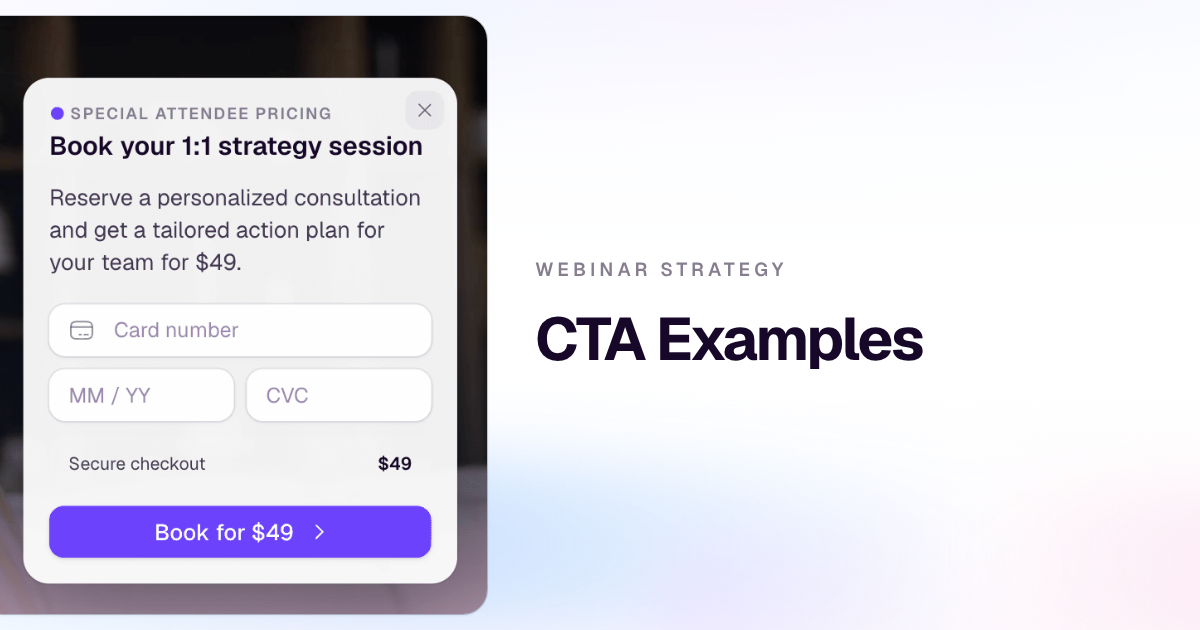
Example: "This framework helped TechCorp increase qualified leads by 60% in 90 days. If you want the complete implementation guide with templates and checklists, visit [link] right now. I'm only sharing this with today's attendees."
Handle Q&A to Build Relationships
Q&A sessions often feel like an afterthought, but they're your best opportunity to identify high-intent prospects and build personal connections.
Q&A strategy:
Reserve 15-20 minutes for questions
Address questions by name: "Great question, Sarah"
Connect answers back to your solution when relevant
Ask follow-up questions to understand context
Offer to continue conversations offline for complex questions
Identifying sales opportunities during Q&A:
Questions about implementation timelines
Requests for specific use cases or industries
Questions about pricing or ROI
Comparisons to competitors
Requests for one-on-one consultations
Follow-up approach: "That's a complex question that depends on your specific situation. I'd love to continue this conversation offline. Can you email me at [address] or book time on my calendar at [link]?"
Post-Webinar Follow-Up: Where Pipeline Actually Happens
Segment Attendees by Engagement Level
Not all attendees are created equal. Your follow-up strategy should reflect different engagement levels and buying intent signals.
Engagement segments:
High engagement: Attended 80%+, clicked multiple CTAs, asked questions
Medium engagement: Attended 50-79%, clicked at least one CTA
Low engagement: Attended less than 50%, minimal interaction
No-shows: Registered but didn't attend
Behavioral signals to track:
Total attendance time
CTA clicks during the session
Chat participation level
Questions asked
Resource downloads
Replay viewing behavior
Intent scoring framework:
+10 points: Attended full session
+5 points: Each CTA click
+3 points: Each question asked
+2 points: Active chat participation
+1 point: Resource download
Create Behavior-Triggered Follow-Up Sequences
Generic post-event emails waste opportunities. Create different follow-up sequences based on engagement behavior.
High-engagement sequence:
Day 1: Personal thank you with exclusive resource
Day 3: Case study similar to their industry/use case
Day 7: Direct invitation for strategy call
Day 14: Final value-add email with soft CTA
Medium-engagement sequence:
Day 1: Thank you with session recording and key takeaways
Day 5: Additional resource related to their interests
Day 10: Invitation to upcoming event or resource
Day 21: Newsletter signup or content subscription
Low-engagement/No-show sequence:
Day 1: Recording access with key highlights
Day 7: Different format content (blog post, case study)
Day 14: Invitation to future webinar on related topic
Personalization tactics:
Reference specific questions they asked
Mention their company or industry
Connect content to their stated challenges
Include relevant case studies or examples
Distribute Replay Content Strategically
Replay content often generates more leads than the live event. Create multiple content formats from your webinar recording.
Replay distribution strategy:
Full recording: Gate behind email capture for lead generation
Key highlights: Create 2-3 minute clips for social media
Audio version: Distribute as podcast episode
Written summary: Turn into blog post with key takeaways
Template/checklist: Extract frameworks into downloadable resources
Replay email sequence:
Immediate: Send recording to all registrants
Week 1: Share highlight clips with key insights
Week 2: Distribute related resources (templates, guides)
Week 3: Invite to upcoming events or content
Measuring What Matters: Beyond Attendance Numbers
Traditional webinar metrics focus on vanity numbers. Pipeline-focused metrics predict business outcomes.
Vanity metrics (don't focus here):
Total registrations
Attendance rate
Session duration
Replay views
Pipeline metrics (focus here):
CTA click-through rates
Post-event meeting bookings
Lead quality scores
Sales opportunity creation
Revenue attribution
Key performance indicators:
Engagement rate: Percentage of attendees who clicked at least one CTA
Conversion rate: Percentage who took desired next step (demo request, trial signup)
Pipeline velocity: Time from webinar attendance to sales opportunity
Revenue per attendee: Total attributed revenue divided by attendee count
Tracking setup:
UTM parameters on all webinar links
CRM integration to track attendee journey
Event tracking for CTA clicks and downloads
Attribution modeling for revenue impact
Technology Stack: Tools That Connect Content to Revenue
Your technology stack determines whether you can connect webinar engagement to pipeline outcomes. Most teams use disconnected tools that create data silos.
Traditional (broken) stack:
Zoom for streaming
Mailchimp for emails
Google Forms for registration
Manual CRM data entry
Separate analytics tools
Problems with traditional stacks:
No unified view of attendee behavior
Manual data transfer between tools
Limited automation capabilities
Impossible to track engagement to revenue
Modern integrated approach:
Choose platforms that unify streaming, registration, engagement tracking, and follow-up automation. Look for tools that provide:
Browser-based streaming with no downloads required
Built-in registration and landing page creation
Real-time engagement analytics and behavioral tracking
Native CTA and conversion tools
Automated follow-up sequences based on behavior
CRM integration for seamless data flow
Platforms like HeyStream solve this by treating streaming and conversion as a unified challenge. You get branded studio capabilities, audience behavior tracking, and conversion automation in one platform instead of managing multiple disconnected tools.
Integration requirements:
CRM connectivity (HubSpot, Salesforce, Pipedrive)
Email automation platform integration
Calendar booking system connection
Analytics and reporting dashboard
Social media sharing capabilities
FAQs
How long should a B2B webinar be?
45-60 minutes is optimal for B2B audiences. This allows 30-40 minutes of content plus 15-20 minutes for Q&A. Shorter sessions feel rushed, while longer sessions see significant drop-off after the hour mark.
What's the best day and time for B2B webinars in 2026?
Tuesday through Thursday, 11 AM or 2 PM in your target audience's timezone. Avoid Mondays (too busy) and Fridays (mental checkout). Test different times with your specific audience, as industry and geography affect optimal timing.
How many people should attend for a successful webinar?
Quality matters more than quantity. 20 highly engaged prospects from your ideal customer profile are more valuable than 200 random attendees. Focus on attracting the right people rather than maximizing numbers.
Should I require registration for webinars?
Yes, always require registration. This lets you capture lead information, send pre-event sequences, track attendance behavior, and create targeted follow-up campaigns. The slight friction is worth the data and conversion opportunities.
How do I handle technical difficulties during live webinars?
Have a backup plan: test all technology 30 minutes before, use a reliable internet connection, prepare a co-host who can handle technical issues, and communicate proactively with attendees if problems occur. Consider platforms that run entirely in browsers to minimize technical issues.
What's the ideal registration to attendance ratio?
Expect 40-60% of registrants to attend live webinars. Higher attendance rates indicate strong topic-audience fit and effective pre-event communication. Focus on improving attendance through better pre-event sequences rather than just increasing registrations.
How soon after a webinar should I follow up with attendees?
Send immediate follow-up within 2 hours while the session is fresh in their minds. Then create a sequence over 2-3 weeks based on engagement level. High-engagement attendees should receive personal outreach within 24-48 hours.
Turn Your Next Webinar Into Pipeline
B2B webinars that generate pipeline require more than great content. You need unified systems that connect audience behavior to business outcomes, automated follow-up sequences that nurture based on engagement, and metrics that focus on revenue impact rather than vanity numbers.
The difference between webinars that build awareness and webinars that build pipeline comes down to treating streaming and conversion as one integrated challenge. When you can track who clicked, who stayed, and who's ready for conversation, you transform broadcasts into business outcomes.
Ready to run webinars that actually generate pipeline? Learn more at heystream.com.