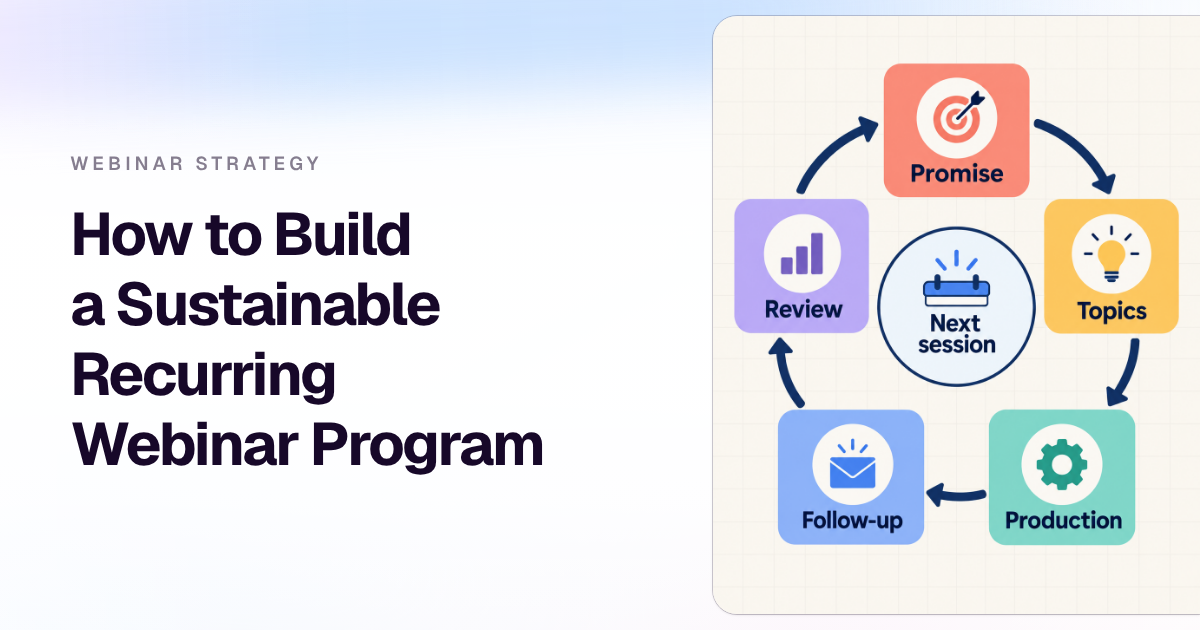
A webinar promotion plan is the campaign system that gets the right people from first awareness to registration, attendance, replay, and follow-up. For B2B teams, the plan should do more than fill a calendar invite. It should clarify who the webinar is for, why that audience should care now, where each message will run, and how registration quality will be measured after the event.
The mistake is treating promotion as a list of channels. Email, social, partners, paid, website placements, and sales-assisted invites can all help, but they work best when they are attached to a clear audience promise and a strong registration handoff. A practical plan connects promotion to the rest of the B2B webinar growth engine: registration, reminders, the live session, replay, CTAs, audience signals, and follow-up.
This guide gives you a B2B webinar promotion plan you can reuse for product demos, launch webinars, customer education sessions, and thought-leadership events.
What Webinar Promotion Means in a B2B Growth Workflow
Webinar promotion is the work of attracting the right audience and giving them a clear reason to register and attend. It includes channel selection, message planning, registration-page routing, speaker or partner amplification, reminder handoff, and measurement.
That definition matters because B2B webinar success is rarely about raw signup volume alone. A large list of low-fit registrants can make the top of the report look busy while leaving sales, customer success, and product marketing with weak follow-up signals. A smaller audience that matches the topic, role, problem, and buying stage can be more useful.
A good promotion plan answers five questions before the first invite goes out:
| Planning question | Why it matters |
|---|---|
| Who is this webinar for? | Keeps channels and copy focused on the right buyer, customer, or user segment. |
| What problem will the session help them solve? | Turns the invite from an event announcement into a relevant promise. |
| Where will the audience discover it? | Helps you choose channels by audience fit, not habit. |
| What happens after they register? | Connects promotion to reminders, attendance, replay, and follow-up. |
| How will quality be measured? | Prevents the campaign from being judged only by total registrations. |
Start With Audience, Promise, and Registration Page
Before choosing channels, define the webinar's audience and promise. Promotion gets much easier when the topic can be explained in one useful sentence.
For example, “Join our webinar” is not a promotion angle. “Learn how B2B teams turn product demos into reusable pipeline signals” is closer because it names a buyer problem and a clear outcome.
Use this three-part planning pass:
- Audience: Which role, segment, account type, or customer group is the session for?
- Problem: What practical job are they trying to do better?
- Reason to attend live: What will they get from the live experience that is stronger than reading a recap later?
Then make sure the registration page supports the same promise. Your promotion should route people to webinar registration pages that repeat the audience, outcome, date, speakers, and next step clearly. If the campaign copy promises a practical checklist, the page should not drift into a broad product pitch. If the invite targets product marketers, the registration page should not sound like it was written for a general events audience.
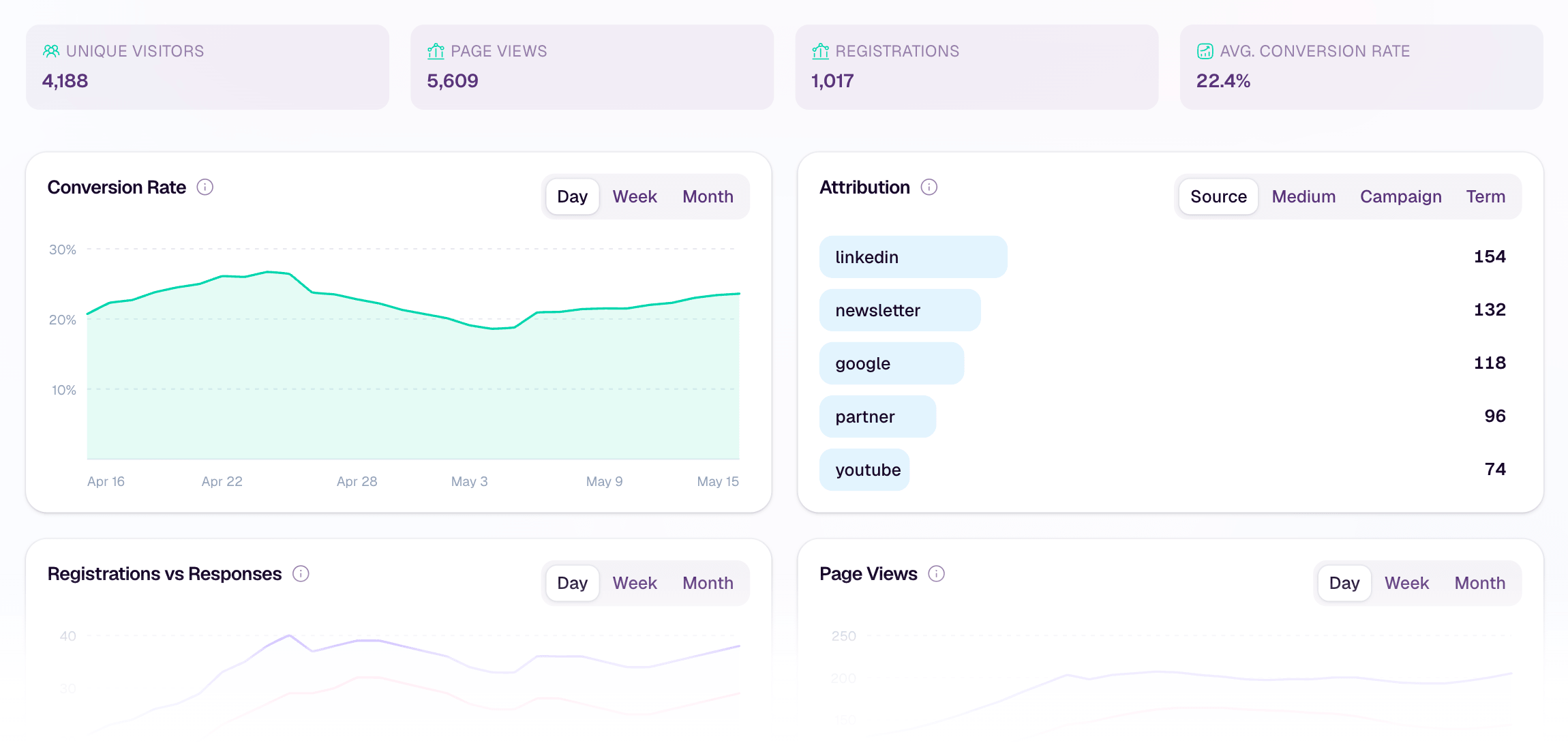
The registration page is also where measurement begins. Capture enough context to understand source quality later, but keep the form short enough that it does not create unnecessary friction. Use this registration-page checklist to plan the promise, fields, source tracking, confirmation, and follow-up together.
A Four-Week Webinar Promotion Timeline
The right timeline depends on the audience, speaker pull, topic urgency, and size of the campaign. For many B2B webinars, four weeks gives the team enough room to launch the page, coordinate partners, repeat the message without fatigue, and make a final push.
Livestorm's 2026 webinar benchmark data says a meaningful share of registrations can arrive late in the promotion window, including during the final week and on the day of the event. Treat that as a reason to plan the final stretch, not as permission to wait.
| Timing | Main job | What to prepare |
|---|---|---|
| Four weeks before | Launch the campaign | Registration page, core invite copy, speaker assets, tracking links, first email, first social posts. |
| Three weeks before | Expand reach | Partner posts, employee enablement, blog or resource placement, community sharing where appropriate. |
| Two weeks before | Reinforce the value | Second invite angle, speaker quote, short clip or visual, sales-assisted invite for high-fit accounts. |
| One week before | Convert interest into registration | Final educational angle, objection-removing copy, retargeting or newsletter placement if used. |
| Day before and day of | Help registrants attend | Reminder sequence, calendar clarity, starting-soon posts, last-call invite for warm audiences. |
| After the session | Extend the campaign | Replay page, follow-up segments, CTA clicks, question themes, next-webinar topic notes. |
Do not treat the timeline as a rigid calendar. A one-off partner webinar with a famous speaker may need more lead time. A customer training session for an existing audience may need less. The point is to assign each week a job, so the campaign does not become four versions of the same reminder.
Build the Channel Plan Around Audience Fit
Most webinar promotion plans include several channels, but every channel should earn its place. Choose channels based on where the audience already pays attention, what trust the channel carries, and what message job it can do.
ON24's webinar marketing guide emphasizes coordinated promotion across assets such as email, landing pages, internal links, and partner activity. That coordination matters because a webinar invite rarely works as a single touch. People may notice the topic in a newsletter, see a speaker post later, then register after a reminder from a teammate or sales rep.
Here is a practical channel matrix for B2B teams:
| Channel | Best use | Setup needed | Message job | Measurement signal |
|---|---|---|---|---|
| Owned email | Known audience, customers, prospects, newsletter subscribers | Segmented list, invite email, reminder handoff | Explain the problem and why the session is worth attending live | Registrations by segment, unsubscribe risk, attendance rate by list |
| Website and blog | Existing organic traffic and product visitors | Homepage strip, relevant blog links, resource placement | Catch active researchers and product-aware visitors | Page views, assisted registrations, path to registration |
| Speakers and partners | Borrowed trust and audience expansion | Partner copy, tracking links, image assets, posting schedule | Make the invite feel recommended, not advertised | Partner-sourced registrations, attendance quality |
| Employee advocacy | Subject-matter credibility and network reach | Short post options, suggested angles, speaker bios | Let team members explain why the topic matters | Referral traffic, high-fit registrations |
| Organic social | Repetition and visible momentum | Post sequence, speaker tags, short clips or visuals | Share hooks, questions, and key takeaways before the event | Engagement, clicks, assisted registrations |
| Communities | Niche audience access | Community rules, non-promotional framing, useful context | Offer help where the topic is genuinely relevant | Qualified traffic, replies, questions |
| Paid or retargeting | Warm audience reinforcement or account targeting | Audience list, budget, creative, conversion tracking | Remind known visitors or target a defined segment | Cost per qualified registration, source quality |
| Sales-assisted invites | Named account or opportunity support | Account list, rep copy, CRM context | Give reps a useful reason to re-engage | Account attendance, meeting creation, follow-up relevance |
MailerLite's webinar promotion guide includes partner swaps, community participation, and search-optimized recurring webinar pages among practical ways to expand reach. Those ideas are useful, but only when they match the audience. A partner swap with the wrong audience can inflate registrations without improving webinar quality.
Write a Message Plan, Not Just Invite Copy
Your promotion plan needs more than one announcement. Each message should do a specific job in the campaign.
A simple B2B message plan can include:
- Core invitation: The main problem, who should attend, what they will learn, and when it happens.
- Proof or credibility angle: Why this speaker, customer example, benchmark, or practical workflow is worth the audience's time.
- Problem-agitation angle: The cost of leaving the current process messy, manual, or unmeasured.
- Tactical takeaway angle: The checklist, template, framework, teardown, or example attendees will leave with.
- Partner or speaker angle: Why the partner or speaker is bringing this topic to their audience.
- Final reminder angle: What registrants and late deciders should do now.
- Replay teaser: Why people who missed the live session should still watch and act.
For the email portion, separate the first invite from the reminder sequence. A webinar invitation email needs to earn the registration. Webinar reminder email templates need to help registered people attend. Mixing those jobs creates vague copy: too much logistical detail for cold invitees and too little live-session value for registrants.
Connect Promotion to Registration, Reminders, and Replay
The best webinar promotion plans look beyond the moment someone fills out the form. Once someone registers, the campaign should shift into attendance and follow-up mode.
Plan these handoffs before launch:
| Handoff | What to decide before promotion starts |
|---|---|
| Registration to reminder | How registrants will receive calendar details, reminder timing, and the strongest reason to attend live. |
| Registration to sales context | Which registrations should be visible to sales, and what account or source context should be included. |
| Live session to CTA | Which offer, demo link, resource, or next step fits the session promise. |
| Live session to replay | How quickly the replay will be available and what message will invite people back. |
| Replay to follow-up | Which viewer actions should shape follow-up, such as watching, clicking, asking questions, or missing the session. |
This is where HeyStream should fit naturally for B2B teams. HeyStream gives marketers a B2B webinar platform for branded registration, live and replay experiences, live and replay CTAs, audience signals, webinar analytics, and webinar follow-up automation. It does not replace your email platform, ad account, or CRM; it helps the webinar itself become a cleaner source of audience and intent data.
Measure Promotion Quality, Not Just Registration Count
Total registrations are useful, but they are not the whole story. A B2B team should know which sources brought in the right audience, which messages produced attendance, and which segments created useful follow-up signals.
Track at least these promotion metrics:
| Metric | What it tells you |
|---|---|
| Registrations by source | Which channels created signups. |
| Registration quality | Whether signups match the intended audience, role, company type, or customer segment. |
| Attendance by source | Which channels produced people who actually showed up. |
| Reminder performance | Whether registrants needed more clarity or stronger live-session value. |
| CTA clicks | Which viewers took the intended next step during live or replay. |
| Replay engagement | Whether the campaign kept working after the live event. |
| Follow-up segment performance | Which attendee behaviors made follow-up more relevant. |
Be careful with benchmarks. Vendor reports can provide useful context, but they should not become universal promises. For your own planning, the better question is whether each webinar improves the team's understanding of audience fit, topic demand, and follow-up quality.
B2B Webinar Promotion Checklist
Use this checklist to turn the plan into production work.
Before launch
- Define the audience, job-to-be-done, and reason to attend live.
- Choose the primary CTA and follow-up path.
- Publish the registration page with speaker, date, promise, and form fields.
- Set source tracking for email, partner, paid, social, website, and sales-assisted invites.
- Prepare invite copy, speaker copy, partner copy, and social copy.
- Confirm the reminder sequence and replay plan.
During promotion
- Launch the first invite and core social posts.
- Add relevant website, blog, and resource links.
- Give speakers, partners, and employees short copy they can adapt.
- Monitor source quality, not just total registrations.
- Refresh the message with a new angle instead of repeating the same announcement.
- Plan the final-week push before the final week arrives.
After the webinar
- Publish or send the replay quickly.
- Segment attendees, no-shows, replay viewers, CTA clickers, and question askers.
- Compare registration source with attendance and engagement.
- Capture questions and objections for future content.
- Add internal links from related blog posts and resources where the promotion plan is relevant.
- Decide what to repeat, stop, or change for the next webinar.
Turn Promotion Into a Repeatable Webinar System
A useful webinar promotion plan gives the team a repeatable system, not just a busier campaign calendar. Start with the audience and promise. Route people to a registration page that matches the invite. Use channels for specific jobs. Plan reminders, live CTAs, replay, and follow-up before launch. Then judge the campaign by audience quality and next-step signals, not vanity volume.
That is the difference between promoting a webinar and building a webinar program. Promotion fills the room. A connected webinar workflow helps the team learn who came, what they cared about, and what should happen next.