Most webinar funnels are built like a sequence of tasks: create the registration page, run the live session, send the replay, hand the list to sales, and move on.
That can work for a single campaign, but it does not create much learning. The team may know how many people registered and attended, but it often cannot see which moments created intent, which offers moved people forward, or what should change before the next session.
A stronger B2B webinar funnel works more like a growth engine. Registration creates the first audience signal. The live session creates engagement moments. CTAs turn attention into action. Replay extends the useful life of the event. Follow-up responds to behavior. Analytics make the next session sharper.
How the growth engine works
The simplest way to think about the growth engine is as one connected loop: every webinar should capture a useful audience signal, give the viewer a relevant next step, and leave the team smarter before the next session.
The stages below are not separate jobs to complete. They are handoffs. Registration shapes the audience, engagement shows what held attention, CTAs turn interest into action, replay keeps the moment alive, follow-up responds to behavior, and learning feeds the next webinar.
| Growth-loop stage | What it should capture | How it improves the next step |
|---|---|---|
| Registration | Topic interest, source, segment, and fit | Sets the promise and gives the team the first audience signal |
| Live engagement | Watch time, questions, chat, polls, and drop-off moments | Shows which parts of the session created real attention |
| CTA moments | Resource clicks, demo interest, pricing views, or trial intent | Turns active attention into a clear next action |
| Replay | No-show views, return visits, rewatched sections, and replay CTA clicks | Keeps the funnel active after the live session ends |
| Follow-up | The strongest behavior signals from live and replay viewing | Makes outreach more relevant than a generic attendee email |
| Learning | Patterns across topics, sources, offers, and audience segments | Improves the next registration page, session, CTA, replay, and follow-up motion |
| Read from left to right, this is the loop the rest of the article unpacks: turn interest into attendance, attendance into action, replay into another intent moment, and the whole cycle into a sharper next session. |
What a webinar funnel should do
A webinar funnel is the path that moves someone from initial interest to a meaningful next step after a live or recorded session.
For B2B teams, that path usually includes registration, attendance, engagement, conversion moments, replay, follow-up, and measurement. The funnel is not only about getting someone to show up. It is about understanding what their behavior says and using that context to make the next interaction more relevant.
This is where many teams lose momentum. They build a good event, but the surrounding workflow is scattered across a landing page tool, webinar platform, spreadsheet, CRM, email tool, and sales process. Each part may work on its own, but the system does not create a clear view of audience intent.
The growth-engine model fixes that by treating every stage as part of one loop.
Start with registration as the first audience signal
Registration is not just a form submission. It is the first moment where a potential buyer tells you something about their interest.
A strong webinar registration page should make the promise clear, explain who the session is for, reduce friction, and set expectations for what the attendee will learn. It should also help your team understand the quality of the audience, not just the size of the list.
That means the registration experience should answer practical questions:
- What problem is the session helping the reader solve?
- Who will get the most value from attending?
- What next step might make sense after the session?
- Which source, campaign, or audience segment brought this person in?
The source context should survive the link-to-form journey and be stored against the registration record. A webinar UTM tracking guide can help teams keep campaign, source, and audience context attached without treating registration, attendance, and downstream outcomes as the same signal.
When registration data is treated as part of the funnel, it becomes more than a vanity number. It becomes the first layer of audience intelligence.
Separate attendance from real engagement
Attendance matters, but it is only the start of the story.
Two attendees can both be marked as present while behaving very differently. One may join for five minutes, leave, and never return. Another may watch most of the session, ask a question, click a CTA, and come back for the replay. Those two people should not receive the same follow-up.
Useful webinar engagement metrics help the team understand the quality of attention. Watch time, questions, chat participation, poll responses, CTA clicks, replay views, and return visits all add context that attendance alone cannot provide.
The key is not to pretend every signal proves buying intent. It does not. The goal is to build a more useful picture of what each person cared about and how much momentum they showed.
That picture becomes the bridge between the live session and the next step.
Use CTAs to turn attention into action
A webinar funnel needs clear conversion moments. Otherwise, the audience can be interested without knowing what to do next.
Good webinar CTAs are matched to the viewer moment. Early in the session, a CTA might invite attendees to download a related checklist or save a resource. Near the end, it might invite them to book a demo, join a follow-up session, start a trial, or view pricing. During replay, it might help late viewers take the same next step without waiting for a manual email.
The strongest CTAs are specific and contextual. They do not interrupt the session for the sake of a pitch. They give interested viewers a clear path forward at the moment when the topic is already active in their mind.
This is also why a reusable CTA system matters. If every webinar team rebuilds offers from scratch, it becomes harder to compare performance over time. When CTA assets are consistent, the team can learn which offers work across topics, audiences, and stages of the funnel.
HeyStream's conversion tools are built around that idea: live and replay CTAs should be part of the broadcast workflow, not an afterthought added once the audience has already moved on.
Treat replay as a second intent moment
Replay is often treated like an archive. The team sends a recording link, checks the task off the list, and moves on to the next campaign.
That misses a major part of the funnel.
A practical webinar replay strategy gives no-shows, late viewers, sales prospects, and returning attendees another chance to engage. It also creates new signals. Someone who watches the replay after the live session, returns to a key section, or clicks a replay CTA may be showing a different kind of interest than someone who only registered.
The replay page should keep the context alive:
- remind viewers what the session helps them solve
- keep one clear next step visible
- preserve relevant CTAs from the live session
- track replay engagement at the contact level
- feed replay behavior into follow-up
Replay does not make every viewer sales-ready. But it does keep the funnel active after the live moment ends.
Make follow-up behavior-based
Generic follow-up is where many webinar funnels flatten.
The same email goes to attendees, no-shows, high-engagement viewers, quiet viewers, CTA clickers, replay viewers, and people who left early. That may be easier to operate, but it ignores the signals the webinar just created.
Better webinar follow-up starts by segmenting behavior into useful groups. A person who attended live and clicked a pricing CTA may need a different next step from someone who registered but did not attend. A replay viewer who watched a product section may need a different message from someone who only opened the replay email.
The point is not to over-automate every tiny branch. It is to make follow-up more relevant by using the strongest available signals.
HeyStream's follow-up automation supports this kind of workflow by helping teams connect audience behavior to the next action. The more connected the data is, the less follow-up depends on guesswork.
Use analytics to improve the next session
The best webinar funnels do not end when the follow-up sequence goes out. They feed learning back into the next session.
This is what turns a funnel into a growth engine.
Analytics should help the team answer practical questions:
- Which topics attracted the right audience?
- Which registration sources produced engaged attendees?
- Where did attention rise or drop during the session?
- Which CTAs earned clicks?
- Which replay segments kept people watching?
- Which follow-up paths created meaningful next steps?
A webinar performance report template gives the debrief a place to capture owners and next-session actions.
Illustrative handoff: an attendee clicks a technical checklist, the owner reviews the account fit and the question the attendee asked, sends the useful resource, records the follow-up decision, and uses the lesson to adjust the next session. The click alone does not establish qualification or a completed booking.
Those answers help shape the next topic, registration page, CTA, replay package, and follow-up motion. Over time, the team is not just running more webinars. It is getting better at running the kind of webinars that create action.
HeyStream's analytics and insights and audience intelligence are designed for this loop: connect behavior to the contact record, make audience signals visible, and help the team decide what should happen next.
Keep the stack simple enough to repeat
A webinar growth engine should be structured, but it should not become so complex that the team cannot sustain it.
This is why the stack matters. If registration, watch pages, CTAs, replay, audience data, analytics, and follow-up all live in disconnected tools, every session creates operational drag. The team has to rebuild workflows, reconcile data, and manually interpret signals before it can act.
Map registration, attendance, replay, and CTA events into distinct CRM fields or events, then verify delivery and ownership with a webinar CRM integration.
A simpler operating model is better:
- Build the registration and watch experience around one clear promise.
- Capture audience behavior throughout the live and replay journey.
- Place CTAs where they match the viewer moment.
- Segment follow-up by meaningful behavior.
- Review the signals before planning the next session.
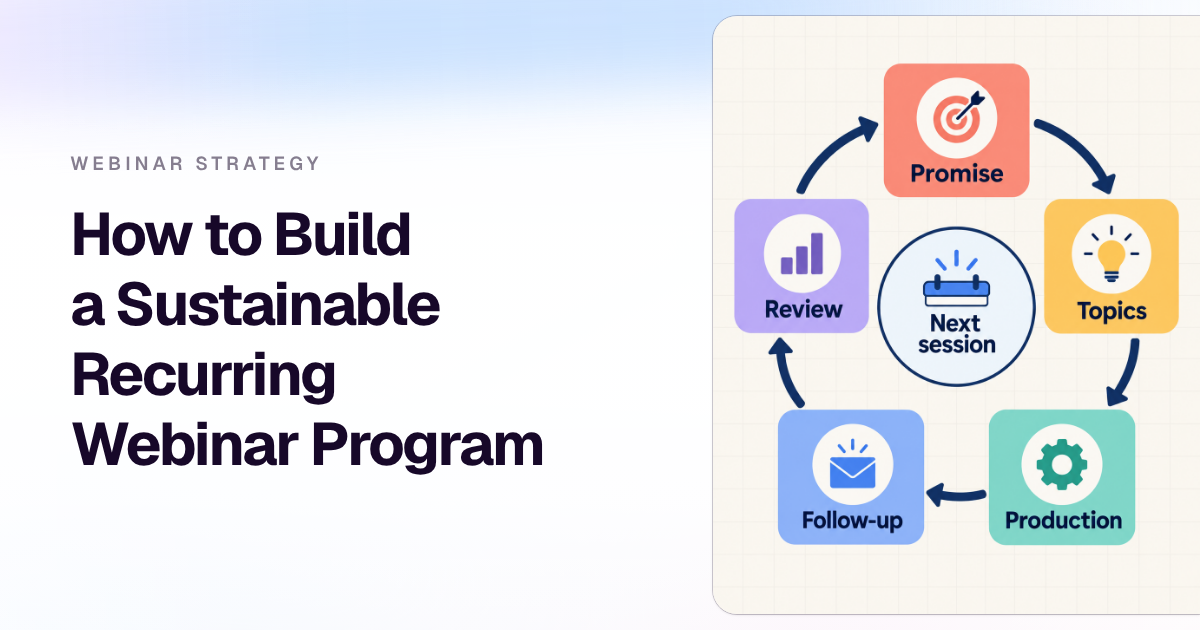
For teams running a recurring webinar program, repeatability is the advantage. Each session should make the next one easier to plan, sharper to run, and more useful to follow up.
This is the broader role HeyStream is built to play. It brings branded registration, watch pages, audience CRM, CTAs, replay, analytics, and follow-up closer together so B2B teams can treat live broadcasts as a connected growth workflow rather than a one-off event project.
Teams can start with the basics, then expand into deeper conversion and automation workflows as the program matures. The pricing page shows how that progression maps to different levels of broadcast volume and operational need.
The takeaway
A webinar funnel is not only a way to get people into a live session. For B2B teams, it should be a system for learning from audience behavior and turning that attention into the right next step.
The growth-engine model makes the workflow more useful because it connects the full loop: registration, attendance, engagement, CTAs, replay, follow-up, and analytics.
When those pieces work together, each session does more than stand alone. It gives the team better signals, better follow-up, and a clearer plan for the next broadcast.