A webinar invitation email is not just an announcement. It is the first moment where a potential attendee decides whether your session is relevant, useful, and worth making time for.
That makes the invitation more important than the format suggests. A clear email can create registration intent, set expectations, and send people to a registration page that feels like a natural next step. A vague one can make even a useful webinar feel easy to ignore.
For B2B teams, the strongest webinar invitations do three jobs at once: they explain the value of attending, remove friction from registration, and start the audience-signal trail that the rest of the webinar workflow depends on. This guide gives you a copyable template, concrete examples, and a practical way to connect the invite to registration.
What a webinar invitation email needs to do
A webinar invitation email has one primary job: help the right person decide to register.
That sounds simple, but many invitations try to do too much. They explain the company, introduce every speaker, mention every topic, add a long agenda, and then place the registration link somewhere near the end. The reader has to work too hard to understand why the event matters.
A stronger invitation focuses on the decision in front of the reader. It answers four questions quickly: who is this for, what problem does it help with, what will I learn, and how do I register?
This is also why a webinar invitation should not feel like a general newsletter mention. Customer.io's guide to webinar invitations and Really Good Emails' webinar examples library both show how much useful invitation content depends on a clear promise, scannable event details, and an obvious next action. Use those examples for structure and inspiration, not as proof that one design or message will perform best for every audience.
Clarify the audience before you write
Before writing subject lines or body copy, decide exactly who the session is for.
A webinar for demand generation leaders should not be framed the same way as a webinar for event marketers, product marketers, customer education teams, or founders. Each audience cares about different risks and outcomes. One may care about qualified pipeline. Another may care about attendee experience. Another may care about helping customers adopt a new workflow.
Write down the audience in one sentence before you draft:
This webinar is for B2B marketing teams that want to improve webinar registration quality without making the promotion workflow heavier.
That sentence keeps the email grounded. It stops the copy from drifting into generic event promotion and helps you choose which benefits deserve space.
The invitation should also clarify the webinar promise. A good promise is not just the topic. It is the useful change the attendee can expect after joining.
Weak promise: Join our webinar about B2B webinars.
Stronger promise: Learn how to write invitation emails that make the webinar value clear before someone reaches the registration page.
The second version gives the reader a reason to care without promising a result the session cannot guarantee.
Include the details people need to say yes
A webinar invitation can be short, but it cannot be incomplete. The reader should not have to click through just to learn the basics.
| Detail | Why it matters |
|---|---|
| Webinar title | Helps the reader understand the topic quickly. |
| Date, time, and timezone | Removes scheduling uncertainty. |
| Speaker or host | Builds context and credibility. |
| Audience fit | Helps people self-select. |
| Key takeaways | Shows what they will leave knowing. |
| Format and duration | Sets expectations for the commitment. |
| Replay availability | Gives busy prospects accurate planning information when a replay is confirmed. |
| One registration CTA | Keeps the next step obvious. |
The details should support the value of attending, not bury it. Put the most important logistics near the CTA, but lead the email with the reader problem or outcome.
If the webinar has a replay, say so clearly. A replay mention can give busy people another way to engage, but it should not make the live session sound disposable. It also sets up your webinar replay strategy as part of the full workflow rather than treating the recording as an afterthought.
Copyable webinar invitation email template
Use this template as a starting point. Replace every bracketed field and remove any line that does not help the reader decide whether to register.
Subject: [Outcome your audience wants] without [audience problem]
Preview text: Join [speaker name and role] on [date] for a practical session on [webinar outcome].
Hi [first name],
If [audience problem], it can be difficult to [desired outcome].
In [webinar title], [speaker name and role] will show you how to [specific payoff].
Date: [day, date]
Time: [time and timezone]
Duration: [duration]
Format: [presentation, interview, workshop, or demo]You will learn:
- [takeaway one]
- [takeaway two]
- [takeaway three]
[Register for the webinar]
If the button does not open, use this registration link: [fallback URL]
The anatomy is deliberately simple:
| Part | What it should do | Template cue |
|---|---|---|
| Subject line | Earn attention with a relevant outcome or problem. | “[Outcome] without [problem]” |
| Hook | Show the reader that the session starts from their situation. | “If [problem]...” |
| Payoff | Explain the practical change or lesson the session offers. | “show you how to [outcome]” |
| Logistics | Make the commitment easy to assess. | Date, time, timezone, duration, format |
| Takeaways | Turn a broad topic into three concrete learning points. | Three outcome-led bullets |
| CTA | Give the reader one unambiguous next action. | “Register for the webinar” |
| Fallback path | Give the reader a clear alternative if the button does not open. | A visible registration URL |
The fallback link is simply a robust alternative path. Do not describe it as a universal accessibility or deliverability improvement unless you have evidence for that claim.
Three B2B invitation examples
Use the audience and webinar type to change the angle while keeping the same basic structure.
| Webinar type | Outcome-led subject line | Opening hook | CTA |
|---|---|---|---|
| Thought leadership | What B2B webinar teams should measure after registration | Registration numbers alone do not explain whether the right audience is moving through your webinar workflow. | Explore the measurement framework |
| Product demo | See how to connect registration, live CTAs, and follow-up | If your webinar tools split the audience journey across several disconnected systems, the handoffs can become hard to see. | Register for the live demo |
| Customer education | Build a repeatable follow-up workflow after every webinar | Your team may already collect useful audience signals during webinars without having a consistent way to act on them. | Save your place in the workshop |
These are examples, not performance formulas. A product-demo audience may respond to a direct workflow promise, while a thought-leadership audience may need a sharper point of view. Test the angle with the list you actually have.
Write subject lines around value, not the event format
The phrase "join our webinar" is usually too weak to carry a subject line by itself. It names the format, but not the payoff.
Better subject lines usually lead with the problem, outcome, audience, or practical lesson:
- Write webinar invites people can act on
- Turn webinar interest into a clear registration journey
- A clearer framework for webinar invitations
- Registration starts with the invitation
- How B2B teams can promote webinars with less guesswork
The best subject line depends on your audience and list relationship. A known audience may respond to a direct practical promise. A colder list may need more context. A customer list may care about a specific workflow improvement.
Avoid universal rules that pretend every audience behaves the same way. Test subject lines against your own list, then use what you learn to improve the next invitation.
Make the body about the reader's reason to attend
Once someone opens the email, the body should quickly move from context to value.
A common mistake is to make the first paragraph about the company, event series, or host. That context can matter, but it is rarely the strongest opener. The reader is asking a different question: is this worth my attention?
Start with the problem or tension they already recognize:
- Your team is getting registrations, but not enough of the right attendees.
- Your webinar topic is strong, but the invitation sounds like every other event announcement.
- People click through, but the email and registration page do not tell the same story.
Then connect the webinar to a practical outcome. Keep the copy specific enough that the reader can picture why attending would help.
For a B2B webinar, this usually means focusing on a business workflow rather than abstract interest. Instead of saying the session covers webinar promotion, say it helps teams write invitations that match the audience, registration page, and follow-up path.
Align the email with the registration page
The invitation email and the webinar registration page should feel like two parts of the same promise.
If the email says the session is about improving registration quality, the registration page should not shift into a generic event description. If the email emphasizes a practical framework, the page should show what that framework covers. If the email CTA says "save your seat," the page should make that action immediate and obvious.
This alignment matters because the click is not the conversion. It is a handoff. Before sending, run this compact consistency check:
- Same audience: both surfaces name or clearly speak to the same people.
- Same outcome: the page continues the useful promise made in the email.
- Same webinar title: wording does not change after the click.
- Same date, time, and timezone: logistics match everywhere.
- Same primary action: the email CTA leads directly to registration, not a generic page.
A strong handoff keeps the reader's momentum intact. The email names the problem and promises a useful lesson; the page reinforces that promise, shows the takeaways and speaker context, and keeps the form simple.
This is also where webinar invitations connect to the broader live growth loop. The email creates intent. The registration page captures the first signal. The live session creates engagement. CTAs and follow-up turn that engagement into possible next actions.
Build a short sequence, not one isolated email
One invitation email is rarely enough context for a meaningful B2B webinar. People are busy, timing varies, and the first angle may not be the one that resonates.
Each message has a separate job:
| Stage | Audience | Job | Useful next step |
|---|---|---|---|
| Invitation | Relevant people who have not registered | Explain who the session is for, why it matters, and what they will learn. | Registration page |
| Confirmation | New registrants | Confirm the booking and make the event easy to save. | Calendar action or event details |
| Reminder | Registered attendees | Help people remember when and where to join. | Join details |
| Live session | Attendees | Deliver the promised experience and offer contextual actions. | Resource, CTA, or question |
| Follow-up | Attendees, no-shows, and replay viewers | Continue the journey using the person's actual context. | Replay, resource, reply, or relevant offer |
A practical invitation sequence might include an initial invitation and a second invitation with a different angle. Once someone registers, move them into confirmation and reminder messaging rather than continuing to persuade them to register. The dedicated webinar reminder email templates guide shows how to handle that registered-attendee job without turning this article into a reminder guide.
After the session, use webinar follow-up email templates that reflect whether someone attended, missed the live session, watched the replay, asked a question, or selected a CTA. Keep those signals in context; they can help make the message relevant, but they do not prove buying intent.
The invitation should prepare the audience for the rest of the journey: registration, the live experience, a contextual webinar CTA, replay, and follow-up.
Choose one clear CTA
The invitation email should have one primary action: register for the webinar.
That does not mean the button text has to be bland. It means the action should be unmistakable. Use direct language that tells the reader what happens next:
- Register for the webinar
- Save your seat
- Join the live session
- Reserve your spot
- Get the session link
Avoid stacking several competing actions in the same email. A link to the blog, a secondary product CTA, a demo request, and a registration button all in one short invitation can make the next step feel less obvious.
The CTA should also match the webinar's stage in the funnel. Before the event, the CTA is registration. During the event, conversion tools might point attendees toward a guide, pricing page, trial, demo, or next session. After the event, the CTA may shift to replay, follow-up, or a more specific offer.
The clearer the CTA is at each moment, the easier it becomes to understand what the audience actually did.
Measure the invitation as part of the full workflow
Email metrics are useful, but they are not the whole story.
Track the basics: sends, opens, clicks, registrations, and registration-page completion. Then connect those numbers to what happens later: attendance, replay views, CTA clicks, questions asked, accounts represented, and follow-up quality.
This is where audience intelligence matters. A registration is a useful first signal, but it becomes more valuable when it sits beside live attendance, replay behavior, CTA engagement, and follow-up context.
Do not overread a single metric. A high click rate can still lead to weak registrations if the page promise is unclear. Strong registration volume can still produce poor attendance if reminders are weak. A CTA click can show interest, but it does not prove buying intent by itself.
A better measurement question is: did this invitation attract the right audience into a webinar workflow we can learn from?
That connects the email back to the B2B webinar growth engine: each session should make the next one clearer.
Where HeyStream fits
HeyStream does not write or send the invitation email for you. It helps the workflow after the invitation become easier to connect.
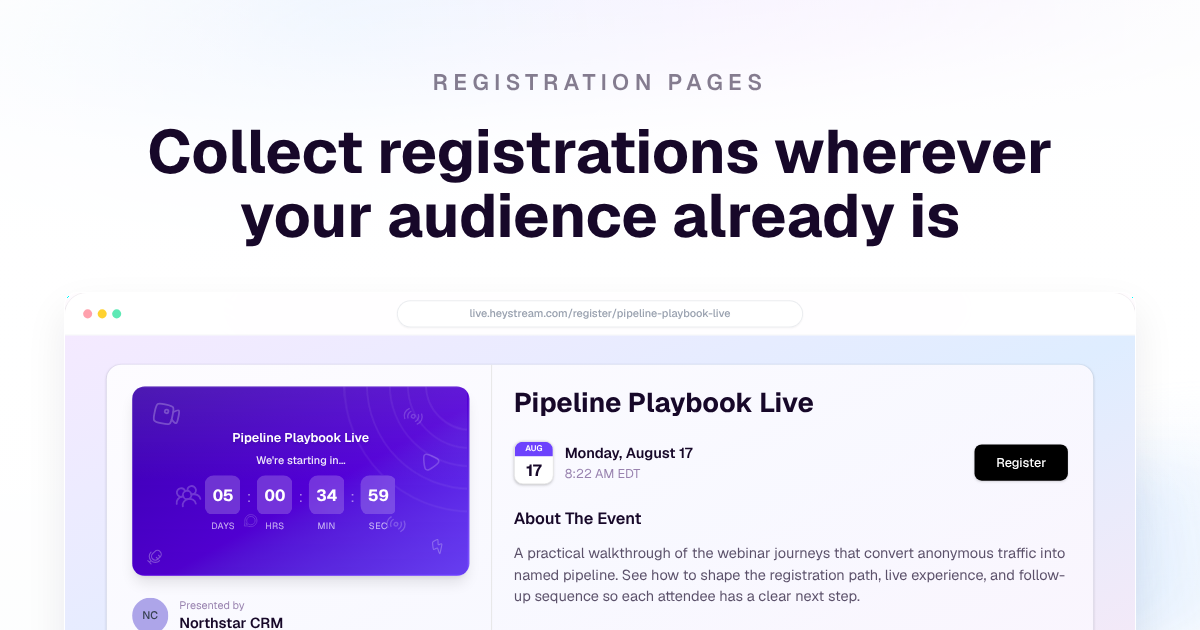
With HeyStream's webinar registration pages, the email promise can hand off to a branded page with the event details and registration action kept in context. From there, branded watch pages, live CTAs, replay, audience signals, follow-up automation, and analytics can sit closer together.
That means the invitation is no longer a disconnected promotion asset. It becomes the first step in a measurable live workflow.
The best webinar invitation emails do not try to hype the event. They make the value of attending clear, give the right audience a simple path to register, and set up everything that happens after the click.