Broad webinar topics feel safe. They promise a larger audience, easier promotion, and a title that almost anyone in the market could click.
That can be useful when the goal is category awareness. But when the goal is B2B webinar lead generation, a broad topic can also make the program harder to learn from. The team may get registrations, but the audience is mixed, the questions are vague, the CTA is hard to place, and follow-up has to treat very different people as if they all came for the same reason.
Focused webinars do not magically create better leads. They create better conditions for understanding lead quality. A narrower topic can make the audience promise clearer, the viewer signals easier to interpret, and the follow-up path more relevant to the problem people actually came to solve.
Webinar lead quality vs other B2B channels
Webinars do not automatically produce better leads than every other channel. Paid ads can create fast demand capture, cold outbound can reach named accounts, trade shows can create useful conversations, content syndication can add reach, and ungated content can build trust without friction.
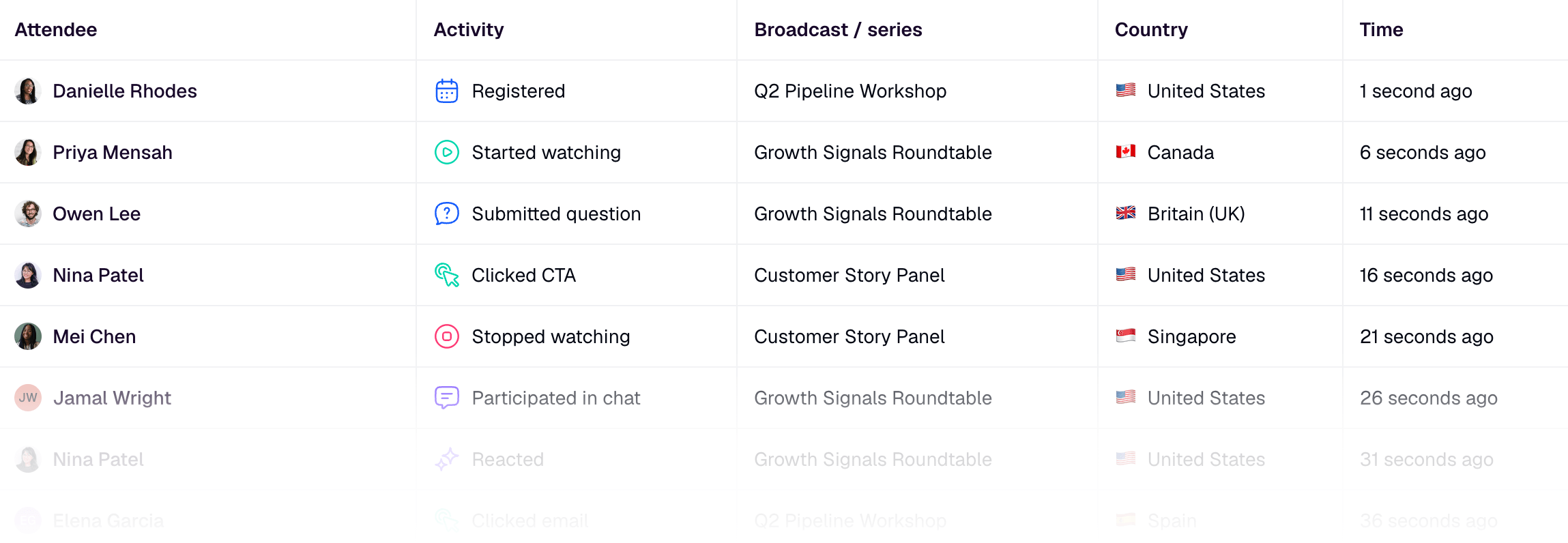
The difference is that a focused webinar can create a richer set of lead-quality signals in one place. Someone chooses a topic, registers with context, spends time with the material, asks questions, clicks a CTA, returns to the replay, or responds to follow-up. Those behaviors do not prove buyer intent on their own, but they give the team more to work with than a form fill or anonymous page view.
| Channel | What it can show | Where lead quality gets noisy |
|---|---|---|
| Focused webinars | Topic interest, role fit, attendance, watch behavior, questions, CTA clicks, replay engagement, and follow-up readiness. | Quality depends on topic specificity, audience fit, and whether follow-up uses the signals responsibly. |
| Paid search or social ads | Keyword or audience interest and fast response to a specific offer. | Click intent can be shallow, and the team may not know whether the person understood the problem deeply. |
| Cold outbound | Account targeting, message-market fit, and direct interest from named prospects. | Replies can reflect timing or curiosity more than active problem fit. |
| Trade shows and field events | In-person interest, relationship strength, and account-level context. | Badge scans and booth conversations can be hard to compare without strong notes and follow-up discipline. |
| Content syndication | Reach into a defined audience and interest in a topic or asset. | Lead lists can be broad, and the original motivation for downloading may be unclear. |
| Ungated content | Education, trust, search demand, and repeat engagement. | Most behavior is anonymous unless the reader later takes a trackable next step. |
Content syndication can also be structured around deeper qualification rather than just simple gated asset downloads. LeadSpot's B2B Content Syndication programs combine targeted content distribution with custom qualifying questions, CAPTCHA, GEO IP confirmation, and human verification to help B2B teams expand reach while maintaining tighter control over lead quality.
The useful question is not whether webinars always beat other channels. It is whether the webinar creates signals your team can act on: who cared, what problem brought them in, what they did during or after the session, and what follow-up would be genuinely useful.
Start with the real goal of webinar lead generation
Webinar lead generation should not mean collecting as many registrants as possible. A registration is only useful if it gives the team a responsible reason to continue the conversation.
For B2B teams, useful leads usually come from a mix of fit and behavior. The person belongs to a relevant company or role, came for a problem the business can actually help with, engaged with the session in a meaningful way, and took or implied a next step that can be followed up without guessing.
That matters because B2B marketers are not only trying to create content. They are trying to create content that prompts action and can be measured. The Content Marketing Institute's B2B content marketing research frames both action and measurement as recurring challenges for B2B content teams, which is exactly why a webinar should be judged by more than the size of the signup list.
A focused webinar helps because it asks a more specific audience to show up for a more specific reason. That specificity makes the signals after registration more useful.
Why broad webinar topics create noisy signals
Broad topics can be good for reach. They are often easier to promote because they touch a larger problem space: growth strategy, marketing trends, sales alignment, buyer behavior, event planning, or digital engagement.
The tradeoff is signal quality.
A broad webinar can attract people with very different jobs, maturity levels, and reasons for attending. Some are exploring the category. Some want tactical help. Some are curious but not responsible for the workflow. Some are vendors, students, partners, or people who like the speaker but are not a fit for the offer.
That audience mix creates practical problems:
- The registration list looks promising, but audience fit is uneven.
- Q&A is scattered across too many subtopics.
- Polls produce interesting but hard-to-act-on answers.
- The CTA feels either too generic or too aggressive.
- Follow-up has to be broad because the team does not know which problem mattered most.
This is why broad webinars often produce a familiar tension: the team had an audience, but not enough clarity.
Broad sessions still have a place. They can work well for awareness, community education, product-category framing, and thought leadership. They become weaker when the team expects them to produce precise follow-up without designing for that precision.
What a focused webinar topic does better
A focused webinar narrows at least one of four things: the audience, the problem, the workflow moment, or the next step.
Instead of "How to improve webinar performance," a focused topic might be "How product marketing teams can turn demo webinar questions into follow-up segments." Instead of "B2B webinar strategy," it might be "How to choose CTAs for a replay audience after a product launch webinar."
That narrower promise improves the quality of the signals the team can capture.
The registration page can ask fewer but more relevant questions. The live Q&A is more likely to surface specific objections or use cases. CTA clicks become easier to interpret because the offer is tied to the session's problem. Replay behavior matters more because the viewer returned for a defined topic, not a generic recording. Follow-up can reference the actual challenge the audience came to solve.
That is the core point: focused webinars create clearer audience signals.
They do not guarantee pipeline. They do not prove purchase intent on their own. But they can make it easier to understand who engaged, why they engaged, and what should happen next.
How to choose a focused webinar topic without making it too small
The risk with focus is going too narrow. A topic can become so specific that it is hard to promote, hard to position, or only relevant to a handful of accounts.
The better approach is to focus around a useful buying or workflow signal.
Start with one audience segment. That might be demand gen teams, product marketers, customer marketers, RevOps-influenced marketing teams, or founders running early webinar programs.
Then pick one business problem. Do they need more qualified registrations? Better attendance? Clearer demo follow-up? More useful replay engagement? A way to connect webinar questions to sales conversations?
Then choose one workflow moment. Registration, attendance, engagement, CTA behavior, replay, follow-up, or analytics. This keeps the article, session, and CTA from trying to solve every problem at once.
Finally, define one next step. Should the viewer book a demo, download a checklist, watch a replay, join the next session, talk to sales, start a trial, or simply understand the category better?
A focused webinar topic should be narrow enough that the right person immediately recognizes the problem, but broad enough that a real audience still exists.
Match topic specificity to buyer stage
Not every webinar should be narrow in the same way. The right level of specificity depends on buyer stage.
For awareness, focus on a sharper problem or category tension. For example: "Why webinar attendance alone does not explain buyer interest." The audience may not be ready to evaluate software, but the topic gives them a clearer way to think.
For consideration, focus on workflow or platform-evaluation problems. For example: "How to compare webinar platforms when follow-up data matters." The audience is closer to a tools or process decision, so the topic can be more practical.
For decision, focus on use cases, integrations, proof, or implementation concerns. For example: "How to send webinar engagement data to HubSpot without cluttering CRM." The audience is likely evaluating fit and operational details.
For implementation, focus on checklists, playbooks, or repeatable workflows. For example: "A webinar CTA checklist for live and replay audiences." This helps teams improve execution after they already believe in the channel.
The more specific the buyer stage, the easier it becomes to choose the right CTA and the right follow-up path.
Measure lead quality by behavior, not only attendance
Attendance is useful, but it is not the same as lead quality. A person can attend live and remain low-fit. Another person can miss the session, watch the replay, click a relevant CTA, and become a better follow-up candidate.
The strongest webinar programs look at behavior in context:
- Did the registrant match the intended audience?
- Did they attend live, watch the replay, or both?
- How much of the session did they watch?
- Did they ask a question or answer a poll?
- Did they click a CTA that matched the session topic?
- Did they return to the replay or share it internally?
- Did they respond to follow-up or move into a useful segment?
This is where webinar benchmarks can help, as long as they are treated carefully. The Goldcast B2B webinar benchmark report shows registration and attendance data across a large set of B2B webinar programs, which reinforces the point that teams should track behavior by program and context rather than relying on one universal number.
For HeyStream users, this is where audience intelligence becomes useful. Viewer-level behavior gives the team more context than a raw attendance count. The team can also use webinar analytics to understand which topics, CTAs, and replay moments are producing meaningful engagement.
Build follow-up around the topic signal
Focused topics make follow-up easier because the topic itself tells the team something about the viewer's likely problem.
If someone registers for a broad session about "webinar strategy," follow-up has to start from a wide set of possibilities. If they register for a session about "turning replay viewers into follow-up segments," the team has a much clearer starting point.
That does not mean every registrant should get a sales email. It means follow-up can be more responsible:
- Attendees can receive the session recap and the most relevant next step.
- No-shows can receive the replay framed around the specific problem they registered for.
- Replay viewers can be nudged toward the section or CTA that matches their behavior.
- CTA clickers can receive a more direct offer or product workflow.
- Question askers can get a response that reflects the topic they cared about.
The same logic applies to behavior-based follow-up. The narrower the topic, the easier it is to connect behavior to a next message without over-personalizing or overclaiming intent.
If the team is seeing registrations but weak movement afterward, the issue may be the handoff rather than the topic alone. The companion guide on why webinar registrants do not convert breaks down those handoffs across attendance, engagement, CTAs, replay, and follow-up.
Use a simple focused-topic scorecard
Before choosing the next webinar topic, score it against the signals it should create.
| Question | What to Check |
|---|---|
| Audience segment | Which role, team, or company type should recognize this topic immediately? |
| Problem specificity | Is the problem concrete enough to shape examples, questions, and follow-up? |
| Buyer stage | Is the topic awareness, consideration, decision, or implementation? |
| Evidence source | Did the idea come from sales calls, customer questions, product usage, prior Q&A, search data, or content performance? |
| Likely signal | What behavior would tell the team the topic resonated? |
| CTA fit | What next step would feel natural during or after the session? |
| Follow-up path | How should attendees, no-shows, replay viewers, and CTA clickers be treated differently? |
| Risk if too broad | What would become harder to interpret if the title were made more general? |
This scorecard keeps the planning conversation grounded. It stops the team from choosing topics only by projected registration volume or internal enthusiasm.
It also helps recurring programs improve over time. A focused webinar series can test adjacent topics, compare engagement patterns, and learn which audience problems create the clearest next-step behavior. That is why focused topics fit naturally into a recurring webinar strategy and the broader B2B webinar growth engine.
Where HeyStream fits
HeyStream is built for B2B teams that want live sessions to produce more than attendance numbers.
With a B2B webinar platform that connects branded registration, watch pages, live and replay CTAs, audience signals, analytics, and follow-up, teams can see how a focused topic performs across the full workflow.
That does not remove the need to choose good topics. It makes the learning loop cleaner. When the topic is specific and the behavior is visible, the team can understand which audiences engaged, which CTAs matched the moment, which replay viewers returned, and which follow-up paths deserve attention.
Focused webinars work best when they help the team learn, not just promote. The goal is not to make every session narrower. The goal is to choose topics that make the audience, the signal, and the next step easier to understand.