If you have no first-party evidence yet, Tuesday in your primary audience's late morning or early afternoon is a reasonable starting hypothesis for a B2B webinar. It is not a universal best time. Current platform benchmarks disagree, and the right slot depends on where your audience works, what the session needs to achieve, and which result you care about.
That distinction matters. The day with the highest attendance rate may attract fewer total registrants. The most popular start time may simply be when the most webinar teams schedule, not proof that the hour caused stronger performance.
This guide gives you a defensible starting point, then a framework for improving it with your own results.
The quick scheduling recommendation
Start with these rules when you do not yet have comparable event data:
- Choose the primary live audience first. Schedule for the region that matters most, rather than trying to make one hour equally convenient across the world.
- Test Tuesday late morning or early afternoon in that audience's local time as an initial hypothesis.
- For a North America and Europe audience, look for a workable overlap, but do not sacrifice both regions to an awkward compromise.
- For a genuinely global audience, plan regional sessions, a repeated or pre-recorded delivery, or prompt replay access.
- Judge the slot against the event's job. A thought-leadership webinar built for reach needs a different success measure from a customer workshop built for live participation.
The recommendation is deliberately conditional. Benchmarks help you choose where to begin. They cannot tell you which slot will work for your specific audience, topic, speakers, promotion plan, and format.
Why "best" can mean five different things
Before choosing a day, decide what you are trying to improve. These measures answer different questions:
- Scheduling popularity is the share of webinars hosted in a particular slot. It tells you what other teams commonly do.
- Registration volume is how many people sign up. It reflects reach and demand as well as timing.
- Attendance rate is the share of registrants who attend live. It is useful, but it can rise when a smaller and more committed audience registers.
- Total attendees is the number of people who show up. A lower attendance rate applied to a much larger registration pool can still produce a bigger live audience.
- Watch time, replay use, and CTA response describe what people did after arriving. They help you judge whether the session held attention and created useful next actions.
Imagine that one event gets 100 registrants and 50 live attendees, while another gets 400 registrants and 160 live attendees. The first has the higher attendance rate at 50%. The second has more than three times as many live attendees despite a 40% rate. Neither result is automatically "better" until you name the event's job.
For a consistent formula and the boundary between live and replay measurement, use HeyStream's webinar attendance rate guide.
What the latest webinar benchmarks show
Two large 2025 platform datasets reach different conclusions about webinar timing. That is useful evidence, not a problem to hide.
| Source | Dataset | What it reports about timing | Important caveat |
|---|---|---|---|
| Goldcast | 26,190 webinars from 522 B2B organizations in 2025 | Wednesday and Thursday were the most popular days. Monday had the highest attendance rate, Thursday had the most average registrants, and Tuesday offered a middle ground. Noon ET was the most common start hour. | The data reflects Goldcast customers. Day and industry cuts are observational, and some slot-level samples are smaller. |
| Livestorm | 33,786 sessions from 3,199 organizations and more than 7 million registrations in 2025 | Tuesday narrowly led Monday and Wednesday on show-up rate. Its recommended times were 11 a.m. and 2 p.m. ET. | Livestorm used its own customer mix, filters, event definitions, and show-up calculation. Its figures should not be blended with Goldcast's. |
The Goldcast 2026 B2B Webinar Benchmark Report shows the clearest split between popularity, reach, and rate. Wednesday hosted 30.53% of webinars and Thursday 30.03%, while Tuesday accounted for 24.42%. Yet Monday led attendance rate at 47.2% with 106 average registrants. Thursday had the lowest weekday attendance rate at 38.7% but the highest average registrant count at 486. Goldcast notes that a small number of very large recurring events influenced Thursday's average.
The Livestorm 2026 Webinar Benchmark Report reaches a different result from its separate dataset. Tuesday produced a 51.7% show-up rate, while Monday reached 51.5% and Wednesday 51%. Livestorm recommends 11 a.m. or 2 p.m. ET as starting times.
Do not average those percentages. The platforms serve different customers and apply different inclusion rules. Their data also cannot isolate timing from topic, promotion, speaker reach, audience source, event format, or recurrence.
Use the same discipline described in HeyStream's webinar benchmark methodology: compare definitions, samples, and measured outcomes before treating a headline number as a target.
The responsible conclusion is narrower than "Tuesday wins." Tuesday late morning or early afternoon is a sensible starting hypothesis because it performs reasonably across both reports without relying on the most extreme result. Your own comparable program data should decide whether to keep it.
Choose the metric before the calendar slot
The event's job should determine which measure leads the decision.
For a new-audience webinar, prioritize qualified registration volume and total live reach. A high attendance rate from a tiny registration pool may not help if the program exists to create demand.
For a live workshop, customer session, or discussion, prioritize live attendance, watch time, and meaningful participation. A slightly smaller audience can be the right outcome when the session depends on interaction.
For a product demo, examine both attendance and next action. Watch time and CTA response can show whether the session helped people evaluate the product, but they do not prove that the hour caused the result.
For a global campaign, treat access as a design constraint. Regional sessions or live-plus-replay delivery may matter more than maximizing one aggregate live rate.
If you are still building demand, do not let schedule optimization distract from reach. Your topic, speakers, distribution, registration experience, and webinar promotion plan can have as much influence on registrations as the calendar slot.
A scheduling framework for B2B teams
Use this five-part decision before placing the event on the calendar.
1. Name the primary live audience
Start with actual audience geography, not your internal team's location. Use registration history, CRM geography, customer concentration, campaign targeting, or the intended account list.
If one region clearly matters most, optimize the live slot for that region. If two regions matter, identify a workable overlap. If three major regions matter equally, a single live time is probably the wrong delivery design.
2. Define the event job
Write one sentence that completes this prompt: "This webinar exists to help us..."
The answer might be to create qualified reach, educate current customers, demonstrate a workflow, convene senior buyers, or build a repeatable thought-leadership series. That job determines which scheduling compromises are acceptable and which metric should lead the review.
3. List real constraints
Check:
- audience working patterns and local holidays
- speaker and moderator availability
- major industry events or competing launches
- promotion runway and reminder cadence
- session length and format
- daylight-saving transitions on the event date
- whether a second session or replay is operationally realistic
Timing and duration are separate choices that interact. Use the webinar length framework when the audience's available window may affect the session format.
4. Choose a primary window and a fallback
Do not create a false sense of precision. "Tuesday or Wednesday, late morning" is often a more useful initial choice than "Tuesday at exactly 11:00."
Pick a fallback that changes the most relevant assumption. If you want to learn about time of day, keep the weekday stable. If you want to learn about weekday behavior, keep the start hour stable.
5. Decide how people outside the live window will take part
A replay gives people another way to attend. It does not prove that the live slot did not matter. Decide when it will be available, how registrants will receive it, and whether questions or CTA opportunities remain available after the live session.
For high-value regional audiences, a second live run may be better than forcing one global compromise.
A practical decision matrix
Use this as a starting point, then adapt it to your audience evidence.
| Audience or event job | Starting window | Fallback design | Measure first |
|---|---|---|---|
| One primary business region | Tuesday late morning or early afternoon locally | Same weekday, alternate time window | Qualified registrations and live attendees |
| North America plus Europe | A carefully checked overlap on the event date | Two regional runs or live plus prompt replay | Results by region, not only the aggregate |
| Europe plus APAC | Optimize for the larger or more valuable live region | Separate regional session | Live reach and watch time by region |
| Global campaign | Do not force one universal slot | Regional runs, repeated delivery, or live plus replay | Total qualified reach across delivery modes |
| Recurring thought-leadership series | Keep a stable window for several sessions | Alternate one preselected slot across comparable episodes | Registration volume, attendance rate, watch time |
| Product demo | Fit the buying audience's working day | Offer another session for priority accounts | Attendance, watch time, CTA response |
| Customer education | Use customer geography and support patterns | Record a reusable session and retain questions | Completion, participation, repeat use |
| Senior-executive audience | Respect tighter calendars and shorter formats | Offer a concise alternative or targeted follow-up | Qualified attendance and meaningful next steps |
Do not copy the matrix without checking the actual event date. Daylight-saving changes occur on different dates across regions, so a familiar overlap can move by an hour.
Time-zone rules that prevent avoidable mistakes
A time-zone plan should make the attendee's decision easy.
- Choose the event date before converting times.
- Use a reliable converter for that date, especially near daylight-saving changes.
- Display local time wherever the registration experience supports it.
- Include the time zone in confirmation messages, calendar entries, and reminders.
- Avoid abbreviations that can be ambiguous across regions.
- Review the calendar invitation on both desktop and mobile.
- If APAC, Europe, and the Americas all matter, use multiple delivery options instead of asking one region to attend at an unreasonable hour.
A registration page should not make people calculate whether "2 p.m." means their time or yours. If you discuss the signup experience as part of your program, HeyStream's webinar registration pages provide the relevant product context.
How to improve timing with first-party data
Do not call two unrelated sessions an A/B test. Different topics, speakers, promotion windows, audience sources, and formats create too many confounding factors.
A more responsible learning loop looks like this:
- Choose two plausible windows before the series starts.
- Run several comparable sessions, alternating the windows where practical.
- Keep topic type, format, promotion runway, reminder cadence, audience source, and speaker profile as consistent as the real program allows.
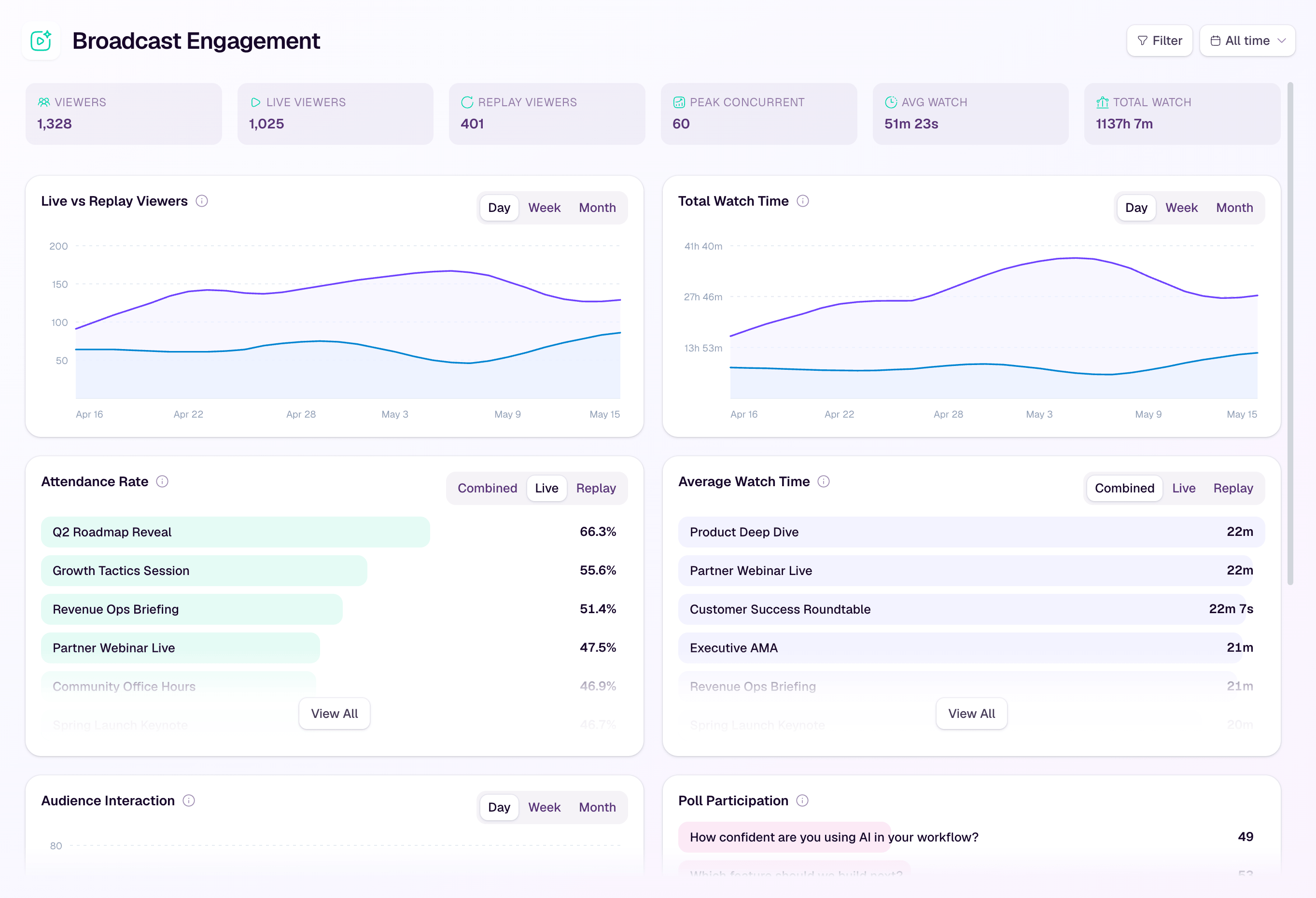
- Review registration volume, registration-to-live attendance, total or median watch time where available, replay share, and CTA response separately.
- Segment by audience region. An aggregate winner can hide a poor experience for an important market.
- Record context, including holidays, competing events, unusual speakers, paid promotion, and major list changes.
- Keep, change, or retest the slot only when the pattern is useful across several comparable sessions.
A webinar series planner makes this easier because cadence, ownership, and review criteria are visible before individual episodes go live.
HeyStream can support the measurement side of this loop with branded registration and watch experiences, replay, and webinar analytics for registration trends, watch time, and CTA performance. It does not automatically select the best time or isolate timing as a causal effect.
Common scheduling mistakes
Copying one benchmark as a rule
A benchmark is descriptive evidence from one platform population. It is not a promise about your audience. Keep the source, sample, date, and measured outcome attached to the recommendation.
Optimizing rate while ignoring reach
A high attendance rate can look impressive while total registrations and attendees remain low. Review rate and volume together.
Choosing for the internal team
The easiest slot for speakers and operators can be inconvenient for the audience. Start with the buyer or customer region, then work back to operational constraints.
Changing everything at once
If the topic, speaker, format, promotion, audience source, and time all change, the result will not tell you much about the calendar slot.
Forgetting daylight-saving transitions
A recurring event can silently shift relative to another region. Recheck conversions for every event date rather than copying the previous calendar entry.
Ignoring replay and late registrants
Live attendance is only one part of the program. Decide how replay viewers will access the content, what they can do next, and how you will measure them separately.
Copyable webinar scheduling checklist
Before publishing the event:
- The primary live audience region is defined.
- The event job and leading success measure are named.
- Benchmark evidence is being used as a starting point, not a guarantee.
- Holidays, industry events, and daylight-saving changes are checked.
- Speaker, moderator, and operator constraints are confirmed.
- The event duration fits the chosen window.
- Local-time display, confirmation messages, calendar details, and reminders are checked.
- A replay, second-session, or regional-delivery decision is documented.
- The primary window and fallback are recorded.
- The review metrics and review date are set.
Make timing part of a repeatable program
The best webinar time is not a magic hour hidden in a benchmark report. It is a defensible starting choice followed by consistent delivery, separate measurement of reach and attendance, and cautious learning across comparable sessions.
Begin with the audience region and event job. Use Tuesday late morning or early afternoon as a starting hypothesis when you have no better evidence. Then test the assumption inside a repeatable B2B webinar growth engine that connects promotion, registration, live delivery, replay, follow-up, analytics, and the next decision.