A useful webinar attendance benchmark is about 40% of registrants attending live. That is a directional starting point, not a target every B2B webinar should hit. Audience source, topic, format, timing, and the value of showing up live can all move the number.
The better question is not simply, “Did we beat 40%?” It is, “Did the right people attend, engage, watch the replay, and take a useful next step?” This guide shows you how to calculate attendance, compare it responsibly, diagnose a weak result, and decide what to change next.
Quick answer: the B2B attendance benchmark to use
Two current platform datasets point to roughly 40% live attendance:
- Wistia's 2026 webinar benchmark analysis, which combines a survey of more than 900 professionals with Wistia-hosted event data, says about 40% of registrants attended live in 2025.
- Goldcast's 2026 B2B Webinar Benchmark Report reports a 40% attendance rate across 26,190 webinars hosted by 522 B2B organizations during 2025.
Those findings make 40% a sensible reference point for a B2B team. They do not make it a universal standard. Both figures come from vendor platform data, and the underlying customers, webinar types, audience sources, and metric definitions can differ.
Use the benchmark to start a diagnosis, not to pass or fail a webinar. A 32% attendance rate from a tightly targeted account list may be more valuable than a 55% rate from broad, low-intent promotion. A lower live rate may also hide a strong replay audience.
How the benchmark sources differ
Do not average vendor benchmarks into a more precise-looking number. Preserve the context behind each one.
| Source | Evidence period and sample | Attendance finding | How to use it |
|---|---|---|---|
| Wistia | 2025 Wistia-hosted webinar data, alongside a survey of 900+ professionals | About 40% attended live | Directional platform benchmark; compare with your own trendline |
| Goldcast | 26,190 webinars from 522 B2B organizations in 2025 | 40% attendance | B2B-specific platform benchmark; use as a market reference, not a prescription |
That last distinction matters. A benchmark can tell you that a result is unusual enough to investigate. It cannot tell you why the result happened or whether the webinar created business value.
How to calculate webinar attendance rate
The standard webinar attendance rate is:
Live attendance rate = unique live attendees ÷ total registrants × 100
If 300 people register and 126 attend live:
126 ÷ 300 × 100 = 42%
Use unique people, not total joins. Someone who disconnects and returns should still count as one attendee.
Keep the denominator consistent too. If your registration total includes internal staff, speakers, test contacts, duplicates, or cancelled registrations, clean those records before comparing one webinar with another.
Separate live attendance from total reach
Replay viewers should not be added to the live attendance rate. Track them as a separate measure:
Total reached rate = unique registrants who watched live or replay ÷ total registrants × 100
Deduplicate people who watched both. Otherwise, the same person appears twice and makes the total look stronger than it is.
This gives you two useful answers:
- Live attendance rate shows how effectively registration intent became live participation.
- Total reached rate shows how much of the registered audience consumed the session across live and on-demand viewing.
You can then add downstream measures such as meaningful watch time, CTA clicks, questions, replay completion, or follow-up response. Keep each metric separate enough that the team can see where the handoff improved or failed.
Why webinar attendance rates vary
An attendance rate is the result of several decisions made before the event. A single percentage compresses all of them.
Audience source and fit
A partner's customer list, a targeted account campaign, an existing community, and a broad paid-social audience can produce very different registration behavior. More registrants do not automatically mean more qualified attendees.
Break attendance down by source before changing the webinar itself. If one campaign creates many registrations but few live attendees, the promise or targeting may be too broad. If a smaller source produces strong attendance and useful questions, it may deserve more attention next time.
Topic specificity
Specific topics create a clearer reason to attend. “How to structure a monthly customer webinar series” sets a more concrete expectation than “The future of B2B engagement.”
A broad topic can still work when the speaker or brand carries enough authority. But for most teams, a narrow promise makes it easier for a registrant to decide that the live session deserves a calendar slot.
Buying stage
An early-stage educational webinar may attract curious registrants who are happy to watch later. A product evaluation, implementation workshop, or customer session can create stronger live urgency because attendees expect answers that affect a current decision.
Do not compare these formats as if they have the same job.
The live-only value
If the recording will be available and the live session adds nothing extra, some registrants will rationally choose the replay.
Live value can come from Q&A, a working session, a product demonstration, a peer discussion, a decision clinic, or access to speakers. The point is not to hold the recording hostage. It is to make attendance worthwhile now while preserving replay value for people who genuinely cannot attend.
Calendar and reminder friction
People register with good intentions, then priorities move. Confirmation details get buried. Time zones are misread. Calendar events do not appear. Reminder emails repeat the title without reminding people what they will get.
Make the practical path easy: accurate calendar details, a clear joining link, a short reminder cadence, and a final message that restates the live value. Our webinar reminder email templates provide a starting structure without pretending one cadence guarantees a particular lift.
Recurring versus one-off programs
A recognizable webinar series can build a habit. The audience learns the format, trusts the value, and knows what happens after registration. A one-off event must earn that confidence from scratch.
Compare recurring webinars with earlier sessions in the same series before comparing them with unrelated market benchmarks.
What a low attendance rate is telling you
Low attendance is a signal, not a diagnosis. Look at the pattern around it.
| Pattern | Likely questions | Useful next action |
|---|---|---|
| High registrations, low live attendance, low replay | Was the promise too broad or the promotion aimed at low-fit people? | Compare attendance by source and tighten the topic or targeting |
| High registrations, low live attendance, strong replay | Did the audience prefer on-demand viewing, or was the time inconvenient? | Preserve replay follow-up and test live timing or live-only value |
| Modest registrations, strong live attendance | Did a narrow, relevant topic attract the right people? | Protect the topic quality and improve distribution rather than broadening it |
| Strong live attendance, weak watch time | Did the opening deliver on the registration promise? | Review the first ten minutes, pacing, and section order |
| Strong attendance and watch time, weak action | Was the CTA relevant, clear, and timed to the audience's needs? | Improve the next step rather than chasing more attendees |
This is why a post-event review needs more than one headline figure. If the team only sees “31% attendance,” it may change the wrong thing.
For a structured readout, use the webinar performance report template. If registrations are healthy but the path from signup to attendance and action is weak, the guide to why webinar registrants are not converting helps examine the handoffs.
What to measure alongside attendance
Attendance becomes useful when it sits beside measures that explain audience quality and next-step behavior.
Registration quality
Look at role, company fit, source, campaign, and the answers to any qualifying registration questions. Avoid collecting fields the team will never use, but capture enough context to distinguish the intended audience from broad interest.
Clear webinar registration pages can also set expectations before someone signs up: who the session is for, what it covers, what happens live, and what the attendee should be able to do afterward.
Attendance by source
Calculate attendance for each meaningful source or campaign. This tells you whether a low overall rate came from the webinar experience or from one part of the promotion mix.
Watch time and drop-off
Attendance says someone arrived. Watch time helps show whether the session held their attention. Review the moments where viewers leave, but do not assume every exit reflects poor content. People join late, switch devices, and leave for reasons you cannot observe.
Use webinar analytics to look for patterns across sessions rather than overreacting to one attendee or one event.
Replay recovery
Track how many no-shows later watch, when they watch, and whether they reach the sections that matter. Replay viewing should extend the measurement window, not be blended invisibly into live attendance.
Different groups also need different next steps. A live attendee, a no-show, and a replay viewer have not had the same experience. Webinar follow-up automation can help keep those paths distinct.
Engagement and CTA activity
Questions, polls, chat, and CTA clicks can add context, but no single action proves buying intent. Use audience intelligence to understand a person's activity in context, then let the next interaction confirm what it means.
Attendance is not ROI either. If you need a broader view of registration, engagement, replay, action, and follow-up, the webinar ROI scorecard provides a more complete diagnostic.
How to improve attendance without attracting worse-fit registrants
The goal is not the largest possible percentage. It is more of the right audience choosing to attend, with a useful path for everyone else.
Tighten the promise
Make the title and description specific enough that the right person can self-select. Explain the problem, audience, format, and outcome. Remove language that makes the event sound relevant to everyone.
Give people a reason to attend live
Name the live elements in advance: Q&A, teardown, working session, peer examples, decision framework, or product walkthrough. Do not rely on vague claims about interaction.
Segment reminders
Use source, role, topic interest, or prior behavior when it meaningfully changes the message. A partner audience may need context about your company. An existing customer may need the advanced use case. A repeat attendee may need only the new angle.
Promote closer to the decision
Long promotion windows can generate early registrations that lose urgency. Test a mix of early awareness and closer-to-event promotion, then compare attendance by registration date. Treat the result as your own learning rather than a universal rule.
Make replay part of the plan
Decide before the live session how no-shows and attendees will receive the recording, what CTA will remain relevant, and what behavior will trigger follow-up. A no-show is not a failed lead by default; it is a person who has not consumed the session live.
Build your own benchmark
Wistia's guide to webinar metrics describes industry benchmarks as a starting point and says the real value comes from comparison with your own data.
Track a consistent set of measures across at least several comparable webinars:
- Live attendance rate
- Total reached rate across live and replay
- Attendance by source
- Meaningful watch time
- CTA activity
- Follow-up engagement
- Qualified next steps
Separate formats where needed. Product demos, thought-leadership panels, workshops, and customer education should not be forced into one baseline if their audiences and goals differ.
Where HeyStream fits
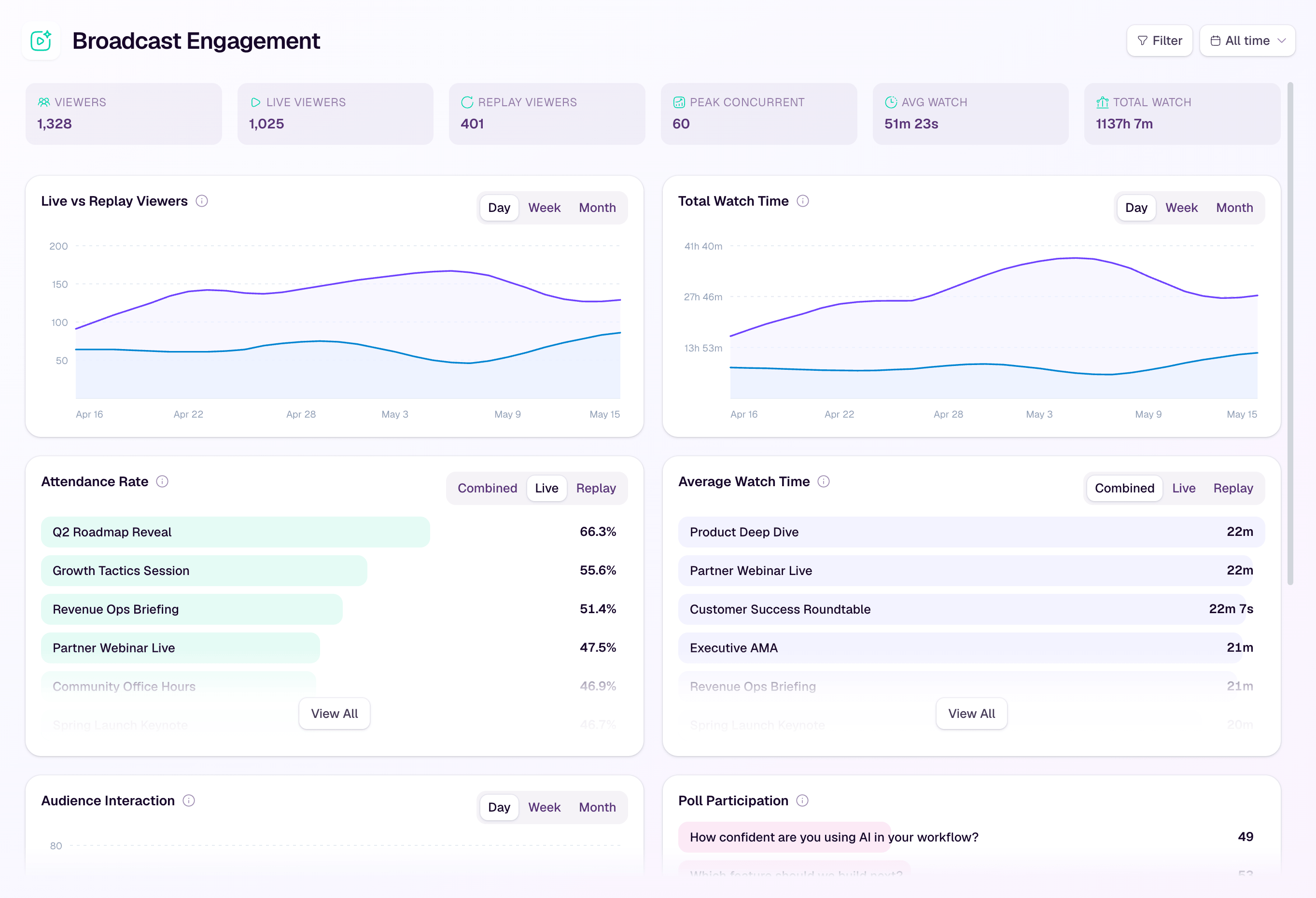
HeyStream keeps branded registration, live and replay viewing, audience records, CTAs, analytics, and follow-up closer together. That makes it easier to move from “What was our attendance rate?” to “Who attended, who watched later, what did they do, and what should happen next?”
The product does not turn attendance into guaranteed intent or revenue. It gives B2B teams a connected record of the webinar journey so they can interpret the signal with more context.
That is the larger B2B webinar growth engine: registration creates an audience, the live and replay experience creates behavior, CTAs create possible next steps, and follow-up turns that context into action and learning.
The benchmark is the start of the review
About 40% live attendance is a useful directional benchmark for B2B webinars, supported by current Wistia and Goldcast platform data. Your own comparable history is more useful.
Calculate live attendance consistently. Track replay separately. Segment by source and format. Then review watch behavior, CTAs, and follow-up before deciding whether the result was healthy.
A good webinar attendance rate is not the number that looks best in a report. It is the number you can explain, learn from, and connect to the next useful audience action.