Choose a webinar programme when your audience needs a visual explanation, scheduled questions or a shared working session. Choose a podcast when recurring conversations fit how that audience already listens or watches. Both can work if you can produce two useful experiences. Neither is a sensible commitment until you have an audience problem, a distribution plan and someone responsible for delivery.
The webinar vs podcast decision starts with the job people need done. It also needs a measurement plan that respects what each channel can show. A podcast play, a webinar registration and a request for a conversation are different actions. Counting them as interchangeable leads makes either programme harder to judge.
Start with the audience job and the next useful action
Write down who the programme is for and what would make an episode worth their time. "Operations leaders comparing approaches to incident reviews" is a more useful starting point than "B2B decision-makers."
Then ask where those people already find material like yours. Do you have an email audience that will join a scheduled discussion? Do customers listen to specialist interviews? Would seeing a workflow change their understanding, or could the explanation work while they are away from a screen?
Use this matrix as editorial guidance for a first choice. It is not a ranking of conversion performance.
| Audience need or constraint | Webinar fit | Podcast fit | Check before committing |
|---|---|---|---|
| Visual explanation | Walk through a process together | Video can support a visual episode | Does the explanation still work without the screen? |
| Scheduled questions | Let participants ask about the topic live | Collect questions for a later episode | Will enough people want to attend at that time? |
| Habitual consumption | Offer replay access after the session | Build a recurring listening or viewing habit | Where does this audience already return for content? |
| Distribution access | Invite through channels you can reach | Distribute through a host and chosen platforms | Who owns promotion beyond publishing? |
| Repeatable production | Plan speakers, live delivery and replay | Plan hosts, editing and episode releases | Can the team sustain the next instalment? |
| Identified next steps | Use registration and relevant optional actions | Offer a separately tracked resource or opt-in | What identifies a person, and what remains aggregate? |
Define the next useful action before choosing software. It might be applying an idea, submitting a question, returning for another episode or explicitly requesting help. If a webinar is the stronger candidate, the guide to webinar goals helps connect that audience job to an observable signal.
A webinar and a podcast can both be video and on demand
A webinar is an online session organised around a topic and an audience. Live delivery can include questions and participation; a replay lets people watch later, with a different experience from being there live. Registration is a design choice, not a requirement of every webinar.
A podcast is an episodic programme people can follow and consume through a hosting and distribution setup. It can be audio or video. Spotify's video podcast offering provides a straightforward example of the latter. What reaches each listening or viewing platform depends on the distribution setup.
That makes "audio versus video" a poor deciding rule. A video interview could become part of either programme. The useful questions are how people access it, whether scheduled participation adds value, how episodes relate to one another and what the team does after release.
An on-demand webinar is not automatically a podcast. Making a recording available does not establish an episodic promise, a listening experience or podcast distribution. Equally, a podcast episode does not have to sacrifice visuals just because its audience can listen.
Once you have chosen webinars, choose a webinar format for the session itself. An interview, workshop and panel serve different audience jobs within the same programme.
Choose the programme your team can produce and distribute
Webinar first
Start here when seeing something and asking questions in the same session materially improve the experience. You also need a credible invitation route and an owner who can coordinate preparation, delivery and follow-up.
Illustrative scenario: a software team has an existing audience of operations managers asking how a new approval workflow fits their process. A live walkthrough with questions is a reasonable pilot. The questions can reveal where the explanation is unclear; they do not prove buying intent.
Budget for rehearsal, moderation, captions or other accessibility needs, and a replay that makes sense to someone arriving later. A successful live session still leaves editing, publishing and distribution decisions. Use the recurring webinar programme guide when the next problem is sustaining delivery across sessions.
Podcast first
Start here when the audience values recurring expert conversations and has a plausible way to discover and revisit them. The subject should support a continuing editorial promise, rather than one announcement stretched into a series.
Illustrative scenario: a specialist consultancy hears customers asking how peers make difficult procurement decisions. Interviews with experienced practitioners could suit an audience that already follows industry conversations. A relevant optional worksheet gives listeners a deliberate next step without turning the show into a sales presentation.
Someone must own guest preparation, recording quality, editing, accessible transcripts or captions as appropriate, show notes and promotion. Publishing to a directory is a distribution step. It is not evidence that your intended buyers will find the show.
Both, with separate finished experiences
A shared recording can support both programmes when each version has a clear audience use. A live conversation might give attendees access to questions, while an edited episode gives later listeners a coherent discussion.
Plan the extra work before promising this. Check permissions, remove references that require an unseen screen, decide how audience contributions will be handled, and assign separate release and measurement responsibilities. If the podcast version is confusing without the webinar, it is not ready simply because an audio file exists.
Neither yet
Hold off when you cannot name the audience problem, reach that audience or assign a production owner. A programme creates repeat obligations before it creates evidence of demand.
A few direct audience conversations or a single useful written explanation may answer the immediate uncertainty. Use what you learn to decide whether a recurring show deserves the commitment. You do not need to launch both formats to discover that the topic lacks a useful promise.
Measure the signals each programme can actually show
Podcast analytics can help you improve a show without producing a person-level lead list. Apple's podcast analytics documentation describes aggregate activity without personally identifiable listener information. Spotify's analytics update describes audience discovery, returning listeners and retention. These are useful observations about consumption, each within its platform's definitions.
An identified interaction is a separate event. A listener might choose a tracked resource and then submit an opt-in form. That gives you information about the form submission. It does not identify everyone who heard the episode or prove that every resource visitor came from it.
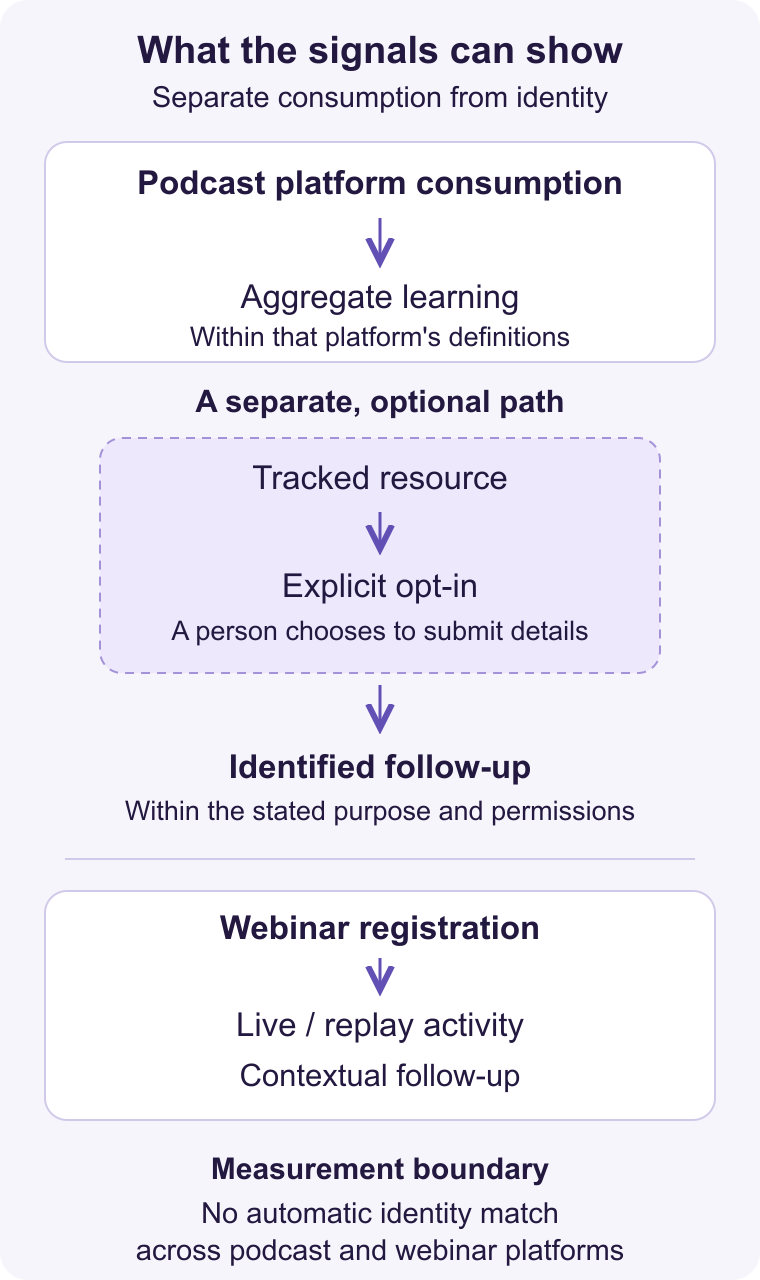
Keep a small measurement ledger so that a useful signal has an owner and a limit.
| Signal and system | What it can tell you | Identity or denominator limit | Useful next action |
|---|---|---|---|
| Podcast consumption and retention in a platform | How content is discovered and consumed there | Platform-specific coverage and definitions; no assumed CRM identity | Review topics, openings and returning-audience patterns |
| Downloads reported by a podcast host, if available | File delivery under that host's definition | A download does not establish complete listening or one unique buyer | Check the host's definition before comparing releases |
| Visits to a tracked resource | Activity at the destination associated with a tagged link | Visits may repeat; shared links and device changes limit attribution | Review whether the resource helps the intended audience |
| Explicit resource or contact opt-in | A person supplied information for a stated purpose | Covers submitters, not all listeners; permission depends on the actual interaction | Fulfil the request and use the stated follow-up process |
| Webinar registrations | Recorded interest in access to that session | Registrants may not attend; registration does not establish purchase intent | Review topic fit, invitations and the attendance path |
| Webinar live or replay attendance | Recorded participation or viewing under the system's rules | Keep live and replay distinct; repeat visits and available identity affect counts | Improve the session or replay using observed behaviour |
| Webinar CTA clicks | Interaction with a specific offered next step | A click is not a completed request or a sales opportunity | Check the destination and what happened after the click |
Attach the source, reporting window and metric definition to each result. Keep missing data unknown. Do not add platform audiences, host downloads and website visits into a supposed count of unique people unless you have a valid basis for deduplication. Different devices, repeated activity and reporting windows complicate comparisons.
The same caution applies to webinars. An email address makes an activity easier to associate with a contact; it does not tell you why they attended. If follow-up involves sales, use a human-reviewed webinar sales handoff with a relevant next action. Follow the organisation's actual consent and outreach policies rather than treating registration or a click as unrestricted permission.
If you reuse a webinar as a podcast, redesign it for listening
Review the recording as if the listener has never seen the session page or slides. "As you can see here" is a warning that context is missing.
Before release:
- Confirm the rights and permissions for guests, audience contributions and reused material.
- Remove private audience details and replace visual-only references with explanations that work in audio.
- Add an opening that explains the topic, participants and what the episode will help someone understand.
- Edit interruptions, waiting time and silent sections that make sense live but slow down a finished episode.
- Review the audio and the accessibility materials appropriate to the release.
- Write show notes with the necessary context and a useful optional next step.
- Publish through an appropriate podcast host and distribution workflow, with a release owner and a separate measurement plan.
The guide to repurpose webinar content covers the wider reuse workflow. The decision here is narrower: will someone get a complete, worthwhile episode from this recording? If the answer is no, choose a different adaptation or leave it as a webinar replay.
Run a small pilot with a decision written in advance
Size the pilot to the uncertainty and the resources you have. One webinar or a short podcast run can be a starting experiment, not an industry benchmark for how quickly either channel should work.
Before production, record:
- The audience and the promise each session or episode makes.
- The production owner and the person responsible for distribution.
- The release budget, including preparation, editing and follow-up effort.
- The useful signals you can observe, with their source and limits.
- A review date and the evidence that would justify continuing, changing or stopping.
For a webinar pilot, you might review whether the right people attended, which questions needed answers and whether the offered resource was useful. For a podcast pilot, you might review consumption within each platform, audience feedback and separately tracked resource requests. Record the team's effort alongside those outcomes.
Avoid judging a new podcast against one webinar's email count. The programmes may serve different jobs and expose different data. Low reach could point to weak distribution, an unclear topic promise or an unsuitable channel. Investigate that boundary before declaring the medium a failure.
For webinar-first teams, HeyStream's webinar analytics bring registration, live and replay viewing, and CTA performance into the review. Use those observations to improve the next session and guide relevant follow-up. This is webinar-side reporting; it does not provide a matched identity for external podcast listeners.
Choose the first programme you can deliver well and learn from honestly. If that is a podcast, commit to its editorial and distribution work. If it is a webinar, make participation and replay useful. Add the second programme only when it earns its own place in the audience's routine.