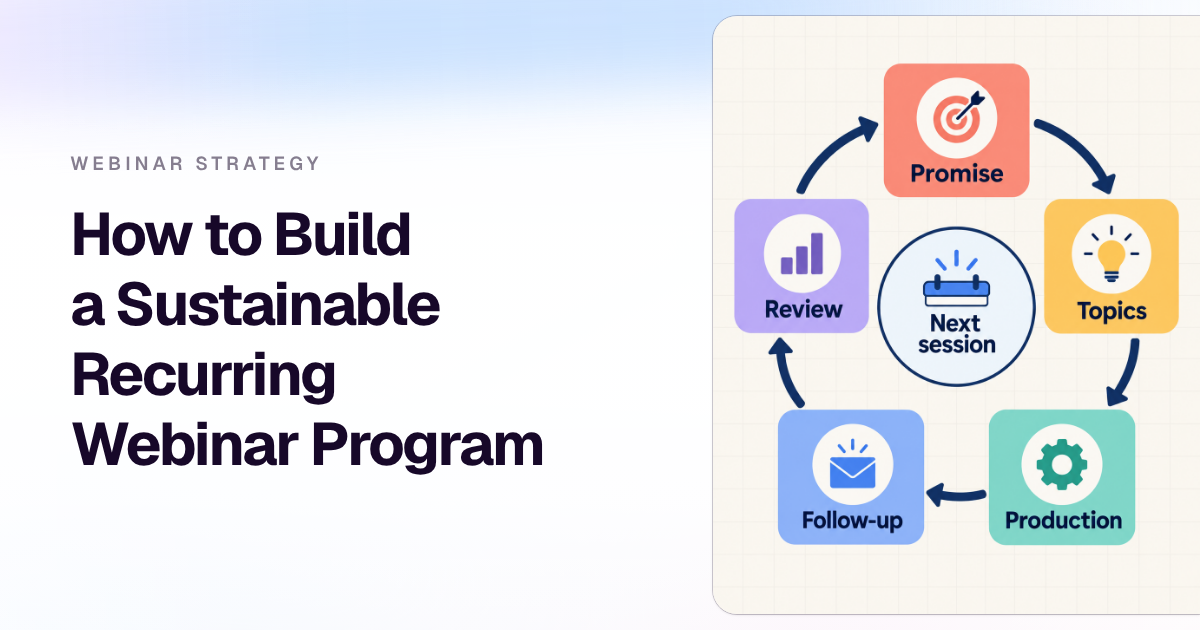
A useful webinar goal names the business change a session should support. It then connects that change to an audience promise, a suitable format, one primary call to action, live and replay signals, a downstream outcome, a follow-up owner, and a review date.
That chain matters because registrations, attendance, watch time, questions, and clicks are evidence. None of them proves buyer intent or business impact on its own. The aim is not to find one magic KPI. It is to decide what the webinar is for, what viewers should get from it, and what evidence will help your team make the next decision.
What makes a useful webinar goal
Start with one primary business goal. It should settle tradeoffs when the topic, format, CTA, promotion plan, and follow-up process compete for attention.
The Content Marketing Institute and MarketingProfs study of 980 B2B marketers found that content was used across awareness, demand generation, nurturing, loyalty, and revenue goals. A webinar cannot serve all of those jobs equally well. Pick the job before you pick the KPI.
Use this sentence to state the plan:
We are running this webinar for [audience] so they can [audience promise], take [primary next step], and help us learn or achieve [business outcome]. We will review [leading signals] and [outcome evidence] by [date], with [owner] responsible for follow-up.
Then build the rest of the plan in this order:
- Name the business change and the review window.
- Choose one audience and write a clear promise for them.
- Select a session format that can deliver that promise.
- Choose one primary CTA that fits the audience's likely readiness.
- Define live and replay signals separately.
- Choose one downstream outcome and the system that records it.
- Name the follow-up owner and expected response window.
- Decide what the team will change after the review.
Secondary learning questions are useful. They can help you understand a topic, format, or audience. They should not compete with the primary goal when the team needs to make a decision.
Keep goals, KPIs, signals, and outcomes separate
Teams often use these terms as if they mean the same thing. They do not. The distinctions keep a useful interaction from being reported as a conversion or a business result.
| Term | What it means | Webinar example |
|---|---|---|
| Business goal | The organizational change the webinar should support | Create qualified conversations with operations leaders |
| Webinar objective | What the audience should understand or be able to do after the session | Diagnose the main cause of a slow reporting workflow |
| KPI | A small set of measures used to judge progress toward the goal | Completed qualified conversations within 14 days |
| Metric | Any value the team can measure | Registrations, attendance, watch time, CTA clicks |
| Target | The expected value and the time window | A provisional number of completed diagnostics within 14 days |
| Signal | An observed action that may guide interpretation or follow-up | A question about implementation or a replay return |
| Outcome | The completed result the business cares about | An accepted sales conversation or verified product action |
A goal is not "200 registrations." That is a target for one metric. It says nothing about whether the right people registered, what the session should help them do, or what your team will do after they attend.
A KPI is also not every number on a dashboard. If every metric is treated as a KPI, the team has a report but no priority. Choose the few measures that tell you whether the plan worked well enough to repeat, change, or stop.
Build the goal-to-signal chain
1. Name the business change and review window
Write the change in business language. Examples include creating qualified market contact, reducing uncertainty for active evaluators, supporting adoption of a workflow, or learning whether a recurring series deserves more investment.
Add a review window at the same time. Live engagement may be available immediately, but downstream outcomes can take days or weeks. Without a date, the team either judges too early or leaves the question open forever.
2. Choose one audience and promise
"Prospects" is too broad. Name the role, situation, and problem. A useful audience might be demand generation leaders building a repeatable webinar program, or customer success teams teaching administrators a new reporting workflow.
The promise describes what the viewer will understand, decide, or complete. It is not your campaign objective. "Learn how to diagnose the three causes of slow webinar follow-up" is an audience promise. "Generate pipeline" is not.
3. Match the format to the promise
The format should make the promised change possible. A detailed workflow may need a workshop or demo. A decision with several valid perspectives may suit a panel or debate. A customer proof point may work best as an interview.
Use the webinar format decision matrix when the goal is clear but the session design is not. The format is a delivery choice, not the goal itself.
4. Choose one primary CTA
The CTA is the audience's next step. It should fit what they know and how ready they are after the session. A diagnostic, checklist, or related session can suit an early-stage audience. A trial, implementation step, or booked walkthrough asks for more commitment.
Keep one action primary. Optional secondary links are fine, but the presenter, page, replay, and follow-up should all make the main next step easy to understand.
5. Separate live and replay signals
Live viewers and replay viewers experience different contexts. Live signals can include attendance, questions, poll responses, watch time, and CTA activity during the session. Replay signals can include return visits, replay watch time, and CTA activity after the event.
Do not blend them into one engagement score if the distinction changes your decision. A replay viewer who watches the product section and clicks a checklist three days later may need a different follow-up from a live viewer who asks an implementation question.
6. Choose the downstream outcome and evidence source
Decide what completed result would matter and where it is recorded. A booked meeting may live in a scheduling tool. A qualified opportunity may live in the CRM. A product action may live in application analytics. Adoption or support outcomes may need a cohort analysis.
The webinar platform can record what happened around the session. It cannot prove a later business result unless the relevant systems and attribution rules connect that evidence.
7. Name the follow-up owner
Someone must own the handoff from signal to action. Name the role, response window, and context they will receive. "Sales will follow up" is weaker than "the account executive reviews named questions and CTA activity within one business day."
This prevents a common measurement failure: the webinar produces useful evidence, but nobody acts on it before the context goes cold.
8. Define the review decision
End the plan with a decision. Examples include repeating the format, changing the audience, revising the CTA, narrowing the topic, improving promotion, or stopping the series.
The review should answer one practical question: what will we do differently because of this evidence?
Match the framework to six common webinar jobs
The same framework works across several B2B use cases, but the promise, CTA, evidence, and interpretation risk should change with the goal.
| Primary business goal | Audience promise | Likely format | Primary CTA | Live signals | Replay signals | Downstream outcome evidence | Follow-up owner | Main interpretation risk |
|---|---|---|---|---|---|---|---|---|
| Brand or category awareness | Understand a market change and its implications | Interview, debate, or expert presentation | Subscribe or explore a related guide | Relevant registrations, attendance, questions, watch time | Replay visits, watch depth, related-content clicks | Branded search, direct traffic, or subscribed audience trend in the chosen review window | Content or demand generation | Reach does not prove changed perception |
| Demand generation | Diagnose a costly problem and identify the next step | Workshop or thought-leadership session | Complete a diagnostic or request a relevant conversation | Audience fit, question themes, watch depth, CTA activity | Replay return, resource click, later CTA activity | Completed qualified conversation or accepted follow-up | Demand generation and sales | Attendance and clicks do not prove pipeline |
| Product education or demo | Understand a workflow and its decision criteria | Live demo or guided workshop | Start a trial, use a checklist, or book a walkthrough | Demo-section watch time, product questions, CTA activity | Replay of key sections, return visit, CTA activity | Trial start, completed meeting, or defined evaluation step | Product marketing and sales | Product interest does not prove purchase intent |
| Product or feature launch | Understand what changed, who it helps, and how to act | Launch presentation with demo and Q&A | Try the feature or read the implementation guide | Target-account attendance, launch questions, feature CTA activity | Replay watch time, feature-page visit, later action | Verified feature use or qualified evaluation step | Product marketing and customer-facing team | Curiosity does not prove adoption |
| Customer education or adoption | Complete a specific task with less uncertainty | Training session or hands-on workshop | Use an implementation checklist or complete the task | Attendance, task questions, watch depth, checklist activity | Replay return, section rewatch, resource activity | Verified product action or change in support demand for the cohort | Customer success or education | Webinar activity may not match product usage |
| Recurring program growth | Build a repeatable audience and learning loop | Consistent series with a stable format | Register for the next session or subscribe | Returning attendees, audience fit, questions, watch time | Replay reach, return frequency, next-session registration | Growth in qualified repeat participation or completed next steps over several sessions | Program owner | More sessions can inflate volume without improving quality |
Do not fill a target column with a percentage borrowed from someone else's report. Use your own comparable sessions, audience, promotion approach, format, and offer whenever possible.
Choose the CTA from the goal
A CTA sits between the audience promise and the downstream result. It is not the business result itself.
Think about commitment:
- Low commitment: read a guide, subscribe, register for a related session, or use a checklist.
- Medium commitment: complete a diagnostic, request a tailored resource, join a workshop, or start a product task.
- High commitment: book a meeting, begin a trial, start an evaluation, or buy.
The right level depends on the audience's readiness and the session promise. A product education webinar for existing customers may use a setup checklist as the primary CTA. A separate link to book a walkthrough can remain available without taking over the session.
Track the steps separately. A CTA impression shows that the offer was displayed. A click shows that the viewer took an action. A completed form, booking, signup, or payment is a completed next step. A qualified opportunity, adopted workflow, retained customer, or revenue result belongs later in the chain.
HeyStream's live and replay CTAs can place the next step inside both viewing contexts and report impressions, clicks, and click-through rate. Those measures help you assess the offer. They do not turn a click into a downstream outcome.
Track signals without pretending they prove intent
Signals are useful because they add context. The problem starts when an observed action is treated as a verdict about the person or the program.
At program level, review registration sources, attendance, live and replay watch time, interaction, CTA impressions, clicks, and completed next steps. HeyStream's webinar analytics keep registration trends, traffic sources, watch time, interaction, and CTA performance together for this review.
At person level, registration responses, attendance history, questions, clicks, and replay visits can help a team choose a more relevant follow-up. Audience intelligence connects those actions to an audience record. The record gives the owner context. It does not prove motive or readiness.
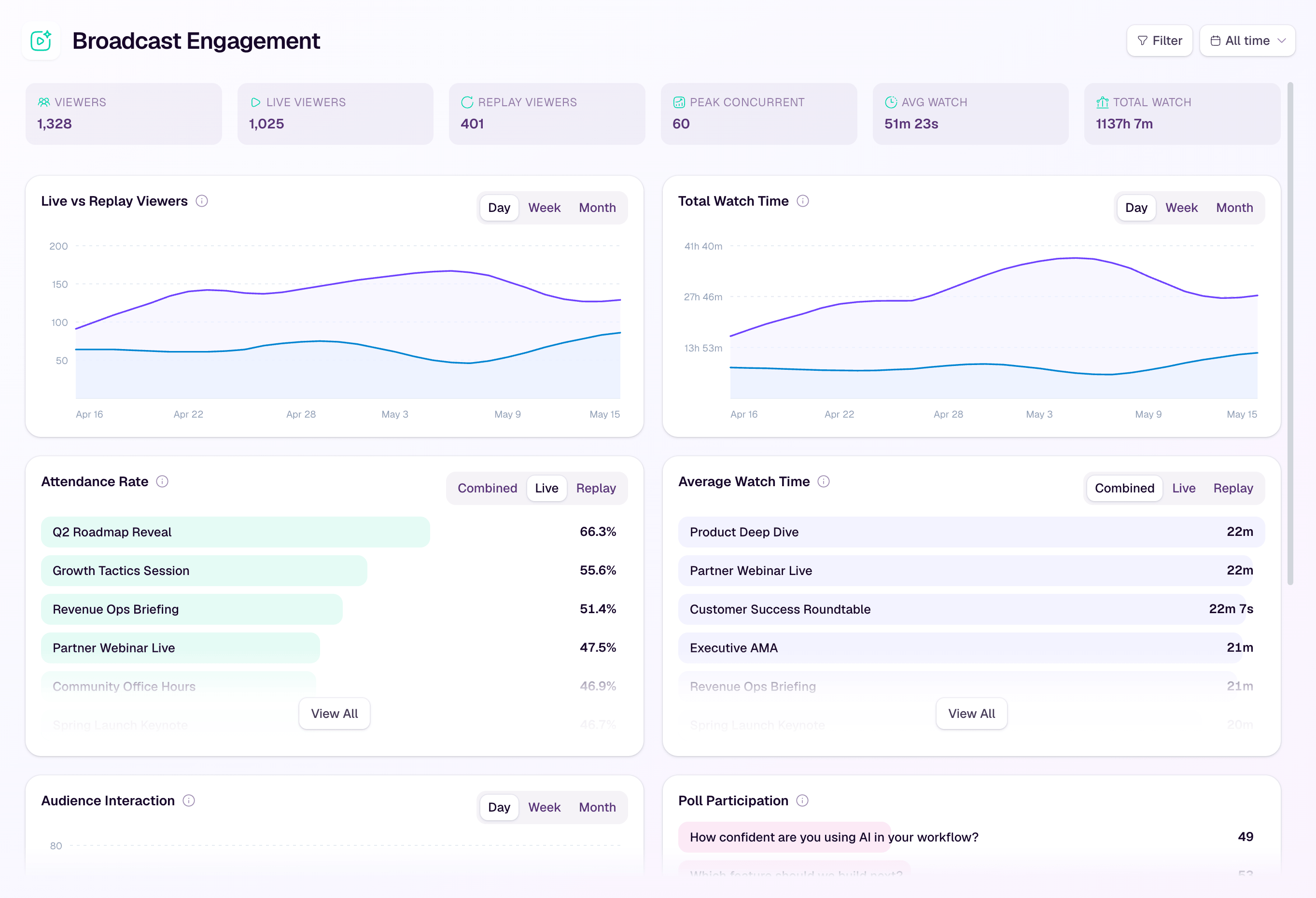
Use this evidence ladder:
- Exposure: invited, visited, or registered.
- Consumption: attended, watched, or returned for replay.
- Interaction: asked, answered, reacted, or clicked.
- Completed next step: downloaded, booked, signed up, started a trial, or completed a task.
- Business result: qualified conversation, product adoption, opportunity, retained customer, or revenue.
Each step needs its own evidence. A person can move down the ladder, skip a step, or stop. Do not infer a later result from an earlier signal.
This distinction also helps with analytics. Google Analytics defines a key event as an event that measures an action important to the business. Marking an event as important improves reporting, but it does not prove that the webinar caused the action. Attribution still depends on the model and the other touchpoints in the journey.
Set a target without a historical baseline
A new webinar program does not need a made-up industry average. It needs a provisional target that produces enough evidence for the next decision.
Start with what the team controls:
- the audience definition
- promotion inputs
- session promise and format
- primary CTA
- follow-up capacity
- review window
- minimum evidence needed to decide what to try next
For recurring sessions, use the median and range from comparable first-party events. Keep the audience, promotion approach, format, and offer similar enough that the comparison means something. Split live and replay data when they behave differently.
The Goldcast 2026 B2B Webinar Benchmark Report covers 26,190 webinars hosted by 522 B2B organizations during 2025. Goldcast describes the figures as a benchmark rather than a prescription. That is the right way to use any platform report: compare its population and definitions with your own program, then use it as context instead of a universal pass line.
| Situation | Best starting point | What to review next |
|---|---|---|
| New program | Capacity, audience fit, and a provisional learning target | Whether the session produced enough evidence to refine the audience, promise, CTA, or follow-up |
| Recurring program | Median and range from comparable first-party sessions | Meaningful movement over several sessions, not one unusually strong or weak event |
| Changed format | Reset the relevant baseline and document the change | Whether the new format delivered the promise and changed viewing or action patterns |
| Changed audience | Treat the new audience as a separate comparison group | Audience fit, questions, watch behavior, CTA response, and downstream outcome |
Reset the baseline when the topic, audience, promotion channel, format, CTA, or follow-up process changes enough to break comparability.
Three worked B2B examples
These examples are illustrative. They show how the chain works without pretending that one target fits every team.
Demand-generation thought-leadership session
The business goal is to create qualified market contact with operations leaders who face an expensive reporting problem. The audience promise is a practical diagnosis they can use before choosing a new process or platform.
The primary CTA is a diagnostic worksheet. Live signals include relevant registrations, watch depth, question themes, and CTA activity. Replay signals include return visits, section-level watch time, and later worksheet clicks.
The demand generation owner reviews completed diagnostics and accepted follow-up within 14 days. A completed qualified conversation is the downstream outcome. Attendance and clicks help prioritize the work, but they do not prove pipeline.
Live product demo
The business goal is to reduce uncertainty for qualified evaluators. The promise is to show the workflow and the criteria they should use when deciding whether it fits.
The primary CTA is a booked walkthrough or trial after the relevant demo moment. Live signals include watch time during the workflow, product questions, and CTA activity. Replay signals include a return to the same section and later CTA activity.
The product marketing and sales owners review completed meetings, trial starts, or a documented evaluation step within the agreed window. Product interest is useful evidence. It is not the same as purchase intent.
Customer education session
The business goal is to support adoption of a specific workflow. The promise is that customers will be able to complete one real task after the session.
The primary CTA is an implementation checklist or the in-product action itself. Live signals include attendance, task questions, and checklist activity. Replay signals include return visits and section rewatching.
Customer success reviews verified product actions for the invited cohort after the implementation window. It may also look for a change in repeated support needs. Those outcomes live outside the webinar platform, so the evidence must be joined carefully.
Run the post-webinar review
Review leading signals soon after the session. Wait for the stated outcome window before judging business results.
Ask:
- Did the intended audience register and attend?
- Did the promise match the questions and viewing behavior?
- Was the primary CTA shown at the right moment?
- What did live viewers and replay viewers do?
- Did the owner follow up within the promised window?
- Which next steps were completed?
- Which business result remains unknown?
- What should change before the next session?
Assign an owner to every unanswered question. Use a post-webinar report template to keep the evidence, interpretation, and actions separate.
After the review, connect the decision to the broader B2B webinar growth engine. One webinar goal sets the direction for a session. The recurring workflow turns those sessions into a system that can learn over time.
Copy the goal-to-signal worksheet
Complete this before promotion starts. Keep the answers specific enough that another person can run the review without guessing what the team meant.
| Field | Your answer |
|---|---|
| Business goal | |
| Review date | |
| Primary audience | |
| Audience promise | |
| Session format | |
| Primary CTA | |
| Live signals | |
| Replay signals | |
| Downstream outcome | |
| Evidence system | |
| Follow-up owner | |
| Follow-up response window | |
| First-party baseline | |
| External benchmark used for context | |
| Decision after review | |
| Main claim risk |
Before you approve the plan, check that it has one primary business goal, one audience promise, one main CTA, separate live and replay signals, one downstream outcome with a named evidence source, a follow-up owner, a response window, a review date, and a decision.
The useful discipline is simple: measure the interaction you observed, verify the result in the system that owns it, and leave unknowns labelled as unknown.