A co-marketing webinar is a live or recorded session that two organizations plan, promote, and deliver together for a shared audience. Done well, it gives each partner a stronger educational offer and a credible reason to reach people beyond its usual network. Done badly, it creates a tangle of vague ownership, uneven promotion, confused branding, and attendee data that nobody agreed how to use.
The useful way to think about a partner webinar is as a small shared operating system. It has to connect partner selection, registration, promotion, production, replay, and follow-up in one visible workflow—much like a B2B webinar growth engine, but with every important decision shared across two organizations.
This playbook gives you the brief, scorecard, RACI, data-sharing decisions, workback plan, live handoffs, and debrief framework to build that system before either partner starts making assets.
Start with a one-page partner webinar brief
Do not begin with a date, a speaker invitation, or a landing page. Begin with a one-page brief that makes the value exchange and campaign boundaries explicit.
| Decision | What to write down |
|---|---|
| Shared audience | The specific people both partners can serve without pretending their audiences are identical |
| Reader problem | One problem the audience already recognizes and both partners can credibly help solve |
| Campaign job | The primary outcome you want to observe, such as qualified registrations, useful conversations, or engagement with a next step |
| Partner value exchange | What each partner contributes: expertise, audience access, production capacity, distribution, or proof |
| Format and host | Interview, panel, workshop, demo, or teardown; plus who owns the platform and registration page |
| Primary CTA | One main next step for the audience, with any partner-specific secondary actions clearly separated |
| Data model | What registration and engagement data is collected, who receives it, why, and under what notice or permission |
| Replay and reuse | Where the recording lives, who can repurpose it, and how long each partner may use the assets |
| Owners | A named person for campaign, content, production, promotion, registration, data, replay, and follow-up |
| Stop conditions | Misaligned audience, missing owner, unclear data rights, weak topic, or promotion commitments neither side can meet |
If the two partners cannot complete this brief in plain language, they are not ready to announce the webinar. That is a useful result: it is cheaper to stop before the campaign acquires deadlines and public expectations.
Know when co-marketing is the wrong format
Not every webinar with two logos is co-marketing.
- A sponsorship usually exchanges money or another benefit for access, placement, or association. The sponsor may not co-own the campaign.
- A guest-speaking appearance brings an expert into one organization's event. The host still owns most of the strategy and operations.
- An affiliate or joint-venture webinar is built around a commercial referral or revenue-sharing arrangement.
- Partner enablement teaches a partner how to sell, implement, or support a product; it may be private and has a different audience job.
- A co-marketing webinar shares the educational offer, campaign responsibilities, and distribution between partners.
Choose co-marketing only when both organizations can improve the audience experience. A famous logo with weak topic fit is not a good trade. Neither is a partner that can supply a speaker but not review copy, promote the session, or make a timely decision when plans change.
Score partner fit before you commit
HubSpot's published co-marketing requirements screen for alignment across the target audience, campaign goals, and partner expertise before a project begins. That is a sound starting point, but webinar delivery also needs operational and trust checks.
Score each category from 0 to 2: 0 means poor or unknown, 1 means workable with conditions, and 2 means strong and evidenced.
| Fit category | A strong score looks like |
|---|---|
| Audience overlap | Both partners can name the same buyer problem without stretching their ICP |
| Complementary expertise | Each partner contributes a distinct, useful point of view |
| Educational credibility | The session can teach something valuable without becoming a paired product pitch |
| Distribution capacity | Each side can name realistic channels, owners, and dates |
| Brand fit | Tone, claims, quality standards, and public behavior are compatible |
| Operational reliability | Reviewers and speakers can meet the agreed workback plan |
| Data and legal fit | Both sides can explain registration notice, access, use, retention, and follow-up |
A low score is not always fatal. It tells you where a condition or stop rule is needed. An unknown data model, however, should be resolved before registration opens, not accepted as a problem for the lifecycle team to untangle later.
Write the agreement before building the campaign
The agreement does not have to be a giant legal document, but it must cover the decisions that could otherwise become disputes:
- shared goal, audience, topic, format, and success signals;
- campaign and speaker approval owners;
- brand order, logo use, claims, and review deadlines;
- registration host, required fields, notices, and data access;
- recording, replay, editing, repurposing, and content ownership;
- promotion commitments and what happens if one partner misses them;
- primary CTA, partner-specific offers, and follow-up boundaries;
- cancellation, speaker replacement, incident handling, and takedown rights;
- reporting, debrief, retention, and deletion responsibilities.
For UK data sharing, the ICO's data-sharing guidance says an agreement should make the purpose, roles, standards, and treatment of data at each stage clear. It also notes that a data-sharing agreement is good practice but does not replace the need to establish the applicable lawful basis and meet the relevant legal duties.
This article is operational guidance, not legal advice. Your privacy, legal, or data protection owner should confirm the rules, notices, and lawful bases that apply to your organizations, audiences, and jurisdictions.
Assign every handoff with a RACI
Shared responsibility often means no responsibility. A compact RACI prevents that by naming who is Responsible for doing the work, Accountable for the result, Consulted before a decision, and Informed after it.
| Workstream | Responsible | Accountable | Consulted | Informed |
|---|---|---|---|---|
| Campaign brief and goal | Campaign lead | Executive sponsor | Partner lead, lifecycle owner | Speakers and sales teams |
| Topic and session design | Content lead | Campaign lead | Speakers and audience experts | Promotion owners |
| Registration and tracking | Registration owner | Campaign lead | Data/privacy owner, partner lead | Lifecycle and reporting owners |
| Promotion assets | Each partner's channel owner | Each partner's campaign lead | Content and brand reviewers | Speakers |
| Live production | Producer | Host organization | Moderator, speakers, partner lead | Support and lifecycle teams |
| CTA and closing | Moderator or producer | Campaign lead | Partner lead, sales/lifecycle owner | Speakers |
| Replay and repurposing | Content owner | Campaign lead | Partner lead, brand reviewer | Promotion and sales teams |
| Follow-up and reporting | Lifecycle owner | Campaign lead | Data/privacy owner, sales owner | Both partner teams |
The exact titles matter less than the named people. Avoid putting “both partners” in the Responsible or Accountable column. If both sides contribute, name one owner on each side and one final decision-maker.
Choose a topic and offer both audiences can trust
The strongest topic sits at the overlap of three things: a real audience problem, complementary expertise, and a credible next step. Use a webinar topic selection framework if the partners have a broad theme but no sharp promise yet.
Write the session promise as a result the audience can understand, not a benefit to the partners. “How lean B2B teams can turn webinar questions into a useful follow-up plan” is clearer than “Partner X and Partner Y discuss the future of engagement.”
Then choose one primary CTA. It could be a checklist, consultation, product trial, assessment, or related guide. If each partner needs a different next step, make the hierarchy clear during registration and in the closing. Competing CTAs dilute the audience experience and make measurement harder to interpret.
Decide registration and attendee data rules
One party usually hosts the registration experience. That decision should make the attendee journey simpler, not quietly grant the host unrestricted ownership of every contact.
| Model | How it works | What must be clear |
|---|---|---|
| Host-only follow-up | One partner collects registrations and sends operational and marketing messages | Which messages are expected, what the other partner receives, and whether any introduction is made |
| Separate partner choices | The form gives people distinct choices about hearing from each partner | The wording, records of choice, withdrawal path, and what happens when someone chooses only one partner |
| Documented shared follow-up | Data is shared for agreed purposes under a reviewed arrangement | Parties, roles, data fields, purposes, lawful bases, notices, security, retention, deletion, and individual rights |
Collect only fields you can explain and use. Tell registrants who is hosting the event, which organizations are involved, what communications to expect, and where they can find the relevant privacy information. Do not treat event registration as automatic permission for both partners to send unrelated marketing.
HeyStream's webinar registration pages can host broadcast or series signup paths. Its registration link builder can also add partner-specific UTM source, medium, campaign, term, and content parameters, so each organization can use a distinct tracked link without creating a different registration experience.
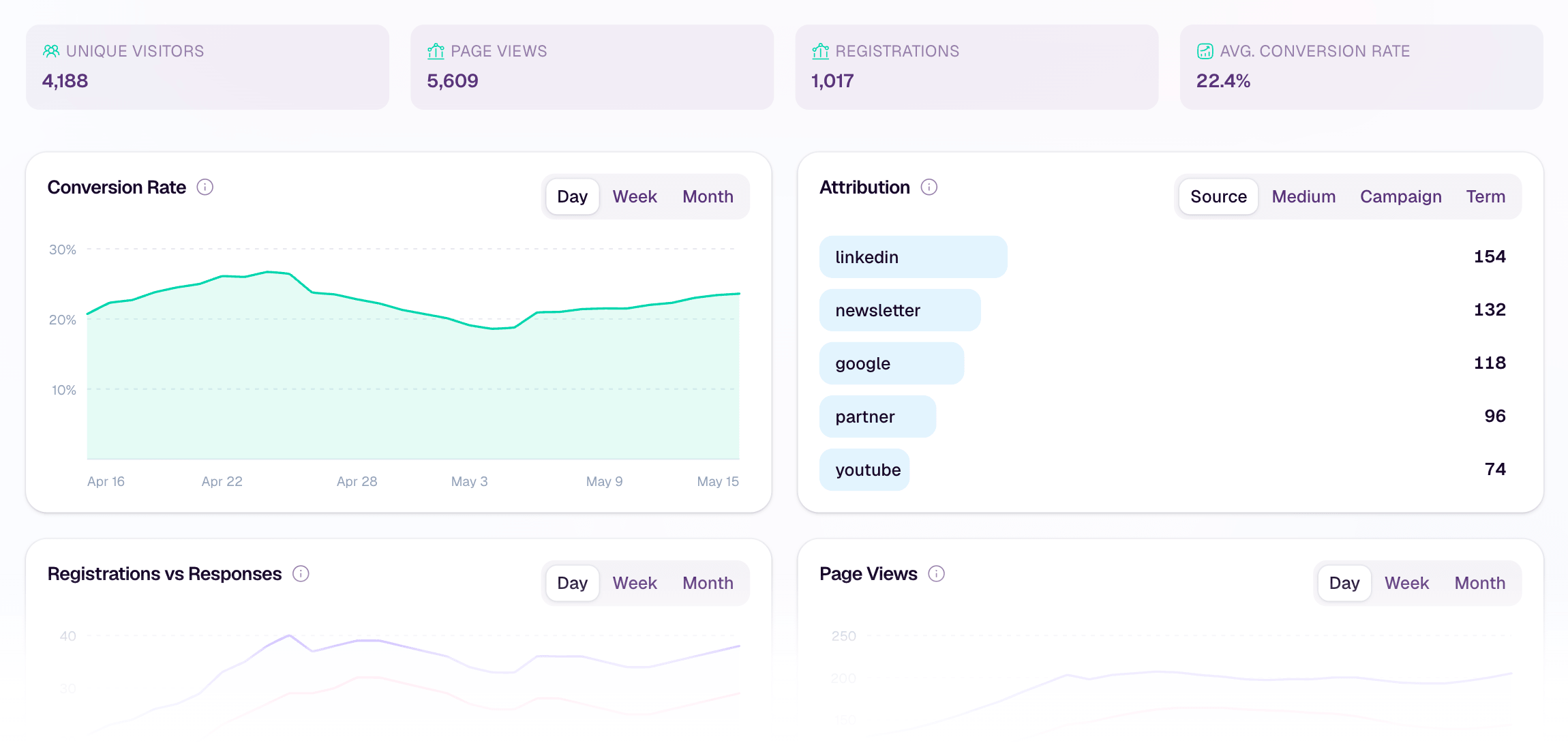
Agree a simple naming convention before links are distributed. For example, keep the same campaign value across both partners and use source values that identify each partner. The values should describe provenance, not imply data rights.
Build a joint promotion kit and workback plan
Give both partners one approved kit rather than asking each channel owner to interpret the brief. Include:
- landing-page copy and final tracked links;
- speaker names, bios, headshots, and pronunciation notes;
- square and landscape images with safe logo treatment;
- email subject lines, body blocks, and reminder copy;
- social options for company, speaker, and employee channels;
- the audience promise, primary CTA, and claims that must not be made;
- accessibility details, calendar copy, and replay expectations;
- a contact for approvals, corrections, and live-day issues.
Use a workback plan with dependencies rather than a universal “launch four weeks before” rule. A complex panel with legal review may need more runway than a focused interview with two experienced speakers.
- Lock the brief, partner decision-makers, and stop conditions.
- Confirm the agreement, registration model, data rules, CTA, and replay rights.
- Approve the title, landing-page copy, speaker details, and tracking convention.
- Build and test registration, confirmation, calendar, reminder, and access paths.
- Release the joint kit through each partner's committed channels.
- Rehearse speaker handoffs, moderation, media, CTA, and incident paths.
- Run the live session, then publish the agreed replay and follow-up.
For the channel-by-channel handoff, use a fuller webinar promotion plan rather than inventing a second campaign calendar inside this playbook.
Rehearse the shared live experience
The audience should experience one coherent session, not two companies taking turns presenting their pitch deck. During rehearsal, confirm:
- who opens, introduces each organization, and states the audience promise;
- brand and speaker order, lower thirds, name pronunciation, and accessibility needs;
- moderator questions, speaker handoffs, Q&A selection, and time checks;
- who can show, hide, or change the CTA;
- what the primary CTA is and how partner-specific next steps are described;
- the backup host, producer contact, missing-speaker plan, and technical fallback;
- recording permission, replay editing, closing language, and next communication;
- who ends the stream and who confirms the recording is safe to publish.
The GitLab virtual-events handbook provides a useful public example of explicit event ownership, with separate responsibilities for registration, moderation, hosting, promotion, and follow-up. Your RACI should be just as concrete, even if your team is much smaller.
Plan replay, follow-up, and repurposing before going live
The live event is one moment in the campaign, not the finish line. Decide in advance:
- where the replay will live and whether registration is required;
- whether edits, captions, or partner approvals are needed before publication;
- who may cut clips, quote speakers, publish transcripts, or reuse slides;
- how live attendees, no-shows, replay viewers, and CTA clickers should be treated differently;
- which partner sends each message and how those messages respect the agreed data model;
- when the campaign stops sending, deletes temporary exports, or returns shared data.
HeyStream can keep live and replay behavior in audience intelligence, including registration context, watch history, engagement, and CTA activity. Webinar follow-up automation can then help teams build relevant segments from attendance, replay, registration answers, clicks, and engagement. Those product signals can inform a follow-up decision; they do not prove buyer intent or override the permissions agreed with attendees.
Reusable HeyStream CTAs can appear during the live session and be enabled for replay viewers. That makes CTA ownership and copy part of the replay plan, not just the producer's live run sheet.
Measure the shared result and decide what happens next
Do not force a single revenue number onto a campaign that may have several useful jobs. Start with the agreed campaign objective, then review a compact scorecard:
| Evidence | Question to answer |
|---|---|
| Registrations by partner source | Did both partners create qualified market contact? |
| Live and replay engagement | Which parts of the session held attention or brought people back? |
| Questions and CTA actions | What problems or next steps earned active interest? |
| Qualified replies or conversations | Did the campaign create useful follow-up, without assuming every registrant is a lead? |
| Content reuse | Did the session produce clips, insights, or assets worth distributing further? |
| Operational delivery | Which approvals, handoffs, data decisions, or technical steps caused friction? |
End the debrief with one of three decisions:
- Repeat when the audience fit, working relationship, distribution, and resulting signals justify another campaign.
- Revise when the partnership is sound but the topic, format, promotion, CTA, or follow-up needs a specific change.
- Stop when the audience fit, trust, ownership, delivery, or data model remains weak.
Record why you chose that outcome. “Good webinar” is not a learning; “the partner audience engaged with the implementation checklist, but approval delays cut the promotion window” is useful evidence for the next decision.
Copyable final checklist
Before announcing:
- Complete the partner brief and fit scorecard.
- Name one accountable campaign owner and one responsible owner for every handoff.
- Confirm the agreement, brand rules, registration host, data model, CTA, replay rights, and stop conditions.
- Approve one audience promise and one primary next step.
- Build and test tracked partner links, registration, confirmation, calendar, reminders, and access.
Before going live:
- Rehearse speakers, moderation, handoffs, CTA, accessibility, recording, and technical fallbacks.
- Confirm who can change the CTA, end the stream, and approve the replay.
- Prepare the follow-up segments and messages without assuming both partners may contact everyone.
After the session:
- Publish the agreed replay and reusable assets.
- Follow up by behavior and permission, not by a generic registrant blast.
- Review the scorecard, operational misses, and audience signals.
- Choose repeat, revise, or stop—and write down the evidence behind it.
A co-marketing webinar works when the audience gets one useful experience and both partners know exactly what they own. Make those agreements visible early, and the campaign becomes easier to promote, safer to operate, and far more useful to learn from.