A strong webinar panel does not depend on finding one dazzling question. It depends on asking the right panelist a clear question, listening closely, and knowing where to take the answer next.
This question bank gives you 36 panel discussion questions for B2B webinars. Each one includes the best panelist to ask, a follow-up prompt, the right moment to use it, and a reminder about what the answer cannot prove. Use the bank to build a live conversation, not a script that every panelist answers in turn.
What makes a good panel discussion question?
A useful panel question does four things:
- Creates audience value. The answer should help the audience understand a decision, trade-off, example, or next step.
- Fits a particular panelist. Direct the question to the person whose experience gives them a real reason to answer it.
- Leaves room for contrast. A good prompt can surface a story, evidence, uncertainty, or a different point of view.
- Opens a follow-up path. You should know what to ask if the first answer is vague, polished, or incomplete.
Toastmasters International recommends keeping prepared questions short, knowing the first and last question in advance, and ranking prompts by their relevance to the audience. Treat questions as thought-starters you can adapt, not lines you must read word for word.
One panelist's answer is still one expert perspective. It may reveal a useful practice or trade-off, but it does not establish a market benchmark, customer consensus, or causal result.
Choose the discussion job before the question
The easiest way to avoid a generic panel is to decide what the next part of the conversation needs to accomplish. Most useful questions perform one of six jobs:
- Establish the context and define the real problem.
- Surface lived experience, evidence, and lessons.
- Expose trade-offs and respectful disagreement.
- Turn ideas into practical decisions.
- Connect audience questions to the panel's expertise.
- Close with implications and next actions.
Pick a few must-ask questions across those jobs, then keep several backups. You will rarely need all 36.
Opening and context-setting questions
Use these prompts to establish the stakes without asking every panelist for a long biography.
| # | Question | Best panelist | Suggested follow-up | When to use it | What the answer cannot prove |
|---|---|---|---|---|---|
| 1 | What has changed most about this problem in the last year? | The panelist closest to recent frontline work | Which part of that change is teams most likely to underestimate? | First substantive question | That the change affects every market or team equally |
| 2 | What does a team need to understand before it tries to solve this? | A practitioner who has implemented the work | What usually goes wrong when that foundation is missing? | Early context | That one prerequisite is universally required |
| 3 | Where do people usually define this problem too narrowly? | A strategist or cross-functional leader | What becomes visible when you widen the frame? | After introducing the topic | That the broader frame is always the better operating scope |
| 4 | Which assumption about this topic would you challenge first? | A panelist with a distinctive or contrarian view | What evidence or experience led you to challenge it? | To create early contrast | That the challenged assumption is false in every case |
| 5 | Who feels this problem first inside an organisation, and who owns fixing it? | A leader who spans several functions | Where does that ownership handoff tend to break? | To clarify roles | That every organisation uses the same ownership model |
| 6 | What would a good outcome from this conversation help the audience decide? | The panelist closest to the audience's job | What information would they still need after the session? | As the final opening question | That the panel can resolve every decision during one webinar |
Evidence, example, and lesson questions
These questions move the panel away from polished opinions and towards specific experience.
| # | Question | Best panelist | Suggested follow-up | When to use it | What the answer cannot prove |
|---|---|---|---|---|---|
| 7 | Can you walk us through a real decision where this issue changed the plan? | A hands-on practitioner | What did you notice that made you change course? | After the problem is clear | That the same decision would work elsewhere |
| 8 | What did you try first that did not work as expected? | A panelist willing to discuss failure | What would you do differently with the same constraints today? | To move beyond success stories | That the failed approach is always ineffective |
| 9 | Which signal helped you separate a real problem from background noise? | An analyst or operator | What other signal did you check before acting? | In a measurement discussion | That the signal proves intent or causation |
| 10 | What is one example that changed your view of the topic? | A panelist whose opinion has evolved | What did you believe before that example? | To reveal learning | That one example represents a wider trend |
| 11 | Where did the data and the team's intuition disagree? | A decision-maker with access to evidence | How did you decide which one to trust? | After a data-led claim | That intuition or data should always win |
| 12 | What lesson took longer to learn than it should have? | The most experienced practitioner | What early warning sign would you tell others to watch? | Midway through an experience section | That experience removes the need for local validation |
Trade-off and respectful-disagreement questions
Disagreement is useful when it clarifies a choice. It is not useful when it becomes theatre.
| # | Question | Best panelist | Suggested follow-up | When to use it | What the answer cannot prove |
|---|---|---|---|---|---|
| 13 | What is the strongest argument against the approach you prefer? | A panelist advocating a clear position | Under what conditions would that argument change your choice? | Before positions harden | That acknowledging a drawback invalidates the approach |
| 14 | Which trade-off do teams often pretend they can avoid? | A leader who has made the decision repeatedly | How do you make that trade-off explicit? | When advice sounds effortless | That the same trade-off dominates every decision |
| 15 | Where would you draw the line between speed and confidence? | Two panelists with different operating models | What would make you move that line? | To invite controlled contrast | That there is one correct balance |
| 16 | Which part of the conventional advice works only in a specific context? | A specialist with domain depth | What context should the audience check first? | After a broad recommendation | That conventional advice is generally wrong |
| 17 | What would another person on this panel reasonably disagree with you about? | A panelist who has just made a firm claim | Who sees it differently, and why? | To open cross-panel dialogue | That disagreement means one side lacks expertise |
| 18 | If the budget, team, or timeline were cut in half, what would you protect? | An operator accountable for delivery | What would you remove first, and what risk would that create? | To expose priorities | That constrained choices are ideal choices |
Customer, practitioner, and decision questions
Use this set to turn principles into choices an audience member could apply.
| # | Question | Best panelist | Suggested follow-up | When to use it | What the answer cannot prove |
|---|---|---|---|---|---|
| 19 | What question should a buyer or internal stakeholder ask before approving this? | A buyer, customer, or procurement-aware leader | What would a weak answer sound like? | Before an evaluation section | That the question alone predicts a good outcome |
| 20 | What should a small team do first if it cannot implement the full approach? | A resource-conscious practitioner | What would tell them they are ready for the next step? | For an audience with mixed maturity | That every small team should follow the same sequence |
| 21 | Which decision deserves more time than teams usually give it? | A leader who owns downstream consequences | What shortcut creates the biggest later cost? | During planning guidance | That more time always produces a better decision |
| 22 | What is one process you would standardise, and one you would keep flexible? | An operations leader | What makes that boundary useful? | To translate ideas into workflow | That the boundary fits every organisation |
| 23 | What information do you need before you are comfortable making this call? | A decision-maker | Which missing input would stop the decision completely? | Before a recommendation | That more information always reduces uncertainty |
| 24 | How would you explain this choice to a sceptical executive? | A panelist who regularly earns internal buy-in | Which part of the case needs evidence rather than persuasion? | Near the end of a practical section | That executive approval proves the approach will work |
Future-looking and implication questions
These prompts help the panel look forward without turning speculation into fact.
| # | Question | Best panelist | Suggested follow-up | When to use it | What the answer cannot prove |
|---|---|---|---|---|---|
| 25 | Which current change will matter less than people expect? | A panelist with a grounded view of the market | What are people overlooking instead? | In a trends section | That the prediction will be correct |
| 26 | What capability will teams need to build before the market forces them to? | A strategic operator | What is a low-risk way to start building it now? | To connect trend to action | That every team needs the capability immediately |
| 27 | What would have to become true for your current advice to stop working? | A panelist who has offered a framework | Which indicator would tell you that shift has started? | To test durability | That the indicator will predict the shift reliably |
| 28 | Where do you expect the human judgement to remain essential? | A panelist discussing automation or AI | Which part can be automated safely today? | In a technology discussion | That the boundary will remain fixed |
| 29 | What second-order effect should teams prepare for? | A systems thinker or cross-functional leader | Who inside the organisation would feel it first? | After a first-order prediction | That the effect will occur at the same scale everywhere |
| 30 | If we repeated this panel in twelve months, what answer might have changed most? | The panelist closest to fast-moving work | What should the audience watch between now and then? | Final question before audience handoff | That the expected change is certain |
Audience-handoff and closing questions
These questions connect the prepared conversation to audience needs and finish with a useful synthesis.
| # | Question | Best panelist | Suggested follow-up | When to use it | What the answer cannot prove |
|---|---|---|---|---|---|
| 31 | We have several audience questions about the same obstacle. What is the first distinction you would make? | The panelist best able to categorise the problem | Which audience situation belongs on each side of that distinction? | At the start of Q&A | That grouped questions share one underlying cause |
| 32 | What detail would you ask this audience member for before answering confidently? | A diagnostic practitioner | How would the answer change under the two most likely scenarios? | When an audience question lacks context | That those scenarios cover every possibility |
| 33 | Which audience question reveals the biggest unresolved tension in our discussion? | The moderator, then one directed panelist | Who on the panel sees that tension differently? | Late in Q&A | That question popularity indicates business importance |
| 34 | What is one idea from another panelist that changed or sharpened your view today? | A panelist who has listened closely | What would you now test or investigate? | Near the close | That agreement means the idea is validated |
| 35 | What should the audience do next, and what should they avoid doing too quickly? | A practitioner with a clear first step | What result would justify continuing? | Penultimate close | That one next step suits every audience member |
| 36 | What is the most useful question we have not asked? | The panelist with the broadest view | Why does that question matter now? | Final panelist question | That an unasked question must become the audience's priority |
Follow-up prompts for difficult live answers
Your prepared question starts the exchange. The follow-up makes it useful.
When the answer is vague
- “Can you give us a specific example?”
- “What did that look like in practice?”
- “Which decision changed because of it?”
When the answer sounds rehearsed
- “What was harder than that summary makes it sound?”
- “Where did the plan change once the work started?”
- “What would someone only learn by doing it?”
When everyone agrees
- “Where might this advice fail?”
- “Which constraint would lead you to choose differently?”
- “Who sees a meaningful exception?”
When a panelist makes an unsupported claim
- “Is that based on your experience, a dataset, or a broader market view?”
- “What should the audience treat as observation rather than established evidence?”
- “What would you want to verify before acting on that?”
When one panelist dominates
- “Thank you. I want to bring Priya in because her experience is different.”
- “Could you give us the shortest version of your recommendation?”
- “Marco, what would you add or challenge?”
When time is running short
- “One sentence from each of you: what should the audience remember?”
- “What is the single next action you would protect?”
- “Which question should we carry into the follow-up?”
Nature's archived Scitable guide recommends limiting prepared questions, directing a prompt to one panelist, inviting another to react, and using rephrased answers to launch follow-ups. The practical lesson is simple: do not work through a list as if the panel were six separate interviews. Build an exchange.
Build your panel question plan
Start with the audience takeaway, then map the panelists and prompts around it.
| Audience takeaway | Panelist | Must-ask question | Likely follow-up | Audience handoff | Backup prompt |
|---|---|---|---|---|---|
| What should the audience understand or decide? | Who has direct experience or a distinct perspective? | Which question best serves that job? | What will you ask if the answer is vague or incomplete? | Will you invite Q&A, use a poll, or ask another panelist to react? | What can restore momentum if the thread ends early? |
For each panelist, record their role, relevant experience, point of difference, name pronunciation, and any topic they should not be asked to discuss. Choose a first question, a last question, and a small set of must-ask prompts. Mark the rest as optional or backup.
Share the themes and any questions that require preparation. You can share selected wording when accuracy or sensitivity matters, but avoid scripting every answer. Plan for uneven preparation, different viewpoints, technical problems, time overruns, and a slow start to audience Q&A.
Panel questions, audience Q&A, and polls do different jobs
A panel question is directed by the moderator to a particular expert. It shapes the conversation and gives the moderator a follow-up path.
Audience Q&A lets attendees raise their own needs and challenge the prepared frame. The moderator still needs to group, clarify, and direct those questions.
A poll asks many attendees to respond in a consistent format. Use it to reveal the room's experience, priorities, or choices, not to prove a causal result or representative market opinion. If you need audience-response prompts, use this bank of webinar poll questions.
Do not count polls or audience prompts among the 36 panelist questions. They are separate tools.
A lightweight webinar panel runbook
Before the webinar
- Confirm the audience takeaway and the panel's scope.
- Research each panelist's expertise, viewpoint, and likely overlap.
- Check names, titles, and pronunciations.
- Agree how the moderator will interrupt, redirect, or move on.
- Choose must-ask, optional, and backup questions.
- Decide when audience Q&A and polls enter the session.
- Rehearse the opening, first question, audience handoff, and close.
During the webinar
- Open with the audience outcome, not a list of biographies.
- Direct each question to one panelist first.
- Listen for a claim, example, trade-off, or gap worth following.
- Invite another panelist when their perspective adds contrast.
- Keep answers balanced and protect time for the audience.
- Summarise points of agreement and disagreement neutrally.
After the webinar
- Record unanswered audience questions.
- Note claims that need checking before they become follow-up content.
- Tag useful replay moments and practical clips.
- Feed recurring audience needs into the next webinar or article.
For spoken openings, handoffs, Q&A cues, and incident responses, pair this question bank with the webinar moderator script.
When a virtual roundtable is the better format
A panel is usually audience-facing: a moderator directs a small group of experts while most attendees listen and contribute through polls or Q&A. A roundtable gives more participants an active voice and depends more heavily on trust, consent, and peer exchange.
If the value should come from participants learning from one another rather than from a featured expert panel, use a virtual roundtable format instead.
Where HeyStream fits
The question plan should work on any capable webinar platform. The technology's job is to make the live operating plan easier to run.
HeyStream gives B2B teams a browser-based streaming studio for branded live sessions with presenters, audience interaction, and a clear production workspace. That makes it easier to keep the moderator focused on the conversation while the team manages the broadcast.
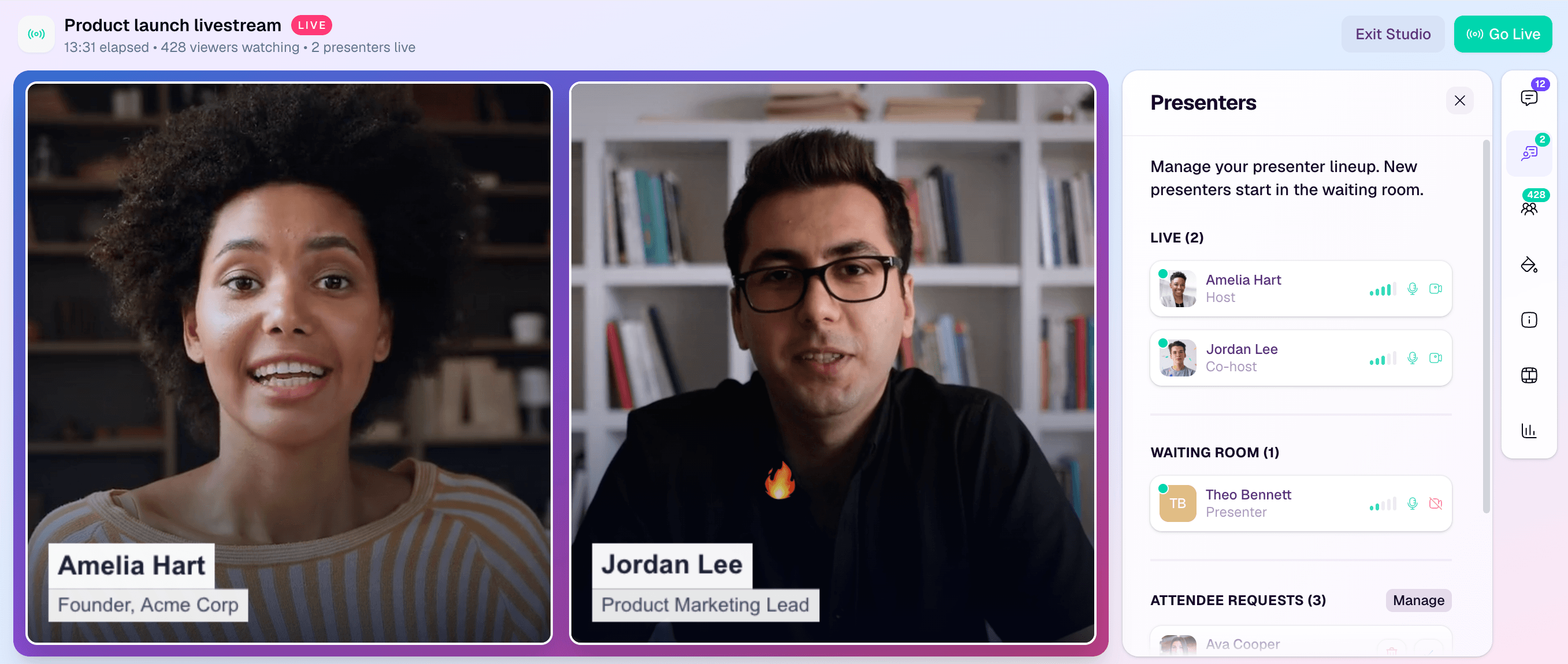
Use platform tools deliberately. Polls can help the moderator read the room, Q&A can surface audience priorities, and the replay can preserve the useful parts of the discussion. None of those signals proves buyer intent by itself.
Prepare for a conversation, not a recital
Choose questions by job, direct them to the right panelist, and prepare the follow-up before the webinar begins. The result is not a perfectly controlled performance. It is a focused expert conversation that gives the audience examples, trade-offs, and decisions they can actually use.