The best webinar platform for B2B lead generation is not simply the tool with the longest feature list, the biggest attendee limit, or the most familiar logo. It is the platform that helps your team move from the right registrants to a credible live experience, useful audience signals, timely calls to action, replay engagement, and follow-up your sales or marketing team can actually use.
That matters because most B2B teams are not short on channels or software. They are short on clear signals. A webinar can look successful on the surface because registrations were high or the room felt busy, while still leaving the team with generic follow-up, unclear next steps, and no reliable way to tell which viewers were genuinely engaged.
This guide gives you a practical way to compare webinar platforms for lead generation. Use it to choose the tool that fits your webinar motion, not just the one that ranks highest on a generic list.
What "best webinar platform" means for B2B lead generation
A B2B lead-generation webinar platform should help you do five jobs well:
- Attract and register the right audience.
- Deliver a polished session that makes your company feel credible.
- Capture meaningful engagement during the live session and replay.
- Give viewers clear moments to take the next step.
- Preserve enough audience context for relevant follow-up.
That is a different buying question from "Can this tool host a webinar?" Most credible webinar products can handle video, registration, reminders, Q&A, and basic reporting. The harder question is whether the workflow helps your team turn attention into qualified next steps.
G2's webinar platform category is useful for understanding the wider review market and seeing which products buyers compare. But reviews should be a starting point, not the decision itself. Your shortlist should come from your team's actual motion: live product demos, recurring thought-leadership sessions, partner webinars, enterprise events, automated replays, or a focused B2B growth workflow.
Quick answer: choose by webinar motion
There is no universal best webinar platform for every B2B team. The right choice depends on what your webinars are supposed to do.
| Webinar motion | Strong fit | What to watch |
|---|---|---|
| Simple internal or customer webinars | Familiar meeting and webinar tools | May be light on branded conversion, replay, and audience workflow |
| Enterprise events and large programs | Event suites and digital engagement platforms | Can be expensive or operationally heavy for lean teams |
| Automated evergreen funnels | Automation-first webinar tools | May be weaker for live conversation and sales context |
| Recurring product demos or demand programs | B2B webinar platforms built around audience behavior | Must still fit your integrations, production needs, and team workflow |
| High-touch field or partner events | Broader event platforms | May be more platform than a repeatable webinar program needs |
For many B2B marketers, the strongest choice is the one that connects registration, the branded watch experience, live and replay CTAs, audience records, analytics, and follow-up. That is the workflow lens behind HeyStream's B2B webinar platform: webinars should create reusable audience insight, not just a finished recording.
Evaluation criteria for B2B lead-generation webinars
Use these criteria before comparing named platforms. They will keep the conversation grounded in the job your webinar program needs to do.
Registration experience and audience fit
Registration is the first audience signal. A strong platform should make it easy to create a registration page that feels credible, captures the right fields, works well on mobile, and gives your team useful context about who is interested.
Do not over-collect. If your form asks for too much, conversion may suffer. If it asks for too little, follow-up may be generic. The right balance depends on your audience, offer, and sales process.
Branded viewing experience
For B2B lead generation, the webinar room is part of your brand. Buyers should not feel like they have been dropped into a generic meeting link if the session is meant to build trust, teach a framework, or introduce a product.
Look for control over the registration page, watch page, presenter experience, session layout, assets, replay, and post-event destination. A polished experience will not create demand by itself, but a weak one can make a good topic feel less credible.
Engagement that creates useful context
Chat, Q&A, polls, reactions, resource clicks, and watch behavior are not proof that someone is ready to buy. They are context.
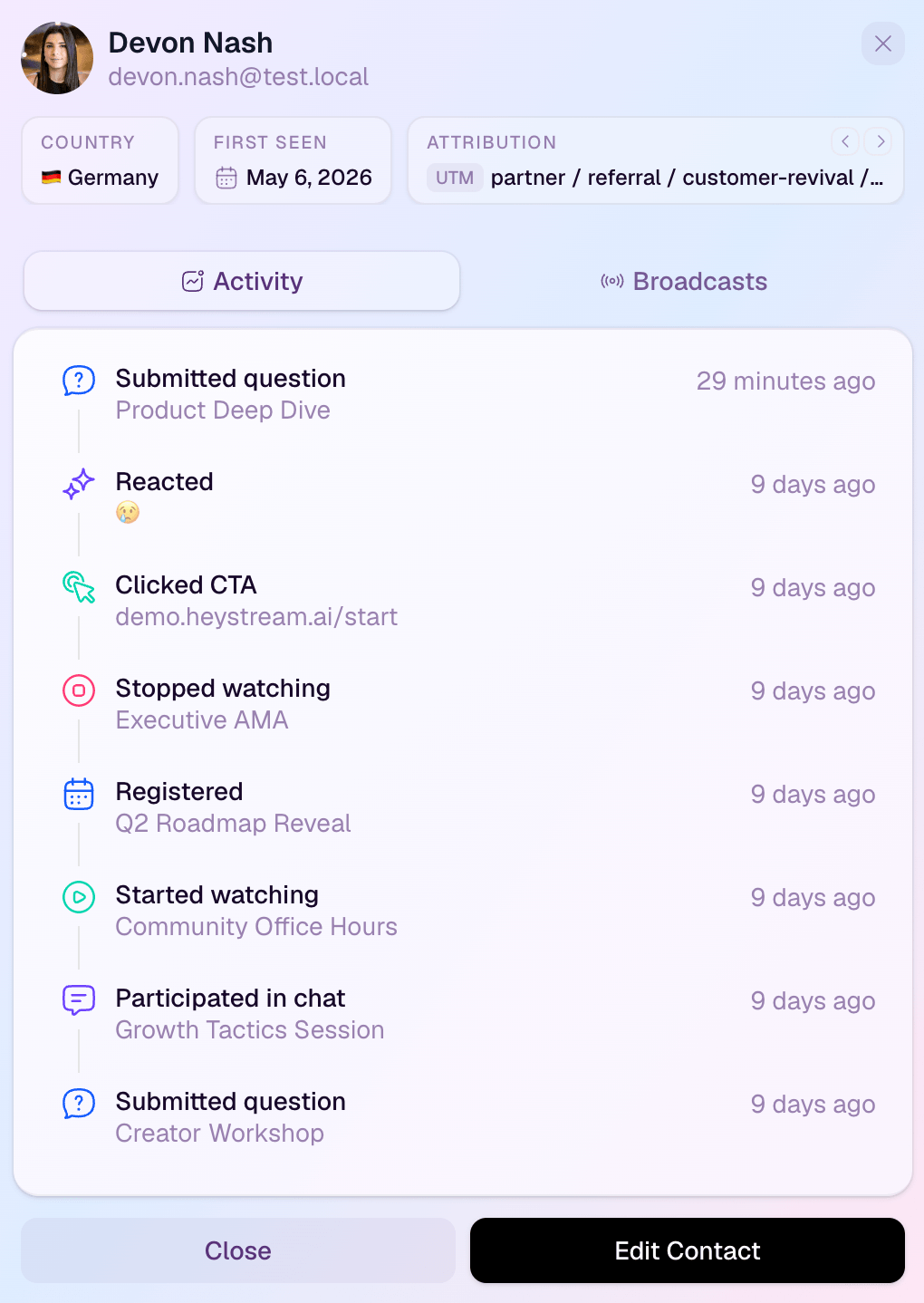
The platform should help you see what people did, not just whether they attended. A viewer who asked a buying-stage question, clicked a pricing-related CTA, or watched the replay section about implementation deserves a different follow-up path from someone who registered and never attended.
CTAs and conversion moments
Lead generation depends on clear next steps. That could be booking a demo, starting a trial, downloading a checklist, joining the next webinar, asking a question, or visiting a pricing page.
The best platforms make those moments easy to place during the live session and replay. HeyStream's webinar conversion tools, for example, are built around reusable CTAs that can turn viewer attention into action while the topic is still fresh.
Audience records and viewer-level signals
Aggregate attendance is useful, but it is not enough. B2B teams need to understand contact-level behavior: who registered, who attended, who watched later, what they clicked, what they asked, and what they might need next.
That is where audience intelligence becomes important. The goal is not to turn every engagement event into a lead score. The goal is to give marketing and sales a clearer picture of the audience so follow-up is more relevant.
CRM, marketing automation, and follow-up handoff
The platform should fit your existing handoff. Some teams need deep CRM and marketing automation integrations. Others need a simple export, webhook, or a clear internal workflow that tells the right person what happened.
The important question is not "Does it integrate?" It is "Can our team act on the right webinar signals quickly and consistently?"
If your follow-up depends on replay viewers, CTA clickers, or people who asked specific questions, make sure those signals can reach the team or tool that owns the next step. A platform that supports webinar follow-up automation can reduce the manual gap between attention and outreach.
Replay and on-demand behavior
Replay is not just an archive. In many B2B programs, replay viewers are still active prospects. They may be watching after a meeting, sharing the session with a colleague, or evaluating a specific section.
If replay matters to your lead-generation motion, compare how platforms handle on-demand viewing, replay CTAs, viewer-level replay data, and follow-up triggers. A platform that treats replay as a dead recording may leave useful demand signals on the floor.
Analytics and learning
A lead-generation webinar program should improve over time. You need to understand what topics brought the right audience, where viewers engaged, which CTAs attracted action, and which follow-up paths created real conversations.
Look for webinar analytics that support decisions. The goal is not to drown the team in charts. It is to answer practical questions: which topics should we repeat, which segments need better follow-up, where did the audience drop off, and what should change before the next session?
Platform types to compare
Once you know the workflow you need, compare platform types before comparing individual vendors.
General meeting and webinar tools
Tools such as Zoom Webinars, Microsoft Teams webinars, and similar products can be a good fit when your team values familiarity, simple setup, and broad organizational adoption. They often work well for internal sessions, customer education, training, and straightforward webinars.
They may be less ideal when marketing needs a fuller lead-generation workflow: branded registration and watch pages, live and replay CTAs, audience records, and behavior-aware follow-up. That does not make them bad tools. It means they may need more surrounding process.
Established webinar platforms
Established webinar products such as GoTo Webinar or Webex-style offerings can fit teams that need reliable webinar administration, scale, training workflows, and familiar corporate event operations.
If you are comparing these platforms, look carefully at how much of your lead-generation workflow they cover without extra manual work. The question is not whether they have engagement features or reporting. Many do. The question is whether those features map cleanly to your team's conversion, replay, and follow-up motion.
If GoTo Webinar is on your shortlist, our guide to GoToWebinar alternatives goes deeper on when an established webinar tool is still the right fit and when a more focused B2B webinar workflow may make sense.
Marketing webinar and event platforms
Marketing webinar platforms and event suites often go deeper on branded experiences, engagement, integrations, analytics, and larger campaign operations. They can be strong for teams running many events, field marketing programs, partner sessions, or digital engagement portfolios.
The tradeoff is complexity. Some teams need that depth. Others need a lighter workflow they can run every week without turning every webinar into an event-production project.
Automated and evergreen webinar tools
Automation-first webinar tools can be useful when the main motion is a repeatable funnel: pre-recorded session, automated reminders, scheduled replays, and conversion paths that run without a live team every time.
That is different from a live B2B conversation. If your webinars depend on Q&A, audience feedback, product nuance, or sales context, do not choose an evergreen-first platform just because it promises scale. Choose it only if automation is genuinely the center of your strategy.
B2B webinar growth workflow platforms
This is where HeyStream fits. It is built for B2B teams that want branded live broadcasts, audience records, reusable CTAs, replay behavior, analytics, and follow-up context in one workflow.
HeyStream is not trying to be a massive enterprise event suite, a generic meeting tool, or a pure evergreen webinar funnel. It is a strong fit when the webinar's job is to create useful market contact and move the right audience toward the next step.
Comparison matrix: what each platform type is best for
| Platform type | Best for | Strengths | Tradeoffs |
|---|---|---|---|
| Meeting and webinar tools | Familiar hosting and simple webinars | Easy adoption, familiar presenter workflow, broad internal use | May need extra tools for branded conversion and audience workflow |
| Established webinar platforms | Reliable corporate webinars and training | Webinar administration, scale, reporting, standard engagement tools | Can feel heavier or less focused on live-to-follow-up growth loops |
| Marketing webinar platforms | Campaigns, events, and digital engagement | Branded experiences, integrations, analytics, event depth | Cost and complexity may be high for lean teams |
| Evergreen webinar tools | Automated replay funnels | Repeatable automated sessions, scheduled replays | Not always ideal for live B2B conversations |
| HeyStream | B2B webinar growth workflows | Branded broadcasts, audience CRM, live/replay CTAs, follow-up signals | Not a full enterprise event suite or generic meeting replacement |
This is also why broad rankings can be misleading. A platform can be excellent for enterprise events and still be too heavy for a lean demand-generation team. Another can be perfect for simple hosting and still weak for audience intelligence. The "best" option is the one whose strengths match your webinar's job.
Where HeyStream fits for B2B lead generation
HeyStream is designed for teams that want webinars to become part of a repeatable growth motion.
That usually means:
- Branded registration and watch experiences that feel like your company.
- Live broadcasts that support a polished presenter workflow.
- Reusable CTAs that can appear during live sessions and replays.
- Audience records that preserve what each viewer did.
- Analytics that help the team learn what worked.
- Follow-up context that makes post-webinar outreach more relevant.
The platform is especially useful when you care about the path from attention to action. For example, a product marketer running recurring demos may want to know which viewers watched the pricing section, clicked a trial CTA, asked an implementation question, or returned to the replay. A demand-generation team may want to see whether a narrow topic created clearer audience signals than a broad thought-leadership session.
That does not mean every viewer is a sales-ready lead. It means the team has better context for deciding what happens next.
Buyer checklist before you choose a webinar platform
Before you commit to a platform, answer these questions with your team:
- What next step should the webinar drive?
- Who owns follow-up after the session?
- What audience signals would change the follow-up message?
- Do replay viewers matter to the campaign?
- Which integrations are required on day one?
- How much production complexity can the team sustain?
- Does the platform help us learn from one webinar to the next?
- Do we need an event suite, a webinar tool, or a webinar growth workflow?
- How will we compare cost against the work the team no longer has to do manually?
- Is the buying path clear enough for the team to move quickly?
If you are still comparing categories, use the HeyStream comparison hub to compare webinar platforms by workflow rather than by a generic feature checklist. If budget is the immediate question, check HeyStream pricing and compare the total operating fit, not just the subscription line item.
Common mistakes when choosing webinar software for lead generation
Choosing by attendee capacity alone
Capacity matters, especially for larger events. But most B2B teams do not fail because their webinar room was too small. They fail because the topic was too broad, the audience was poorly matched, the CTA was unclear, or follow-up did not use the context the webinar created.
Treating registrations as leads
A registration is interest, not qualification. It may become a useful lead signal when combined with company fit, role, attendance, replay behavior, CTA clicks, questions, and follow-up response.
That is why focused topics often matter. A narrower session can create clearer signals than a broad, high-registration webinar. Our guide to focused webinars and B2B lead signals goes deeper on that point.
Ignoring replay behavior
Replay can extend the life of the webinar, but only if your platform and process treat it as active audience behavior. If replay viewers cannot see relevant CTAs, and your team cannot tell who watched, the replay becomes a content archive rather than a growth asset.
Buying too much platform
An enterprise event suite can be the right answer for a large event portfolio. It can also slow down a lean team that needs a repeatable monthly or weekly webinar workflow.
Choose the platform your team can run consistently. The best lead-generation system is usually the one your team can actually operate, measure, and improve.
Using meeting software for a demand-generation job
Meeting tools are excellent for many things. But if your webinar is meant to build demand, capture audience signals, drive CTAs, and support segmented follow-up, you may need more than a meeting room with registration.
Final recommendation
Start with the workflow, then choose the platform.
If your webinars are mostly trainings or internal sessions, a familiar webinar tool may be enough. If you run large event programs, an event suite may be worth the operational weight. If your motion is automated replay funnels, an evergreen-first tool may be a better fit.
If you are a B2B team trying to turn live and replay attention into clearer audience signals and qualified next steps, compare platforms by the whole growth workflow: registration, branded viewing, engagement, CTAs, audience records, replay, analytics, and follow-up.
That is the lens HeyStream is built around. As Content Marketing Institute's 2026 B2B research shows, many B2B marketers are still wrestling with fundamentals such as creating content that prompts action, measuring effectiveness, and using first-party data well. The right webinar platform should help with those fundamentals instead of adding another disconnected tool to the stack.