The best Goldcast alternative depends on which part of the event and video workflow your team needs one platform to own. Choose HeyStream or Univid for focused webinar-to-follow-up workflows; Bizzabo, Cvent Webinar, ON24, or RingCentral Events for broader event portfolios; Zoom Webinars or Zoom Events for a familiar communications ecosystem; and BigMarker for flexible webinar and digital-event formats.
Goldcast may remain the strongest fit when recording, field-event delivery, AI repurposing, distribution, and measurement need to live in one B2B video suite. A lean demand generation team running recurring webinars has different requirements from an enterprise event team coordinating conferences, field events, compliance, and global reporting.
This guide compares seven credible paths by operating model without pretending one product is universally best.
Quick answer: choose the operating model first
- For a focused webinar-to-follow-up workflow: consider HeyStream or Univid.
- For a broad enterprise event portfolio: consider Bizzabo, Cvent Webinar with ON24, or RingCentral Events.
- For teams already standardized on Zoom: compare Zoom Webinars and Zoom Events before adding another platform.
- For broad webinar formats and highly configurable event programs: include BigMarker in the shortlist.
- For video recording, event delivery, AI repurposing, and field-event workflows in one suite: Goldcast may remain the strongest fit.
Use that first cut to narrow the field, then compare the details that affect your actual program: event formats, registration, production, audience data, integrations, replay, content reuse, buying model, and follow-up.
What Goldcast is built for
Goldcast describes its platform as an end-to-end B2B video content system spanning webinars and events, podcasts and demos, field-event management, content repurposing, distribution, and pipeline measurement. It is designed for teams that want events and video content to keep working across channels after the live session ends.
Its packaging reflects that range. Goldcast's current plan guide separates Starter, Pro, Premium, and Enterprise packages. Event formats, included event counts, integrations, reporting, field-event access, and Content Lab allowances vary by tier, while buyers are directed to sales for pricing.
That makes Goldcast a sensible reference point for a broad event-and-content operation. It also explains why some teams compare alternatives: they may need a narrower webinar workflow, a deeper enterprise event system, a familiar communications ecosystem, or a different buying model.
Why teams compare Goldcast alternatives
Looking at alternatives does not mean Goldcast is missing a basic capability. More often, it means the buyer is trying to match platform scope to the program it actually runs.
A focused webinar team may care most about branded registration, reliable browser-based delivery, attendee records, live and replay calls to action, and fast follow-up. An event department may instead need hotel sourcing, mobile apps, onsite check-in, badges, exhibitors, sponsors, and multi-day agendas. A content team may prioritize recording quality and automated repurposing.
Buying model matters too. Goldcast's public pricing page uses a custom bundle and demo-led path. Some buyers prefer that flexibility; others want prices they can evaluate without a sales process. Public pricing is useful context, but it does not prove lower total cost. Services, integrations, attendee limits, event allowances, users, and content-processing limits can change the real comparison.
How this shortlist was chosen
The seven options below cover distinct operating models rather than seven near-identical webinar tools. Each was checked against current official product or pricing information in July 2026.
The comparison uses the same questions throughout:
- Which event formats does the platform support?
- How much of registration, production, engagement, replay, and follow-up lives in one workflow?
- Does it serve focused webinar teams or wider event departments?
- How does it handle audience data and marketing integrations?
- Is content repurposing a core job or an adjacent feature?
- Is the buying path self-serve, publicly priced, or sales-led?
This is not a paid ranking. The order starts with HeyStream because this is HeyStream's guide, then moves through different buyer-fit lanes.
1. HeyStream: focused B2B webinar growth workflows
HeyStream is the best fit on this list for lean B2B marketing, product marketing, and demand generation teams that want a focused workflow from registration to follow-up.
It brings branded registration and watch pages, browser-based live delivery, a built-in audience CRM, reusable live and replay CTAs, analytics, and behavior-based follow-up into one product. That is useful when a webinar program needs to create measurable next steps rather than end with an attendance report.
The important limitation is scope. HeyStream is not positioned as a replacement for a broad enterprise event portfolio, field-event operations, multi-day conferences, podcast recording, or automated content repurposing at Goldcast's scale. It is a narrower choice for teams whose main job is running repeatable webinars, demos, launches, and live sessions that feed a growth workflow.
For more detail, review the B2B webinar platform for marketing teams, then check HeyStream pricing against your attendee, multistreaming, automation, and operator requirements.
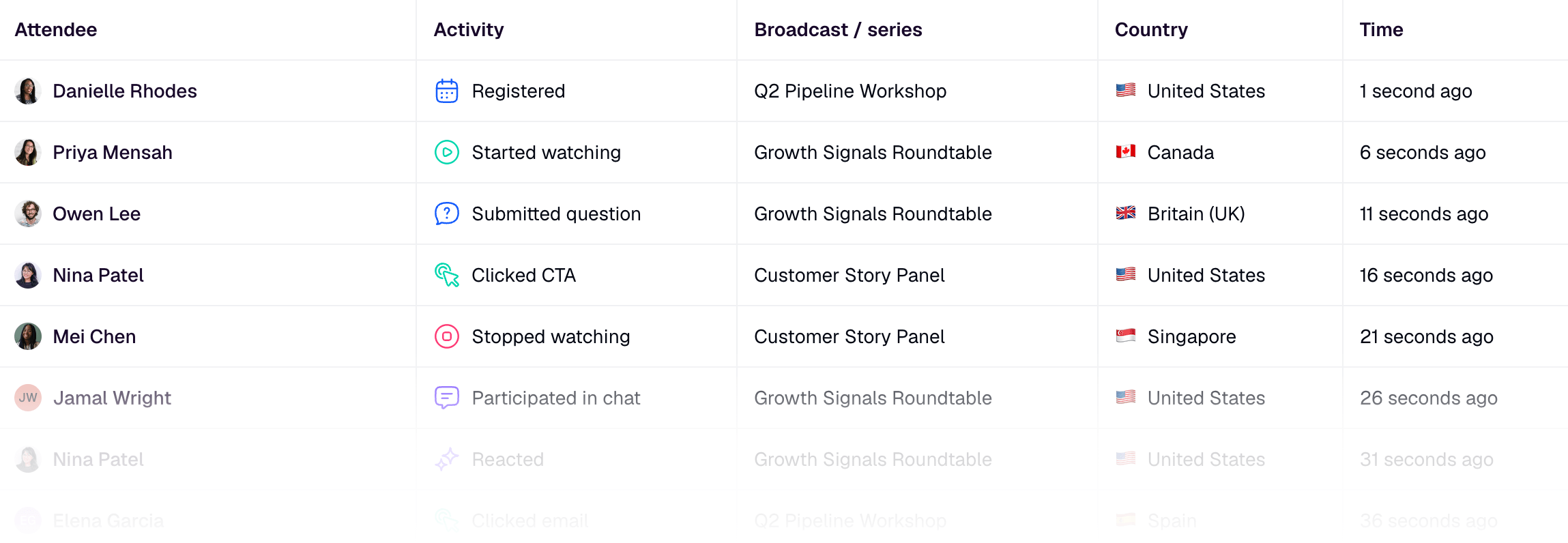
HeyStream's audience activity view keeps registration, attendance, questions, CTA clicks, and other engagement signals attached to the person, so follow-up can start from what happened rather than a disconnected CSV.
2. Bizzabo: enterprise event portfolios
Bizzabo belongs on the shortlist when webinars are one format inside a wider portfolio of in-person, virtual, hybrid, and multi-day events.
Bizzabo's current pricing page describes an annual Event Experience OS subscription with unlimited events and registrations, plus event websites, ticketing, email, mobile apps, reporting, and premium add-ons for virtual production, onsite operations, integrations, sponsors, speakers, and networking. Its published starting price and three-user minimum make the intended enterprise commitment clear.
Choose Bizzabo when the event department needs one operating system across registration, mobile, onsite, sponsorship, networking, and virtual production. The tradeoff to verify is whether that breadth and annual commitment are justified for a team that mainly runs recurring single-session webinars.
Goldcast may still fit better when high-production B2B video, recording, and AI-led repurposing are closer to the center of the program than event logistics.
3. Cvent Webinar and ON24: connected enterprise events and digital engagement
Cvent now owns both Goldcast and ON24, so this is a product-path comparison inside the same broader family—not a claim that they are unrelated vendors. Cvent completed its ON24 acquisition in April 2026, after acquiring Goldcast in December 2025.
Cvent's webinar platform guide now distinguishes three priorities: Goldcast for content, engagement, and repurposing; ON24 for compliance, scale, and engagement intelligence; and Cvent Webinar for teams that want webinars integrated with in-person event programs.
Choose ON24 when a global or regulated enterprise needs mature digital engagement, detailed audience signals, compliance-oriented workflows, and integrations into marketing and sales systems. Choose Cvent Webinar when the event team already uses Cvent and wants registration, attendee data, and reporting connected across webinar and in-person formats.
The tradeoff is evaluation complexity. Buyers should confirm which product owns each requirement, how data moves between products, what is included in the proposed package, and whether a focused team needs that broader event infrastructure. Goldcast may still be the better Cvent-family option when premium webinar production and rapid content reuse are the main jobs.
4. Zoom Webinars and Zoom Events: the familiar communications ecosystem
Zoom is a practical alternative for organizations that already use its meetings and communications stack and value familiar presenter controls.
Zoom's current webinar product page separates standard Webinars from Webinars Plus and Zoom Events. The product family covers straightforward broadcasts, richer branded webinar experiences, multi-session events, on-demand video, engagement features, and production tools, with plan boundaries and attendee capacity affecting the final package.
Choose Zoom when procurement, presenters, and attendees already know the platform, or when the team wants webinar and event delivery inside its existing Zoom account. Verify registration flexibility, marketing integrations, content management, attendee-level data, and post-event automation against the exact Zoom plan you are considering.
Goldcast may fit better when the team wants the event-to-content workflow, B2B marketing data, and repurposing system to be central rather than layered onto a general communications ecosystem.
5. RingCentral Events: virtual, hybrid, and onsite programs
RingCentral Events, formerly Hopin Events, spans webinars, virtual events, hybrid programs, and onsite experiences. It is a credible choice for teams that want a configurable virtual venue and event operations under one organizer-based plan.
RingCentral's current Events plans describe branded webinars, virtual, hybrid, and onsite events, with unlimited events and registrations, event analytics, and AI-supported setup and content reuse. The platform also covers multi-session formats, networking, expo areas, check-in, and badging as requirements expand.
Choose RingCentral Events when a simple webinar may grow into a wider virtual or hybrid event, or when the team values the Hopin-style venue model. Verify organizer seats, onsite requirements, integrations, support, and the exact capabilities of the selected tier.
Goldcast may be the stronger fit when the central job is a B2B video content engine with recording and repurposing, rather than a configurable multi-format event venue.
6. Univid: focused, browser-based webinars
Univid is another focused option for teams that want browser-based webinars without buying a broad event suite.
Univid publishes its plan details around monthly registrants rather than team seats. Its current plans include browser-based hosting, recordings, on-demand webinars, integrations such as HubSpot, Zapier, and Make, with simulated-live, API, SSO, restreaming, and additional enterprise capabilities depending on tier.
Choose Univid when the priority is a modern webinar experience, a simple buying path, and a compact set of webinar-specific tools. Verify registrant and live-participant limits, the integrations your workflow needs, and which automation or enterprise capabilities require a custom plan.
Goldcast may fit better when the team needs field events, large-scale content repurposing, recording workflows, and a wider enterprise video operation.
7. BigMarker: broad webinar formats and configurable digital events
BigMarker is a strong shortlist candidate when the team needs many webinar formats or wants webinars, virtual events, registration, media hubs, and event services from one vendor.
BigMarker's current packages cover live and on-demand webinars, simulive and evergreen formats, configurable attendee capacity, registration, interactive tools, analytics, CRM and marketing integrations, custom audience experiences, and separate virtual, hybrid, and onsite event packages.
Choose BigMarker when format breadth, customization, large audiences, or event-specific services matter. Its range can also suit organizations combining webinars with ticketing, learning, media hubs, or virtual venues. Verify the quote, host licenses, attendee capacity, integration allowance, support level, and which event modules sit outside the webcast plan.
For a deeper fit-based review, read the existing BigMarker alternatives guide.
Goldcast may remain the better option when the buyer wants a cohesive B2B video-and-content workflow rather than assembling the right combination of webcast and event packages.
Goldcast alternatives comparison
| Alternative | Best for | Webinar and event scope | Content and repurposing angle | Buying model | Main tradeoff to verify | When Goldcast may fit better |
|---|---|---|---|---|---|---|
| HeyStream | Lean B2B webinar growth teams | Focused webinars, demos, launches, live and replay workflows | Audience records, CTAs, analytics, and follow-up rather than broad content production | Public self-serve plans plus Enterprise | Not a full enterprise event or content suite | Field events, recording, and AI content repurposing are core |
| Bizzabo | Enterprise event departments | Webinars, virtual, hybrid, in-person, and multi-day portfolios | Virtual production and on-demand content within a wider event OS | Published annual starting point, sales-led package | Annual commitment and platform breadth | Video content and post-event repurposing matter more than onsite operations |
| Cvent Webinar + ON24 | Connected enterprise events, regulated programs, and digital engagement | Webinars through global event portfolios | Engagement intelligence, compliance, and connected event data | Sales-led | Which Cvent-family product owns each requirement | Goldcast's production and repurposing path is the closer fit |
| Zoom | Teams standardized on Zoom | Standard webinars through multi-session events | Recording, on-demand, and plan-dependent AI/content features | Public and sales-led options vary by product | Plan boundaries, marketing data, and workflow depth | A B2B event-to-content system is more important than ecosystem familiarity |
| RingCentral Events | Configurable virtual, hybrid, and onsite events | Single webinars through multi-track venues and onsite programs | Replay, analytics, and AI-supported content reuse | Organizer-based public starting price plus higher tiers | Seats, tier boundaries, and integrations | Recording and B2B content activation are the main jobs |
| Univid | Focused browser-based webinar teams | Live, on-demand, and plan-dependent simulated-live webinars | Recordings and webinar reuse without a broad content suite | Public free and Growth plans plus Custom | Registrant limits and enterprise features by tier | The team needs field events or content operations at scale |
| BigMarker | Broad webinar formats and configurable programs | Webinars, webcasts, virtual, hybrid, onsite, media hubs, and learning | AI content tools and media hubs on selected packages | Quote-led webcast and event packages | Package composition, licenses, and add-ons | A unified B2B video content platform matters more than format breadth |
Where HeyStream fits—and where it does not
HeyStream fits when the team runs recurring webinars, product demos, launches, panels, or branded live sessions and wants the workflow after registration to stay connected. Its clearest difference is not that it has more event features. It is that attendee identity, live and replay behavior, reusable CTAs, analytics, and follow-up sit close together.
That focus can remove friction for a small B2B marketing team. It does not make HeyStream a substitute for hotel sourcing, onsite badging, exhibitor operations, multi-day event logistics, podcast recording, or high-volume AI content production.
If the focused lane sounds right, use the webinar platform comparison hub to compare HeyStream with adjacent tools. If your program needs the broader jobs Goldcast, Bizzabo, Cvent, RingCentral, or BigMarker are designed to own, keep those products in the shortlist.
Recommended shortlist by team type
Lean B2B demand generation or product marketing team: Start with HeyStream and Univid. Add Zoom if your organization strongly prefers its existing ecosystem.
Enterprise webinar and digital engagement team: Compare ON24, Goldcast, and Cvent Webinar. The distinction is less about whether each can host a webinar and more about compliance, event integration, content repurposing, and data orchestration.
Enterprise event portfolio team: Compare Bizzabo, Cvent, RingCentral Events, and BigMarker. Include Goldcast when video production and content reuse are major parts of the event strategy.
Team focused on video content and repurposing: Keep Goldcast near the top. Its recording, Content Lab, distribution, and AI workflows are exactly the capabilities a narrower webinar platform may not replace.
Pricing and buying-model questions to ask
Avoid comparing one headline price with another vendor's custom quote. Ask every supplier the same questions:
- How many live events, registrants, attendees, organizers, and workspaces are included?
- Which event formats require a higher tier or separate package?
- Are CRM, marketing automation, APIs, webhooks, SSO, and custom reporting included?
- What are the recording, storage, processing, and on-demand limits?
- Are field-event, check-in, badging, mobile app, or exhibitor tools part of the plan?
- What onboarding, production, and support services are required or optional?
- Can the team test the real workflow before an annual commitment?
That comparison exposes the operational cost, not just the subscription line.
Choose the platform around the job
Goldcast is a broad B2B video, event, and content platform. A strong alternative is not simply a cheaper tool with a shorter feature list. It is the product whose scope matches the system your team needs to run.
Choose HeyStream or Univid for a focused webinar lane. Choose Bizzabo, Cvent with ON24, RingCentral Events, or BigMarker for broader event requirements. Choose Zoom when ecosystem familiarity matters. Keep Goldcast when production, recording, repurposing, and event breadth belong together.
Product packaging changes, especially across recently acquired platforms. Verify the current product and plan pages before signing a contract, and test the handoffs your team will use every week.