The best BigMarker alternative depends on the event program you need to run. Choose HeyStream for recurring live B2B webinars with branded registration, audience records, CTAs, replay, and follow-up; ON24, Bizzabo, Cvent, or RingCentral Events for broader enterprise event programs; Zoom Webinars, GoTo Webinar, or Webex for familiar organizational infrastructure; and eWebinar or EverWebinar when automated delivery matters most.
BigMarker can still be the right choice when your team needs one broad platform for live, on-demand, automated, and event-style experiences. A switch makes sense when a more focused operating model would be easier for your team to buy, run, and repeat.
This guide compares the alternatives by workflow fit rather than declaring a universal winner. Use it to narrow the shortlist around the work your team actually needs the platform to own.
When to consider a BigMarker alternative
Look for a BigMarker alternative when the platform decision is less about "can this run a webinar?" and more about operational fit.
For example, your team may want:
- A simpler platform for recurring B2B webinars, product demos, partner sessions, or thought-leadership broadcasts.
- A workflow that connects registration, the live session, CTAs, replay, audience records, and follow-up without needing a larger event suite.
- Clearer commercial evaluation, especially if you want public plan details before a sales conversation.
- A tool built around one dominant motion, such as evergreen demos, internal meeting infrastructure, or large virtual events.
- A platform your marketing and sales teams can use without treating every webinar like a conference.
BigMarker may still be the right choice if you need a broad platform for many formats, heavy customization, large event programs, automated and on-demand experiences, certification workflows, or enterprise event operations. The goal is not to treat breadth as a weakness. It is to decide whether that breadth matches the way your team actually runs webinars.
What BigMarker is built for
BigMarker positions itself as a broad webinar and event platform. Its webinar software page describes live, simulive, on-demand, automated, and evergreen webinar programs, along with registration, audience engagement, analytics, CRM and marketing automation integrations, media hubs, and custom audience experiences.
BigMarker's own knowledge base article on webinar types also lists six webinar formats: live, summit or series, on-demand, automated, evergreen, and 24-7 webinars. That matters because many buyers comparing BigMarker are not only comparing webinar tools. They are comparing event operating models.
There is also a commercial caveat. BigMarker's pricing page currently routes buyers to request a quote, while its Basic package lists up to 1,000 live attendees, one host license, live and on-demand webinars, and Facebook and YouTube Live. If pricing transparency is part of your decision, include that in your shortlist criteria.
How to choose the right BigMarker alternative
Before comparing logos, decide what job the platform needs to do most often.
Use these questions to sort the field:
- Do you primarily run live webinars, or do you need automated and evergreen webinar funnels?
- Is this a recurring B2B marketing program, or a broader event program with sessions, sponsors, networking, and logistics?
- How important are branded registration pages, watch pages, replay pages, and CTAs?
- Do sales and marketing need viewer-level signals after the session?
- Do you need deep production control, or is a familiar meeting/webinar interface enough?
- Will attendees mainly watch live, catch the replay, or move through on-demand content at their own pace?
- Do you want public pricing and self-serve plan evaluation, or is quote-based enterprise packaging acceptable?
- Which internal systems matter most: CRM, marketing automation, email, data warehouse, or event operations?
The best alternative is the one that makes your dominant workflow easier. A great enterprise event tool may be too much for a lean webinar program. A great automated-webinar tool may not fit if live audience engagement and follow-up signals are the main goal.
Best BigMarker alternatives by fit
1. HeyStream: for B2B teams running live webinar growth programs
HeyStream is a strong fit when your team cares less about running every possible event format and more about turning live webinars into a repeatable growth workflow.
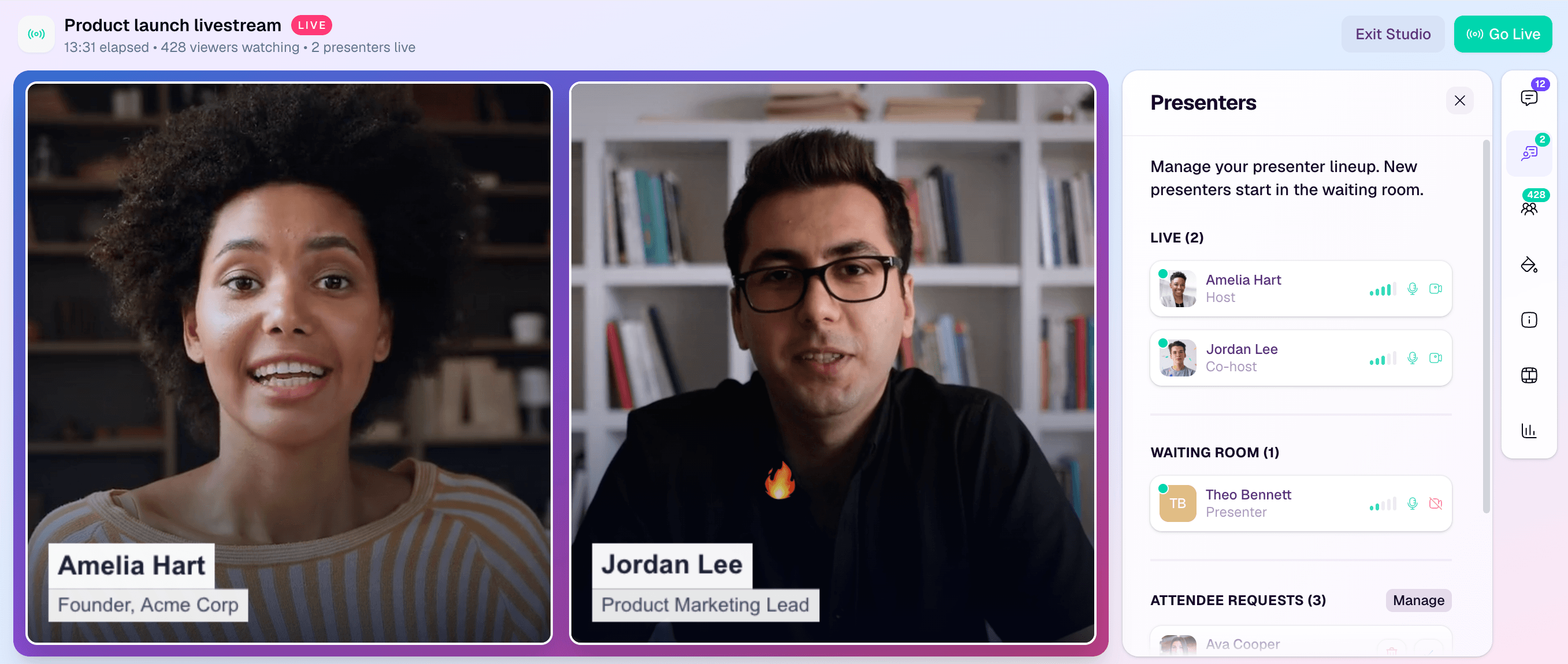
It is built for B2B teams that want polished live broadcasts, branded registration and watch pages, CTAs during the session, replays, audience intelligence, and webinar analytics that help teams understand what happened after someone registered, watched, clicked, asked a question, or returned for the replay.
Choose HeyStream when your webinar program needs:
- A focused B2B webinar platform rather than a broad virtual-event suite.
- A branded live experience for product demos, thought leadership, customer sessions, partner webinars, or recurring shows.
- CTAs and follow-up signals connected to the session and replay.
- A clearer path from attendee behavior to sales or marketing action.
- A decision-stage way to compare webinar platforms without treating all event tools as interchangeable.
Do not choose HeyStream as a direct replacement for every BigMarker use case. If you need automated evergreen webinars, 24-7 webinars, certification programs, mobile event apps, or full enterprise event logistics, BigMarker or a broader event platform may fit better.
2. ON24: for enterprise digital engagement programs
ON24 is commonly considered by enterprise teams that want a mature digital engagement platform, content hubs, analytics, and webinar programs at scale. It is more likely to fit teams with established event operations, larger marketing teams, and more complex program governance.
Consider ON24 when webinar content is part of a broader enterprise engagement engine. Watch for complexity and commercial fit if your team mainly needs a lighter recurring webinar workflow.
3. Zoom Events and Webinars: for teams standardized on Zoom
Zoom is a practical option when the organization already runs meetings, webinars, and internal events through Zoom. The biggest advantage is familiarity. Hosts, presenters, and attendees often know what to expect before the first session starts.
Choose Zoom when standardization matters more than building a differentiated branded webinar growth workflow. If the webinar needs a more bespoke registration-to-replay experience, or if marketing wants richer audience records and CTAs, compare Zoom against more marketing-led platforms.
4. GoTo Webinar: for established hosted webinars
GoTo Webinar is familiar to many teams and can still be a fit for straightforward hosted webinars, training sessions, and operationally simple programs.
It is worth comparing when your team wants a known webinar tool and does not need a larger event suite. If you are already evaluating this category, HeyStream's GoToWebinar alternatives guide gives a more focused decision path for B2B webinar teams.
5. Webex Events and Webinars: for Cisco and Webex-heavy organizations
Webex can be a natural shortlist option for organizations already standardized around Cisco collaboration tools. It is especially relevant when procurement, security, IT familiarity, or existing internal workflows matter.
It may be less compelling if marketing wants a more modern, conversion-oriented webinar experience that feels separate from the company's meeting stack.
6. Livestorm or Demio: for simpler marketing webinar UX
Livestorm and Demio are often considered by teams that want a clean webinar experience without stepping into a larger event-suite platform. They can fit marketing webinars, live demos, and smaller recurring programs.
Include them if ease of use and browser-based webinar workflows are higher priorities than complex event management, deep customization, or enterprise event operations.
7. eWebinar or EverWebinar: for automated and evergreen webinar funnels
If your main job is automated delivery, an automation-first webinar platform may be a better fit than a live-first workflow.
Choose this lane when the webinar is closer to an on-demand funnel: scheduled replays, evergreen demos, automated chat or interactions, and repeatable lead capture. Avoid choosing an automation-first tool if your team relies on live audience participation, presenter energy, and sales follow-up signals from the live session.
8. Airmeet, RingCentral Events, EventsAir, Cvent, or Bizzabo: for broader event programs
Broader event platforms make sense when the webinar is only one part of a larger program. Think multi-session conferences, sponsor or exhibitor needs, networking, hybrid events, registration operations, mobile event experiences, and event logistics.
These tools can be strong if your team runs event programs, not only webinars. They may be more than you need if the real job is a repeatable B2B webinar motion.
G2's BigMarker alternatives page shows a similar review-market spread across event and webinar tools, including RingCentral Events, Zoom Events and Webinars, GoTo Webinar, Webex Events and Webinars, Airmeet, Livestorm, Whova, and vFairs. Treat that kind of list as market context, then apply your own workflow criteria.
BigMarker alternatives comparison table
| Alternative | Best fit | Strongest reason to consider it | Watch-out | Choose HeyStream instead when... |
|---|---|---|---|---|
| HeyStream | B2B live webinar growth programs | Branded live broadcasts, registration, CTAs, replay, audience records, analytics, and follow-up signals | Not a full enterprise event suite or evergreen automation platform | You want a focused live webinar workflow tied to audience action |
| ON24 | Enterprise digital engagement | Mature enterprise webinar and content-experience programs | Can be heavier than a lean team needs | You want fewer enterprise-event layers around recurring webinars |
| Zoom Events and Webinars | Zoom-standardized organizations | Familiar host and attendee experience | Can feel closer to meeting infrastructure than branded marketing workflow | Marketing needs richer webinar pages, CTAs, and viewer signals |
| GoTo Webinar | Straightforward hosted webinars | Familiar webinar operations | May not feel built around modern live-to-follow-up growth workflows | You want a more marketing-led webinar operating model |
| Webex Events and Webinars | Cisco/Webex-heavy organizations | IT familiarity and existing collaboration stack | May be less differentiated for external B2B marketing programs | You want the webinar experience to feel branded and campaign-led |
| Livestorm or Demio | Simpler marketing webinars | Cleaner webinar UX for live demos and recurring sessions | May not cover larger event-suite needs | You need audience intelligence, CTAs, and replay/follow-up context in one workflow |
| eWebinar or EverWebinar | Automated webinar funnels | Evergreen and automated delivery | Less suited to live participation as the core motion | Live presenter energy and audience behavior are central to the program |
| Airmeet, RingCentral Events, EventsAir, Cvent, or Bizzabo | Broader virtual, hybrid, or event programs | Multi-session and event-management breadth | Can be overbuilt for recurring B2B webinars | The webinar program is the main growth motion, not one module in an event suite |
Where HeyStream fits against BigMarker
The simplest way to compare HeyStream and BigMarker is to separate "broad event platform" from "focused live webinar growth workflow."
BigMarker is broad. It can support many webinar and event formats, including automated and evergreen programs. That is useful when the same platform needs to support demand generation, customer education, virtual events, certification programs, media hubs, and on-demand experiences.
HeyStream is more focused. It is designed for B2B teams that want to make live webinars easier to run, easier to brand, easier to watch, and easier to follow up on.
That makes HeyStream especially relevant when your team wants:
- Branded registration and watch experiences.
- Live sessions that feel more polished than a standard meeting room.
- CTAs that help attendees take the next step while interest is high.
- Replay experiences that continue to collect useful audience signals.
- Viewer-level context for sales, marketing, and follow-up.
- Clearer commercial evaluation through HeyStream pricing.
It also means you should be honest about non-fit. If the buying requirement is automated evergreen webinars, certification tooling, mobile event apps, badge or check-in operations, or a large multi-session event program, put broader platforms on the shortlist.
Recommended shortlist by team type
For a lean B2B marketing team, start with HeyStream, Livestorm or Demio, and Zoom Webinars. That gives you a focused webinar-growth option, a simpler webinar UX option, and a familiar meeting-stack option.
For a product marketing or demo team, compare HeyStream, Zoom Webinars, GoTo Webinar, and eWebinar. The key question is whether demos need live interaction and follow-up signals, or whether they should run mostly as automated evergreen sessions.
For an enterprise event team, compare BigMarker, ON24, Cvent, Bizzabo, RingCentral Events, Airmeet, and Webex Events. Your requirements probably include governance, scale, event operations, integrations, and internal process fit.
For a customer education or training team, compare BigMarker, ON24, Webex, Zoom, and any LMS-adjacent platforms you already use. If certification, assessments, or structured learning paths matter, do not force that into a webinar-only tool.
For an automation-first funnel team, compare eWebinar, EverWebinar, BigMarker, and other evergreen-focused tools. HeyStream is a better fit when the live session and the replay both feed a broader audience-intelligence workflow.
For a team already standardized on Zoom or Webex, include those tools in the first pass. Familiarity matters. Then compare whether the marketing team needs more brand control, CTAs, replay flow, and viewer-level audience context than the standard stack provides.
Final recommendation
Do not choose a BigMarker alternative by counting feature checkboxes. Choose based on the webinar operating model your team runs most often.
If you need a broad webinar and event platform with multiple formats, automation, on-demand experiences, and enterprise event depth, BigMarker may stay on the shortlist. If you need large virtual-event operations, compare ON24, Cvent, Bizzabo, Airmeet, RingCentral Events, and Webex Events.
If your real job is running recurring live webinars that create useful audience signals and next steps, evaluate HeyStream. It is not trying to replace every event-suite use case. It is built for B2B teams that want live webinars to connect more cleanly to registration, branded viewing, CTAs, replay, analytics, and follow-up.